
 New added
Karnak Temple
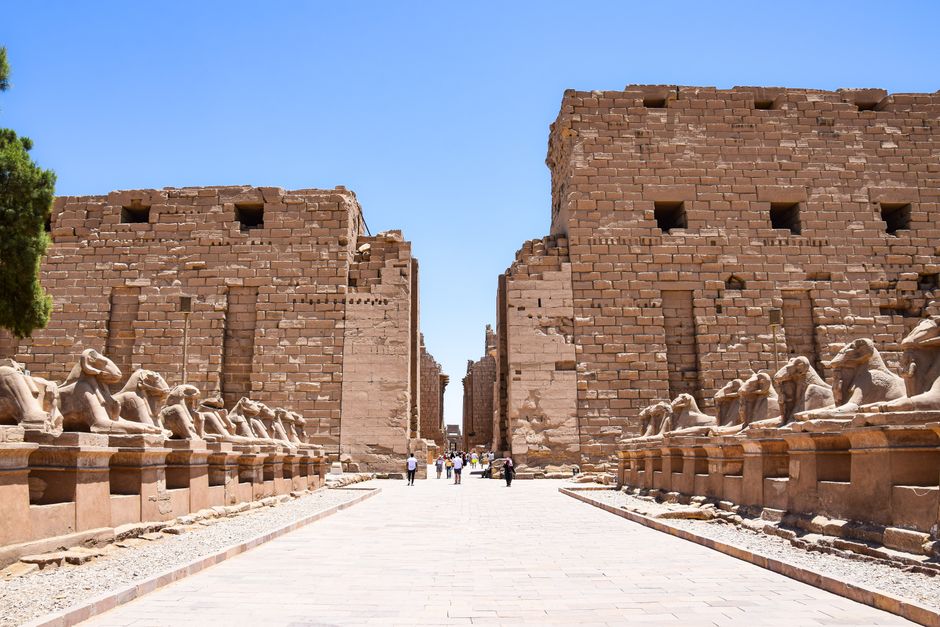
Accumulating architectural additions across fifteen hundred years—from the Middle Kingdom through the Ptolemaic dynasty—the Precinct of Amun-Re at Karnak represents the zenith of New Kingdom monumentalism. Successive pharaohs, including Hatshepsut, Thutmose III, and Ramesses II, continuously dismantled, enlarged, and consecrated this vast limestone and sandstone expanse as the earthly throne of the sun god, Amun-Ra. Entrance begins along a dromos guarded by ram-headed sphinxes, each sheltering a miniature effigy of the king between its paws, leading to the immense, unfinished First Pylon whose soaring 30-meter mud-brick ramp fragments still reveal how ancient engineers hoisted stone to the sky. Crossing into the Great Hypostyle Hall, the desert glare yields to a dense, shadowed forest of 134 colossal sandstone columns arranged in sixteen rows. Standing beneath the central nave, visitors crane upward toward open-papyrus capitals rising 21 meters into the air, where clear Upper Egyptian light slants through high stone clerestory grills onto deeply carved cartouches. Deeper into the complex, Hatshepsut’s 97-foot single-block obelisk of red Aswan granite pierces the horizon, its surface smoothed to an enduring sheen. Beside the mirror-like stillness of the Sacred Lake, where high priests once performed ritual dawn ablutions, travelers encounter the monumental stone scarab of Amenhotep III, enveloped by the cool thermal mass of stone that holds the weight of millennia.
More in Luxor
Photo credits (3)
- Ian Lloyd, CC BY-SA 3.0, via Wikimedia Commons
- Diego Delso, CC BY-SA 4.0, via Wikimedia Commons
- Chabe01, CC BY-SA 4.0, via Wikimedia Commons