
 New added
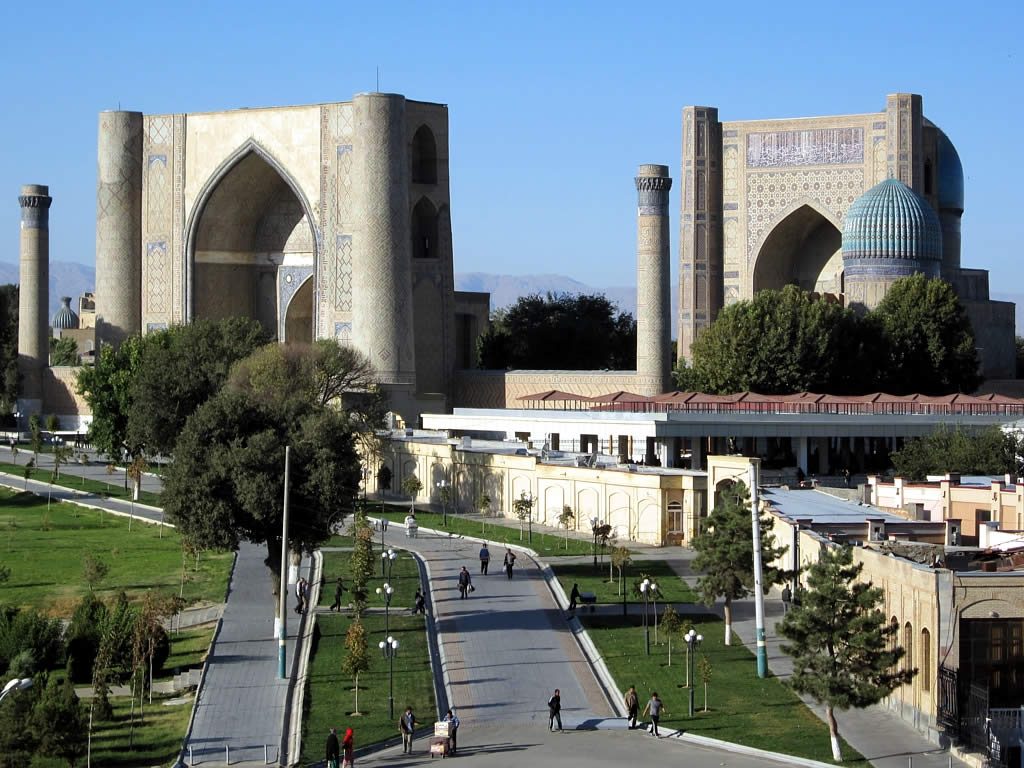
Bibi-Khanym Mosque
Commissioned in 1399 by the Turco-Mongol conqueror Timur following his plunder of Delhi, Bibi-Khanym Mosque was conceived as the crowning jewel of the Timurid Renaissance—an imperial Friday mosque meant to eclipse every sanctuary from Damascus to Samarkand. Nearly a hundred captured war elephants hauled stone from the subcontinent to erect this colossus, honoring Timur’s senior empress, Saray Mulk Khanum. The monument pushed medieval masonry to its breaking point; its monumental 35-meter-high *pishtaq* (entrance portal) was so audaciously vast that stress fractures plagued the brickwork before the builders had even finished laying the final tiles. Stepping beneath the vaulted portal into the sprawling paved courtyard, travelers encounter an immense carved-marble lectern, crafted during the reign of Timur’s astronomer grandson, Ulugh Beg, to hold the colossal Uthman Quran. Overhead, the main sanctuary’s double-ribbed turquoise melon dome swells against the desert sky, girdled by bands of lapis lazuli mosaics and glazed terra-cotta spelling sacred Kufic calligraphy. Within the cavernous, half-restored interior, the sheer verticality induces a quiet vertigo, where deep structural fissures in the aged brick bear witness to centuries of seismic tremors and the raw hubris of an emperor bent on defying architectural limits.
More in Samarkand
Photo credits (5)
- David Stanley from Nanaimo, Canada, CC BY 2.0, via Wikimedia Commons
- Vaurien, CC BY-SA 3.0 de, via Wikimedia Commons
- Arina Pan, CC BY-SA 4.0, via Wikimedia Commons
- Koshkinhome, CC BY-SA 4.0, via Wikimedia Commons
- Bobyrr, CC BY-SA 4.0, via Wikimedia Commons