
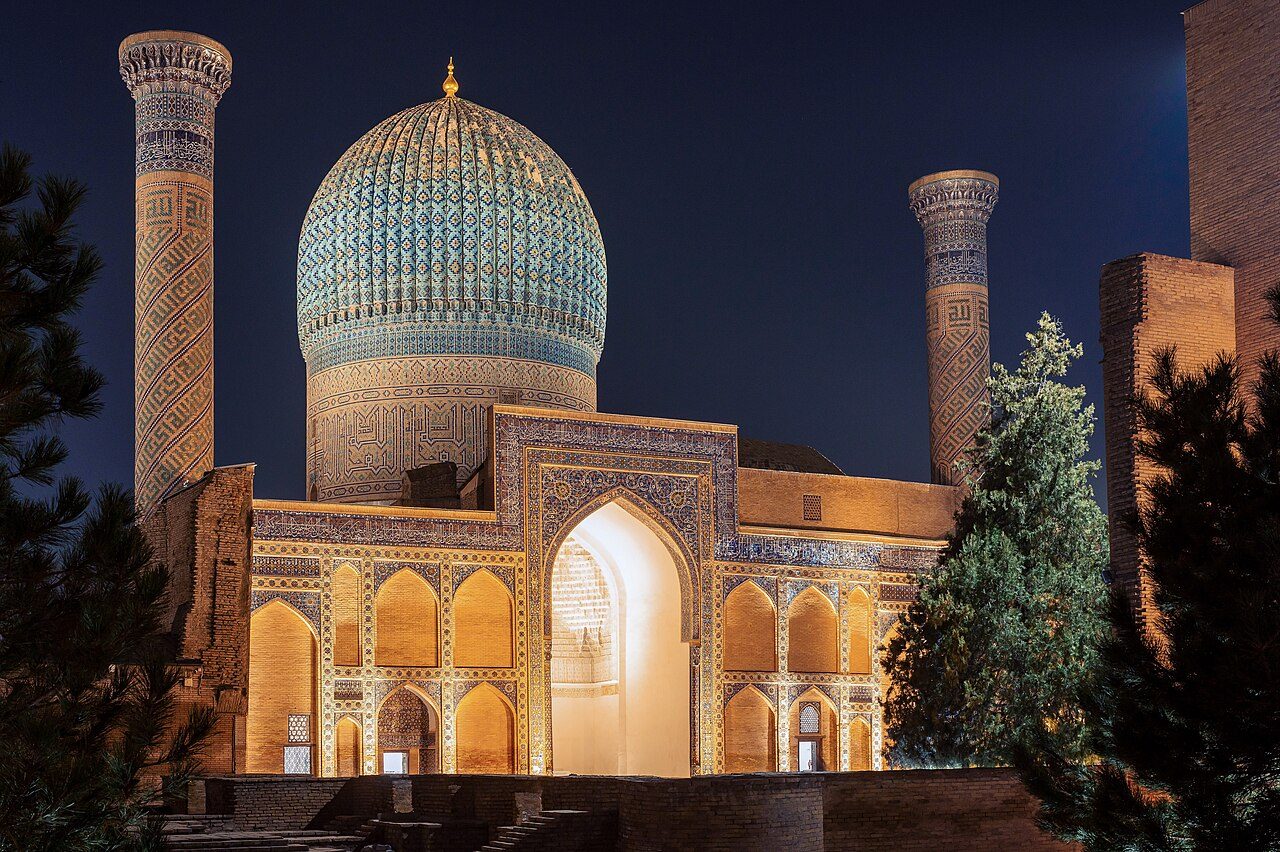
Gur-e-Amir Mausoleum
Commissioned in 1404 by the conqueror Timur following the sudden death of his chosen heir, Muhammad Sultan, Gur-e-Amir stands as the preeminent masterpiece of Timurid architecture—a pioneering structural model that later inspired Agra's Taj Mahal. The complex arrests the eye with its colossal, 64-ribbed fluted dome, whose brilliant azure tiles gleam against the dry Samarkand sky. Flanked by twin minarets and entered through an intricately carved *pishtaq* portal, the sand-colored brick facade is layered with geometric *girih* starbursts and towering bands of cobalt-glazed Kufic calligraphy, physically projecting the imperial gravitas of an empire that once stretched from Delhi to Damascus. Stepping beneath the vaulted threshold into the cruciform chamber, the desert glare yields to a hushed, shadow-dappled glow. Overhead, the interior dome reveals a dizzying canopy of gilded papier-mâché relief, deep lapis lazuli accents, and honeycomb *muqarnas* niches that simulate a star-filled cosmos. At the center of the hall, enclosed within a carved marble screen, rests the famous monolithic slab of dark green Mongolian nephrite jade marking Timur’s symbolic tomb, surrounded by the cenotaphs of his sons and his astronomer-grandson, Ulugh Beg. Standing over these silent markers, with the sovereign's actual crypt sealed in the chamber below, travelers encounter an atmosphere thick with centuries of dynastic intrigue, imperial ambition, and enduring tomb-curse lore.
More in Samarkand
Photo credits (5)
- Arina Pan, CC BY-SA 4.0, via Wikimedia Commons
- Vaurien, CC BY-SA 3.0 de, via Wikimedia Commons
- David Stanley from Nanaimo, Canada, CC BY 2.0, via Wikimedia Commons
- Koshkinhome, CC BY-SA 4.0, via Wikimedia Commons
- Adam Harangozó, CC BY-SA 4.0, via Wikimedia Commons