
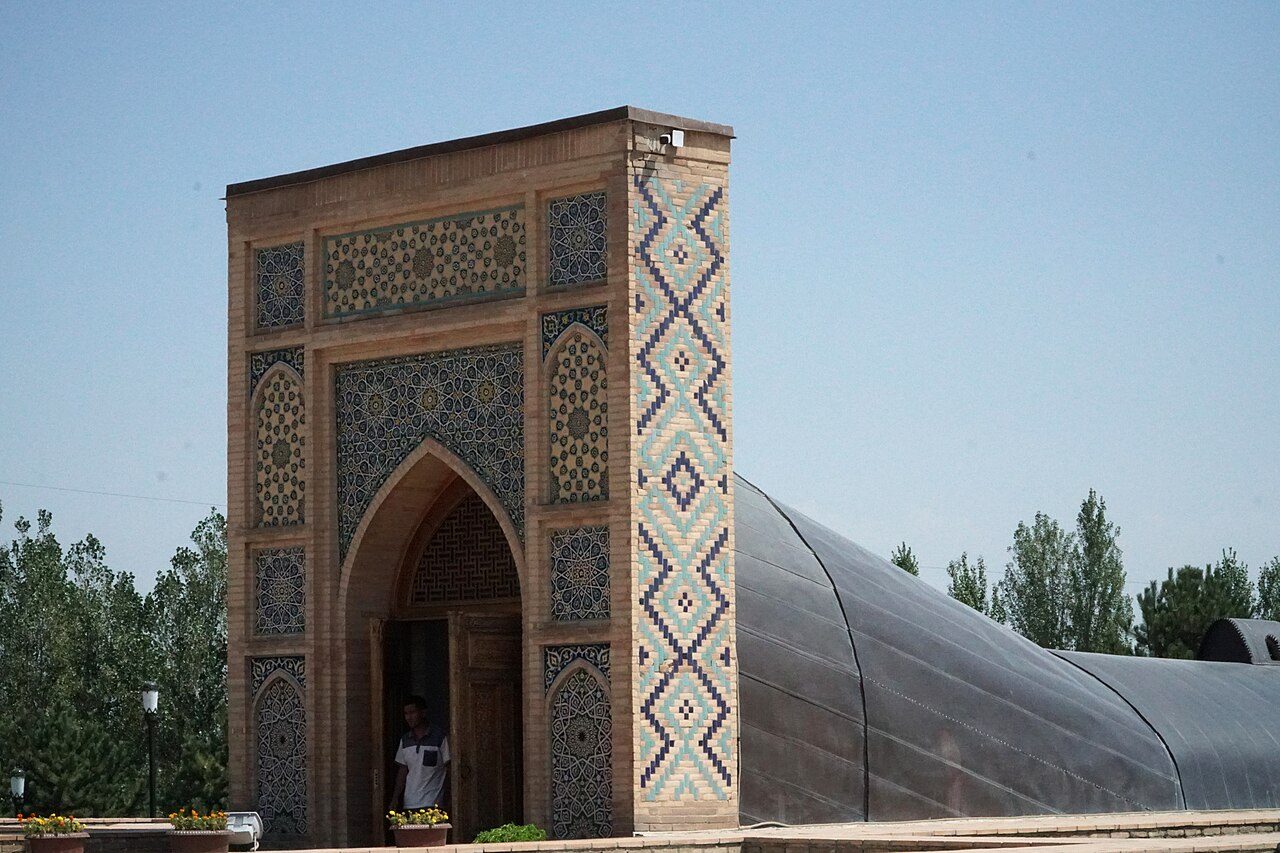
Ulugh Beg Observatory
Perched atop the windswept Kuhak Hill on the northeastern rim of Samarkand, the subterranean trench of Ulugh Beg’s 15th-century observatory preserves one of the Islamic Golden Age’s crowning scientific achievements. Commissioned between 1424 and 1429 by the astronomer-sultan Mirzo Ulugh Beg—grandson of Timur—the original complex was a monumental, three-story cylindrical tower clad in glazed azure tiles, housing intricate celestial maps and mechanical calculating devices. Although religious zealots razed the above-ground monument following Ulugh Beg’s assassination in 1449, Russian archaeologist Vassily Vyatkin unearthed its bedrock foundation in 1908, resurrecting the lost center of Timurid astrophysics. Today, visitors walk past manicured terraced gardens to peer directly into the surviving core of the observatory: a monumental, subterranean Fakhri sextant carved through solid limestone. Descending along the damp brick barrier, you look upon the twin arc of polished grey marble tracks, deeply incised with meticulous degree markings and Arabic numerals that Ulugh Beg’s scholars used to calculate the solar year with an error margin of merely twenty-five seconds. The cool, quiet subterranean trench contrasts sharply with the blazing steppe sun above, while the adjacent memorial museum displays copper astrolabes, star quadrants, and folio reproductions of the *Zij-i Sultani*, the revolutionary 1,018-star catalog drafted upon this very ridge.
More in Samarkand
Photo credits (5)
- Adam Harangozó, CC BY-SA 4.0, via Wikimedia Commons
- Vaurien, CC BY-SA 3.0 de, via Wikimedia Commons
- David Stanley from Nanaimo, Canada, CC BY 2.0, via Wikimedia Commons
- Arina Pan, CC BY-SA 4.0, via Wikimedia Commons
- Koshkinhome, CC BY-SA 4.0, via Wikimedia Commons