
 New added
Registan Square
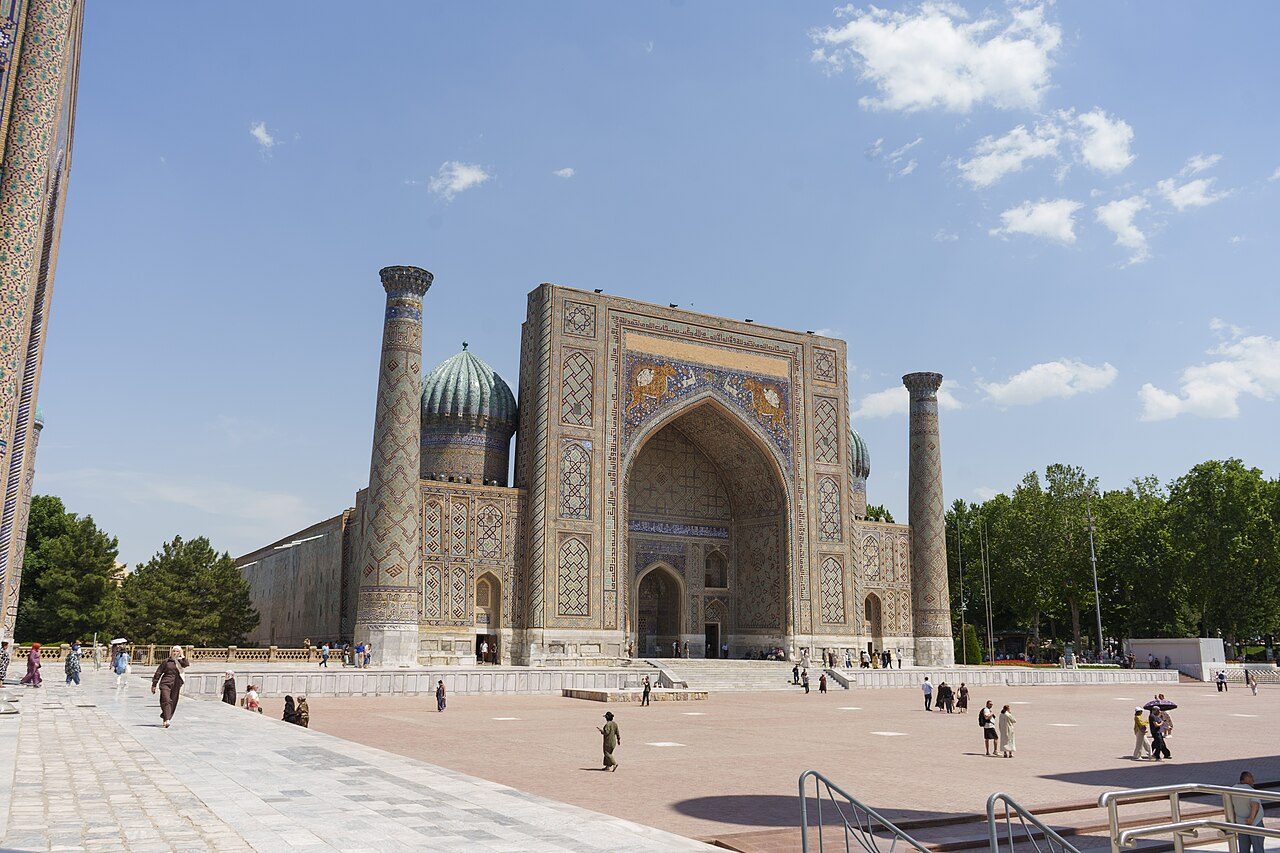
Framed by three monumental madrasahs, Samarkand’s Registan stands as the crowning achievement of Timurid architecture. Between 1417 and 1420, the astronomer-king Ulugh Beg erected the square’s earliest academy, adorning its soaring facade with star-spangled geometric tilework that celebrated celestial science. More than two centuries later, military governor Yalangtush Bakhodur completed the symmetrical ensemble, commissioning the Sher-Dor Madrasah in 1636—famed for flouting orthodox aniconism with dazzling mosaics of roaring lions chasing stags under rising suns—and the Tilya-Kori Madrasah in 1660. Meaning "Gilded," Tilya-Kori houses an opulent mosque whose trompe l’œil ceiling drapes visitors in intricate gold leaf and rich cobalt relief work. Stepping onto the central stone esplanade, travelers are immediately dwarfed by forty-meter-high vaulted *pishtaqs* that glow in shifting shades of lapis lazuli, turquoise, and glazed terracotta. The midday sun catches the heavily ribbed melon domes, casting sharp geometric shadows across the vast plaza before softening into twilight, when the intricate Kufic inscriptions seem to hum against the desert dusk. Passing through the monumental archways leads away from the grand scale into quiet, bi-level courtyards ringed by arched student cells (*hujras*), where hand-carved elm pillars and cool marble flagstones offer a serene, contemplative hush.
More in Samarkand
Photo credits (5)
- Koshkinhome, CC BY-SA 4.0, via Wikimedia Commons
- Vaurien, CC BY-SA 3.0 de, via Wikimedia Commons
- David Stanley from Nanaimo, Canada, CC BY 2.0, via Wikimedia Commons
- Arina Pan, CC BY-SA 4.0, via Wikimedia Commons
- Bobyrr, CC BY-SA 4.0, via Wikimedia Commons