
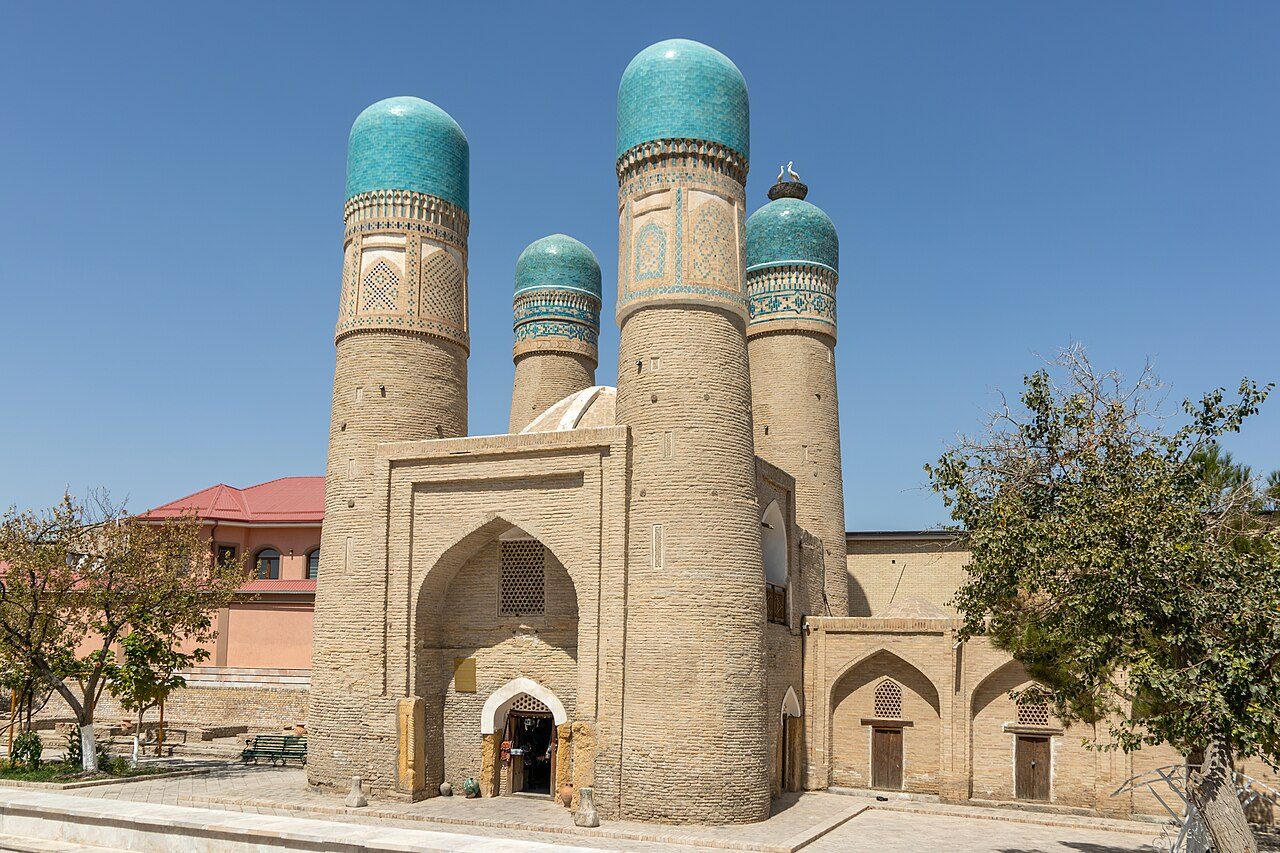
Chor Minor
Commissioned in 1807 by the wealthy merchant Khalif Niyaz-kul, Chor Minor—meaning "Four Minarets" in Persian—originally functioned as the gatehouse for a now-vanished madrasa complex. Defying conventional Central Asian Islamic architecture, its four stout towers were built purely as decorative corner anchors rather than functional platforms for the call to prayer. Each cylindrical turret is crowned with a vibrant turquoise cupola and adorned with distinct lapis-and-ochre masonry; local tradition suggests these varied geometric brick patterns and friezes deliberately reflect four major world religions: Islam, Christianity, Buddhism, and Zoroastrianism. Reaching this eccentric monument requires ducking away from Bukhara's monumental plazas into the dusty, quiet labyrinth of a residential *mahalla*. The sudden appearance of the gatehouse in an intimate courtyard feels like stumbling upon a lost architectural fable, its almost whimsical scale contrasting sharply with the colossal grandeur of the nearby Po-i-Kalyan. Visitors pass beneath the cool, vaulted ceiling of the ground-floor vestibule and ascend a narrow brick staircase to the open roof terrace, finding themselves at eye level with the glazed azure domes set against a backdrop of sun-baked mudbrick homes.
More in Bukhara
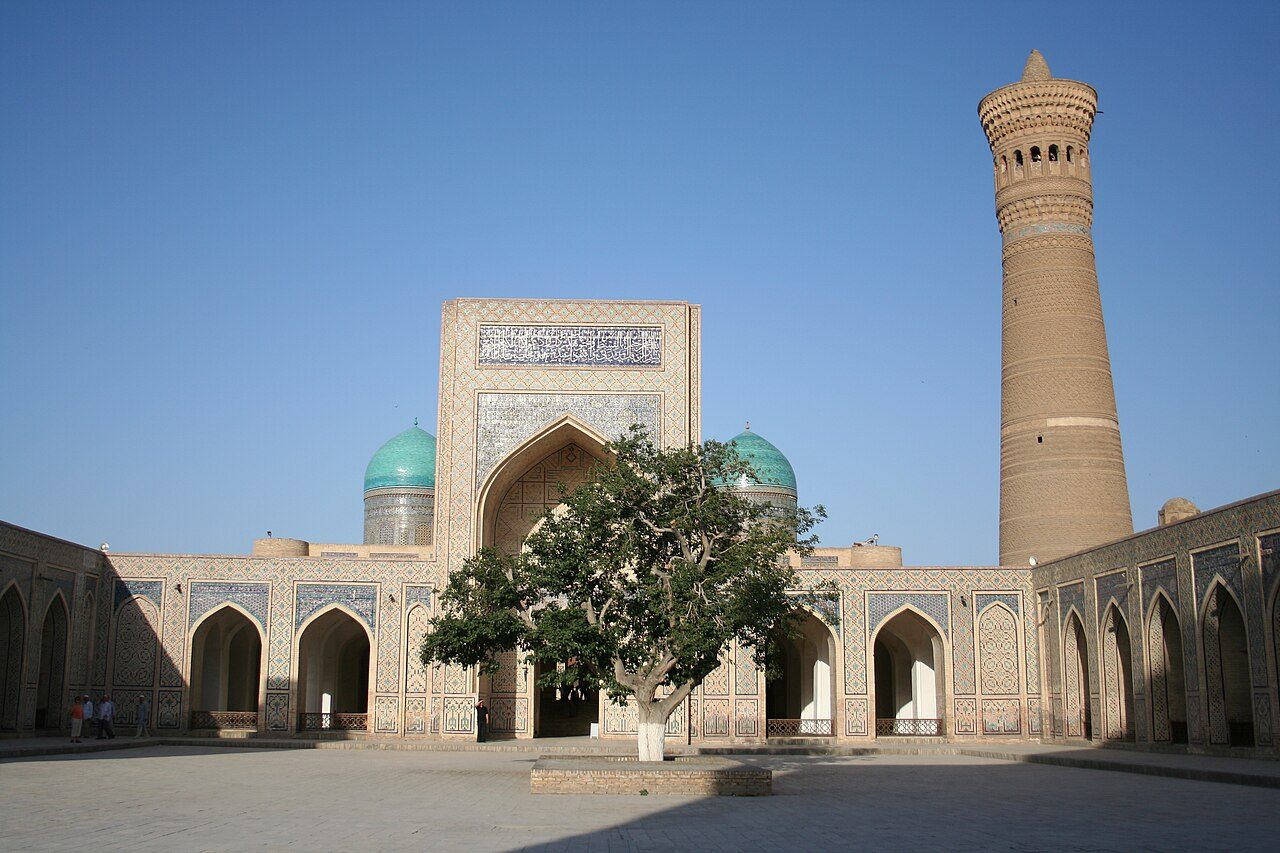
Photo credits (6)
- ElenaLitera, CC BY-SA 4.0, via Wikimedia Commons
- RK, CC BY-SA 4.0, via Wikimedia Commons
- Patrickringgenberg, CC BY-SA 3.0, via Wikimedia Commons
- Hylgeriak / Wikipedia, CC BY-SA 3.0, via Wikimedia Commons
- NatalieChunina, CC BY-SA 4.0, via Wikimedia Commons
- Официальный веб-сайт Агентства культурного наследия Республики Узбекистан, CC BY 4.0, via Wikimedia Commons