
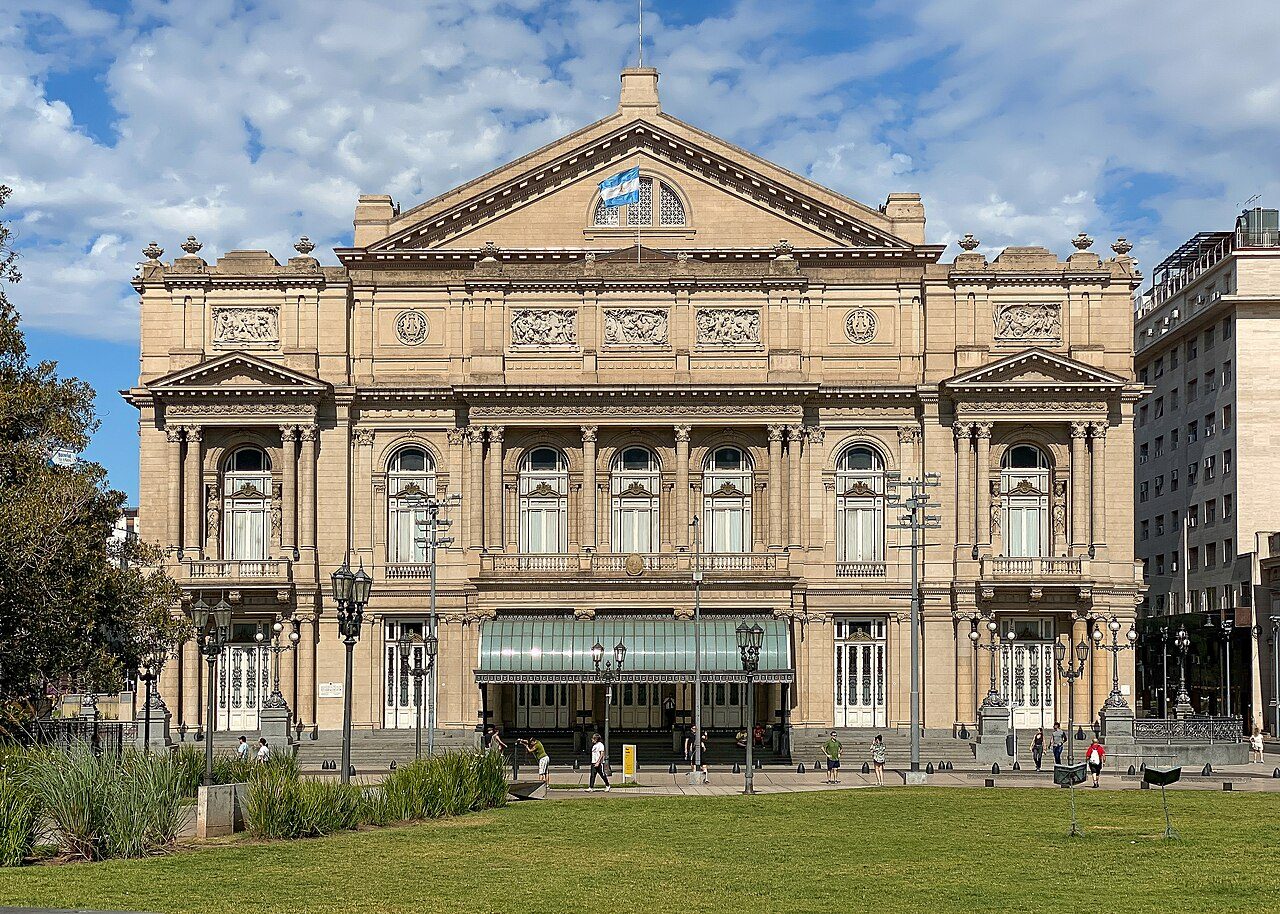
Teatro Colon
Inaugurated on Argentine National Day in 1908 with Giuseppe Verdi’s *Aïda*, Teatro Colón stands as an opulent monument to the golden age of Buenos Aires. Architects Francesco Tamburini, Vittorio Meano, and Julio Dormal combined Italian Neo-Renaissance massing with French Beaux-Arts detailing across an entire city block. Entering through the main vestibule, visitors encounter a lavish progression of yellow Siena and red Verona marble, crowned by French stained-glass skylights forged by the Gaudin workshop in Paris. Just beyond lies the Salón Dorado, an incandescent ballroom encrusted with 24-karat gold leaf, fluted Corinthian columns, and mirrored walls inspired by the Hall of Mirrors at Versailles. Inside the cavernous, seven-tiered horseshoe auditorium, the world-renowned acoustics envelop 2,487 crimson-velvet seats in warm resonance. Looking up, eyes are drawn to a five-ton bronze chandelier ringed by seven hundred incandescent bulbs, illuminating Raúl Soldi’s 1966 domed fresco, which depicts musicians, commedia dell'arte actors, and allegorical muses. Standing near the proscenium once graced by Enrico Caruso, Maria Callas, and Igor Stravinsky, you feel the visceral intimacy of a vast space engineered to sonic perfection—where an unamplified whisper carries effortlessly from the stage up to the steep balconies of *el paraíso*.
More in Buenos Aires
Photo credits (7)
- EEJCC, CC0, via Wikimedia Commons
- Dragan, CC BY 3.0, via Wikimedia Commons
- Bleff, CC BY-SA 3.0, via Wikimedia Commons
- ProtoplasmaKid, CC BY-SA 4.0, via Wikimedia Commons
- Sking, CC BY-SA 3.0, via Wikimedia Commons
- Bleff, CC BY-SA 3.0, via Wikimedia Commons
- DerHexer, CC BY-SA 4.0, via Wikimedia Commons