
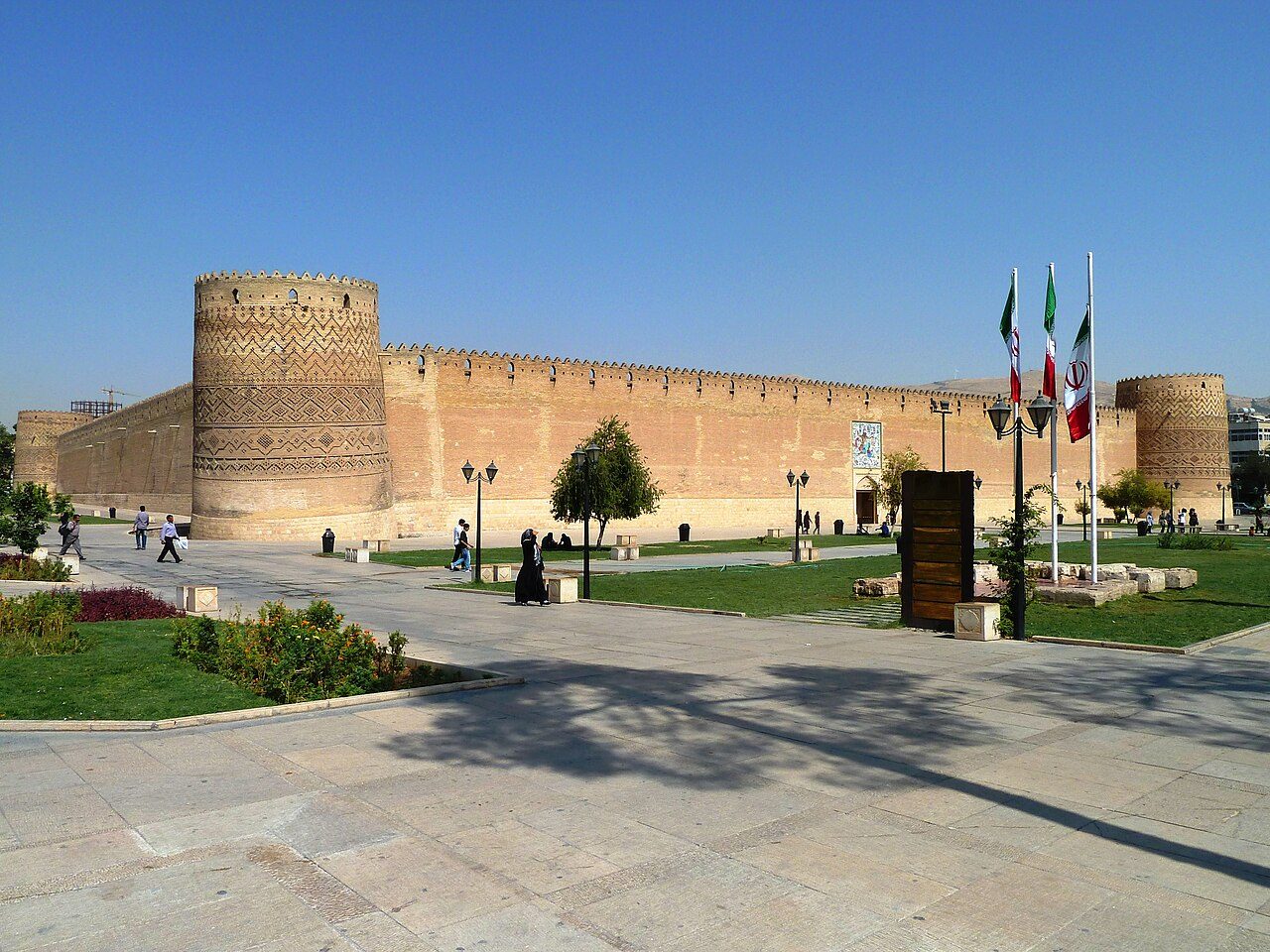
Karim Khan Citadel
In the late 1760s, Karim Khan Zand fortified Shiraz as his imperial seat, commissioning a massive brick citadel that fused military deterrence with royal luxury. From the surrounding city streets, the fortress appears impenetrable, bounded by twelve-meter-high curtain walls and four stout corner bastions embellished with intricate geometric relief brickwork. One of these circular towers leans at an alarming angle due to subterranean subsidence, presenting an unmistakable silhouette to approaching travelers. Directly above the entrance, an ornate Qajar-era tile panel depicts the legendary hero Rostam vanquishing the White Demon from the *Shahnameh*, preparing visitors for the layered history inside. Passing beneath the entrance vault, the fortress walls yield to the tranquil courtyard of a refined Zand palace. The air is fragranced by rows of sour orange trees, their glossy leaves mirrored in the still waters of a central limestone reflection pool. Within the residential wings, sunlight filters through multihued *orsi* (stained-glass) lattice windows, projecting vivid crimson and amber patterns across painted gypsum walls and carved wooden ceilings. In the citadel’s private royal *hammam*, travelers step into a subterranean world of vaulted brick arches and limestone benches, where daylight pierces through floral-cut glass skylights, illuminating centuries-old plasterwork in the quiet heart of the sovereign’s inner sanctum.
More in Shiraz
Photo credits (4)
- User:Hardscarf, CC BY-SA 3.0, via Wikimedia Commons
- Stefan Krasowski from New York, NY, USA, CC BY 2.0, via Wikimedia Commons
- Soheil Callage, CC BY-SA 4.0, via Wikimedia Commons
- Siamak.ess, CC BY-SA 4.0, via Wikimedia Commons