
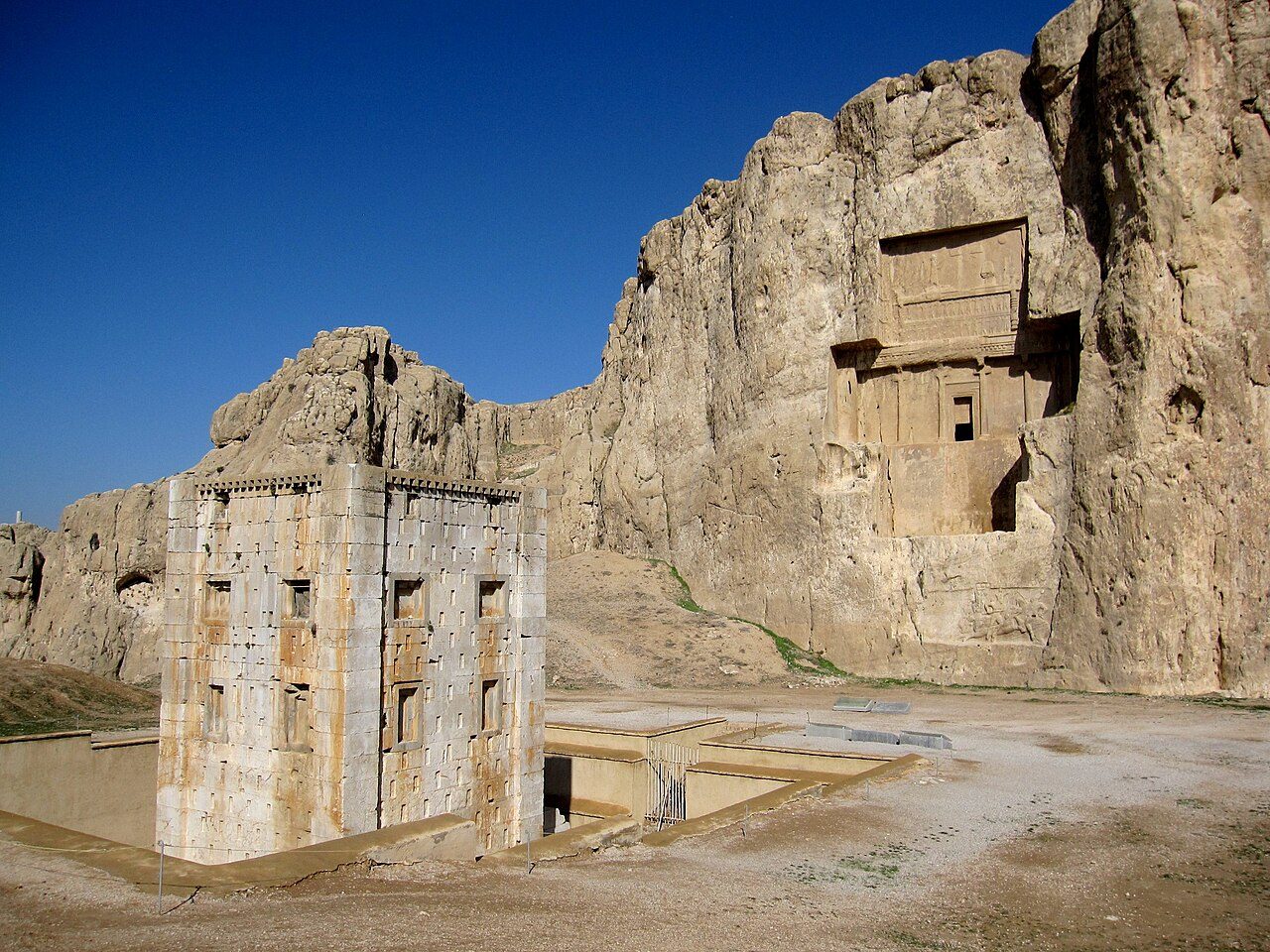
Naqsh-e Rostam
Carved into the towering limestone cliffs of the Hossein Kuh mountain, four monumental cross-shaped tombs pierce the desert sky, marking the eternal resting places of Achaemenid royalty. Between 522 and 404 BCE, stonecutters hewed these colossal cruciform facades directly into the sheer vertical rock, creating grand sepulchers for Darius I, Xerxes I, Artaxerxes I, and Darius II. Craning your neck upward, you encounter friezes chiseled high above the central entrances, where the sovereign stands atop a dais supported by thirty subject nations, his right hand raised toward a roaring fire altar while the winged Faravahar hovers overhead. At the base of the cliff face, history shifts by eight centuries into the Sassanian era. Vivid equestrian rock reliefs leap from the stone at eye level, most strikingly the triumph of Shapur I, depicting Roman emperor Valerian kneeling in humiliation following his capture in 260 CE. Standing across the dust-blown trench, travelers face the enigmatic *Ka’ba-ye Zartosht* (Cube of Zoroaster), a solitary, twelve-meter-high tower of mortarless white limestone fitted with dark blind windows. The true impact of the site lies in this vertical compression of two distinct Persian golden ages, where the midday desert sun bakes the rock face into warm amber hues and thousands of years of imperial ambition loom overhead in absolute silence.
More in Shiraz
Photo credits (4)
- Stefan Krasowski from New York, NY, USA, CC BY 2.0, via Wikimedia Commons
- Soheil Callage, CC BY-SA 4.0, via Wikimedia Commons
- Siamak.ess, CC BY-SA 4.0, via Wikimedia Commons
- User:Hardscarf, CC BY-SA 3.0, via Wikimedia Commons