
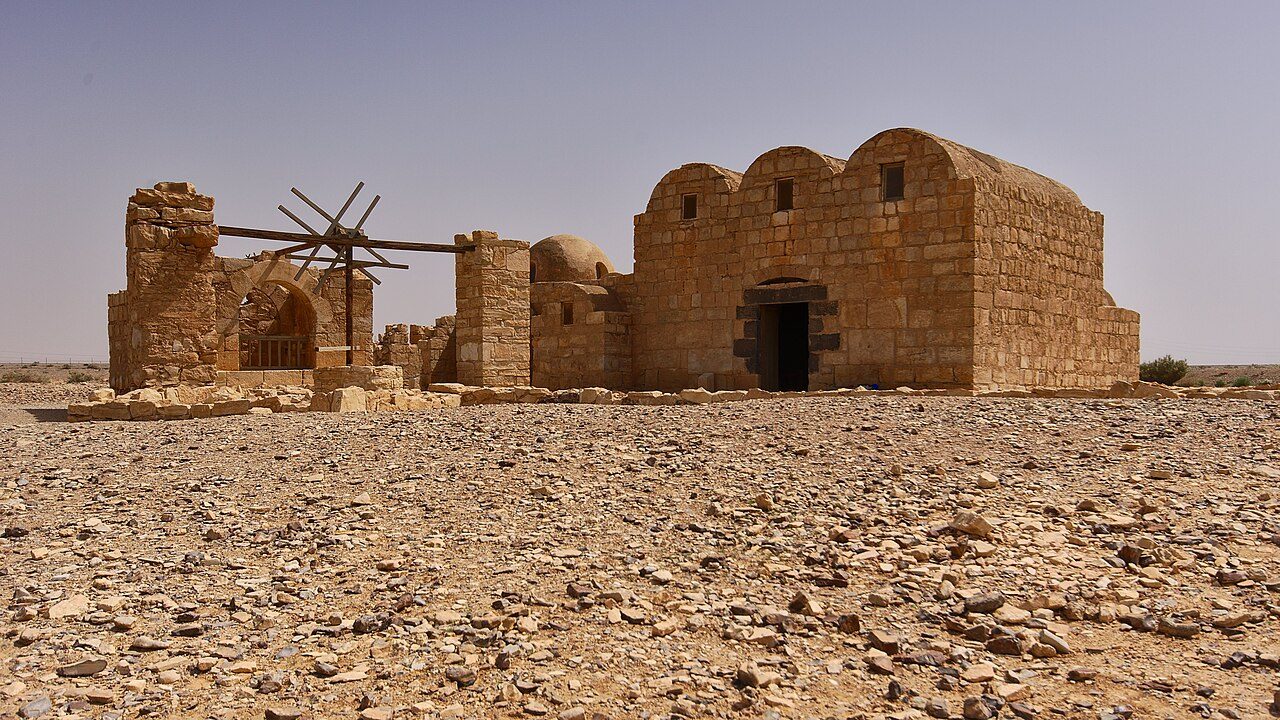
Qasr Amra
Commissioned in the early eighth century during the reign of Umayyad Caliph Walid II, Qasr Amra rises from the sun-scorched steppe east of Amman as a masterwork of early Islamic secular architecture. Originally conceived as a desert retreat and private bathhouse far from the strict gaze of Damascus, this low-slung, honey-hued limestone complex defies conventional expectations of Islamic art. Stepping across the threshold from the blinding heat of the Jordanian badia, visitors enter a cool, three-vaulted audience hall where nearly every square foot of plaster is cloaked in vivid Umayyad-era tempera frescoes, preserved through twelve centuries of desert isolation. Inside, the dim chambers reveal scenes of hedonism and statecraft: bare-chested dancers, musicians, wrestling athletes, and artisans at work. Travelers immediately encounter the famed "Fresco of the Six Kings," which depicts the defeated sovereigns of the era, including the Byzantine Emperor and the Sassanian King of Persia. Moving into the circular *caldarium*, or hot room, look directly up into the masonry dome to witness one of the earliest known surviving depictions of the night sky painted on a curved surface. The constellations and the twelve signs of the zodiac, rendered in deep cobalt, charcoal, and ochre, swirl overhead, capturing the sophisticated astronomical knowledge and artistic daring of a burgeoning empire.
More in Amman
Photo credits (7)
- Rob Oo from NL, CC BY 2.0, via Wikimedia Commons
- Gadora81, CC BY-SA 4.0, via Wikimedia Commons
- Bernard Gagnon, CC BY-SA 4.0, via Wikimedia Commons
- Berthold Werner, CC BY 3.0, via Wikimedia Commons
- David Bjorgen, CC BY 2.5, via Wikimedia Commons
- Ldud at English Wikipedia, Public domain, via Wikimedia Commons
- The original uploader was Freedom's Falcon at Arabic Wikipedia ., CC BY-SA 2.5, via Wikimedia Commons