
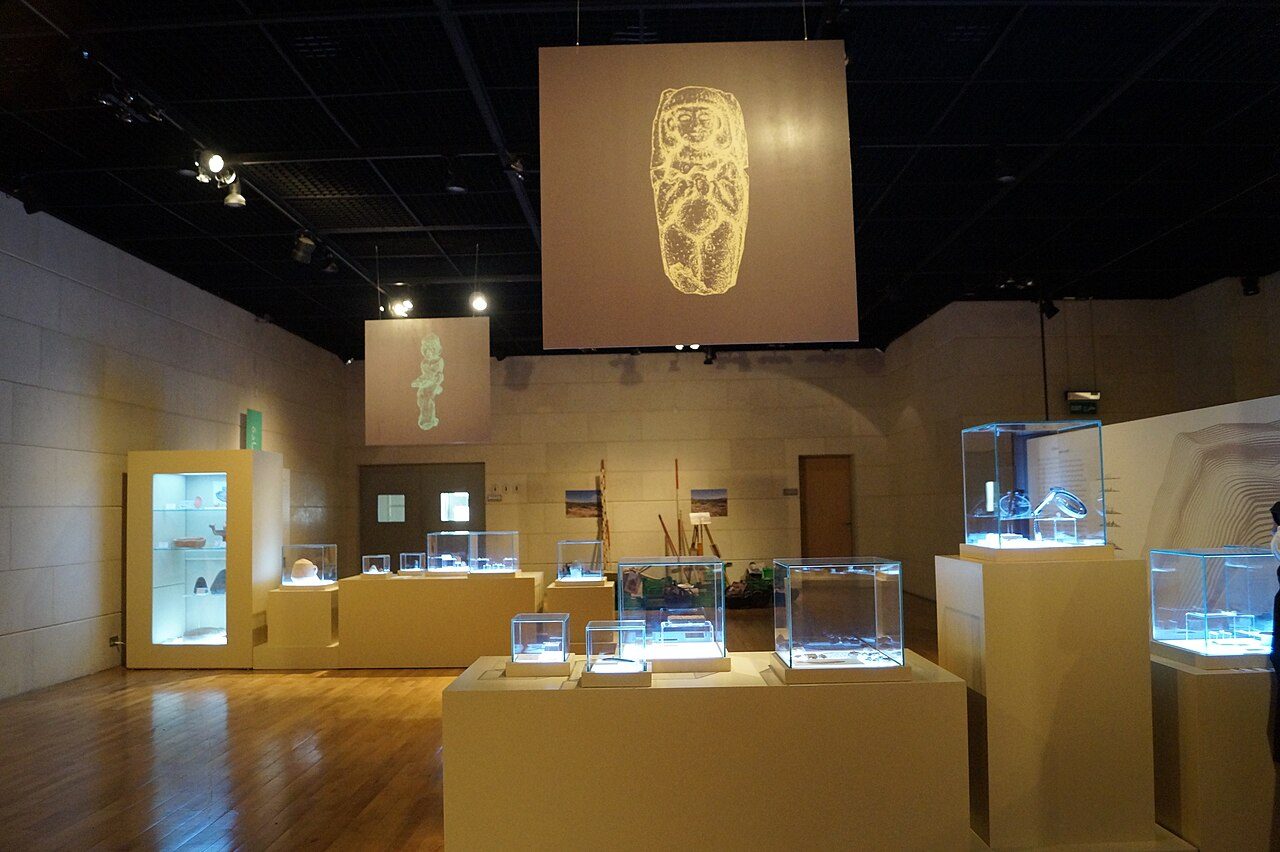
Jordan Museum
Conceived by renowned architect Jafar Tukan and opened in 2014, the complex anchors Amman’s historic Ras al-Ayn district. Its exterior serves as an architectural homage to regional geology, clad in alternating bands of rough-hewn cream limestone and dark volcanic basalt that echo the stratified cliffs of the Jordan Rift Valley. Within its polished, cavernous halls, the museum charts 1.5 million years of Levantine civilization, tracing human ingenuity from Paleolithic toolmakers and the Nabataean hydraulic engineers of Petra to the gilded courts of the Umayyad caliphs. Inside the climate-controlled galleries, visitors encounter some of humanity's earliest artistic masterworks in hushed, atmospheric spaces. The centerpiece belongs to the haunting Ain Ghazal statues: modeled from lime plaster around 7500 BCE, these anthropomorphic figures gaze back at onlookers through almond-shaped eyes rimmed with dark bitumen. Just steps away in a softly lit, temperature-stabilized vault lies the enigmatic Copper Scroll from the Dead Sea caves, its etched ancient consonants inventorying long-lost temple treasures. The tactile journey allows travelers to trace the evolution of the written word, marvel at intricately carved Roman capitals, and touch reproductions of ancient pottery, bridging vast millennia in a single, quiet corridor.
More in Amman
Photo credits (5)
- Gadora81, CC BY-SA 4.0, via Wikimedia Commons
- Bernard Gagnon, CC BY-SA 4.0, via Wikimedia Commons
- Berthold Werner, CC BY 3.0, via Wikimedia Commons
- David Bjorgen, CC BY 2.5, via Wikimedia Commons
- Ldud at English Wikipedia, Public domain, via Wikimedia Commons