
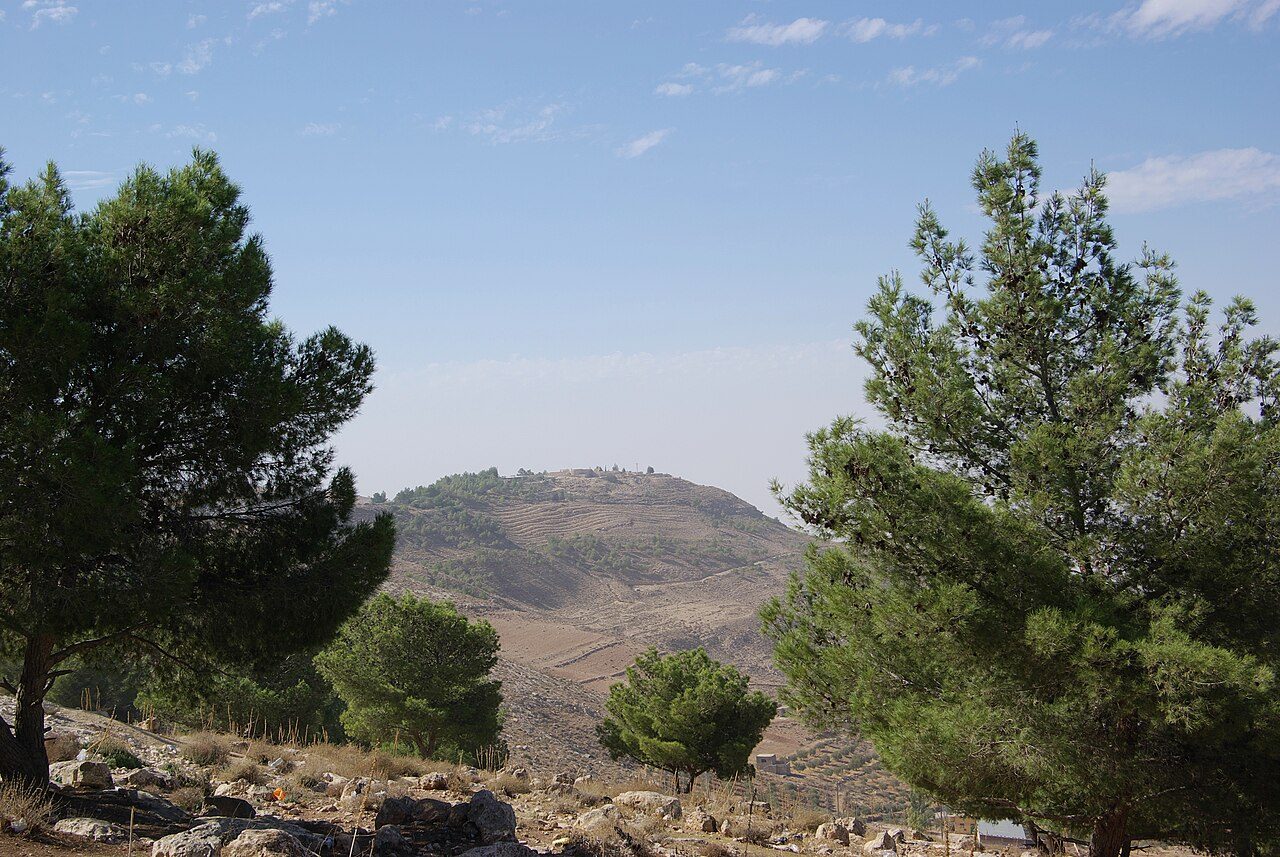
Mount Nebo
Perched along the Abarim ridge some 710 meters above sea level, Mount Nebo marks the biblical sanctuary where tradition holds that Moses was granted a vision of the Promised Land before his death. In the late fourth century, early Christian pilgrims erected a basilica atop Syagha—the mountain’s highest crest—which expanded into an elaborate Byzantine monastery by the sixth century. Today, a modern protective sanctuary shields these excavated ruins, centering on the remarkably preserved 530 AD Diakonikon mosaic floor. This vibrant tapestry of limestone tesserae depicts pastoral scenes of hunters, vineyards, and exotic wildlife, including lions and humped zebu. Outside, Italian artist Gian Paolo Fantoni’s monumental bronze Serpentine Cross twists against the sky, visually uniting the Old Testament bronze serpent with the Christian crucifix. Stepping onto the windswept stone promontory, travelers confront the vast, silent panorama of the Jordan Rift Valley just as pilgrims have for two millennia. A brisk desert breeze carries the subtle scent of wild rosemary and pine as the earth plummets westward toward the metallic, mirror-like shimmer of the Dead Sea. On clear afternoons, the horizon expands to reveal the dark oasis smudge of Jericho, the rolling Judean hills, and the faint, sun-bleached contours of the Mount of Olives. Standing beside the stone orientation marker, surrounded by the sun-baked bedrock of the ancient Kingdom of Moab, visitors experience a tangible convergence of topography, profound silence, and monumental sacred history.
More in Amman
Photo credits (7)
- Berthold Werner, CC BY 3.0, via Wikimedia Commons
- Gadora81, CC BY-SA 4.0, via Wikimedia Commons
- Bernard Gagnon, CC BY-SA 4.0, via Wikimedia Commons
- Berthold Werner, CC BY 3.0, via Wikimedia Commons
- David Bjorgen, CC BY 2.5, via Wikimedia Commons
- Ldud at English Wikipedia, Public domain, via Wikimedia Commons
- The original uploader was Freedom's Falcon at Arabic Wikipedia ., CC BY-SA 2.5, via Wikimedia Commons