
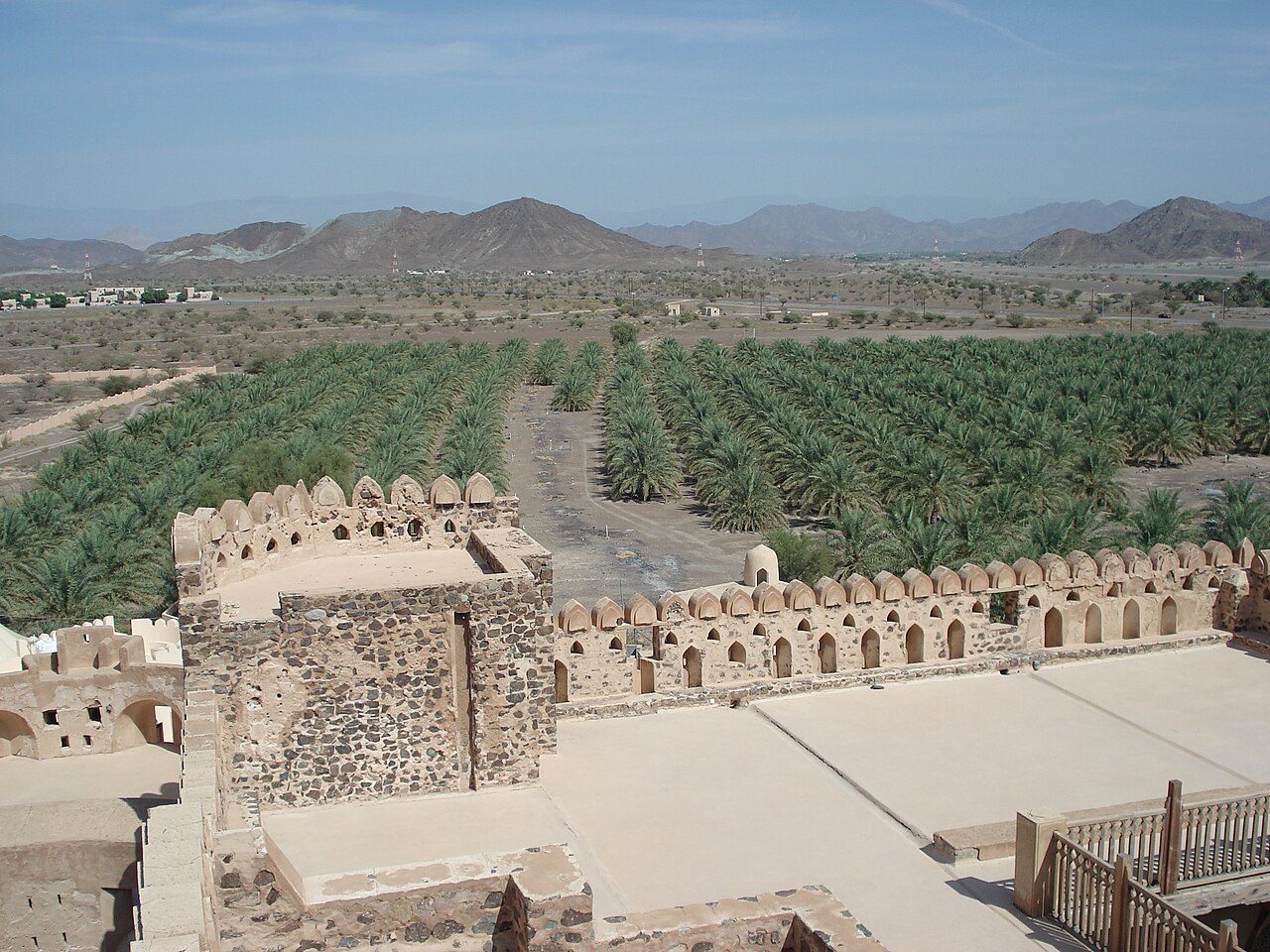
Jabrin Castle
Commissioned around 1675 by Imam Bil'arab bin Sultan of the Yaruba dynasty, Jabrin Castle was conceived not merely as a military redoubt, but as an enlightened seat of Islamic scholarship, medicine, and jurisprudence. Unlike the austere garrison fortresses scattered across Oman’s Ad Dakhiliyah region, this sand-hued, three-story palace gracefully balances fortified architecture with domestic refinement. Slotted "murder holes" engineered to pour boiling date syrup conceal themselves above intricately carved doorways, while an ancient *falaj* (irrigation channel) still runs through the central courtyard, cooling the air where theologians and poets once gathered within thick mudbrick walls. Stepping through the labyrinthine interior, travelers move from dim, subterranean date-pressing rooms (*madbasa*) into the luminous Hall of the Sun and Moon (*Ghurfat ash-Shams wal-Qamar*). Here, fourteen arched windows manipulate desert breezes and light, framing the castle's most breathtaking treasure: timber ceilings of imported cedar emblazoned with vibrant floral rosettes, geometric interlacing, and calligraphic verses rendered in preserved vegetable dyes. After paying respects at the Imam's modest tomb tucked beneath the ground floor, visitors emerge onto the breezy roof terraces, greeted by the scent of baking earth and sweeping, 360-degree panoramas of emerald date palm oases rippling toward the jagged peaks of the Jebel Akhdar range.
More in Nizwa
Photo credits (5)
- Unknown author, CC BY-SA 3.0, via Wikimedia Commons
- Francisco Anzola, CC BY 2.0, via Wikimedia Commons
- Andries Oudshoorn, CC BY-SA 2.0, via Wikimedia Commons
- Ji-Elle, CC BY-SA 3.0, via Wikimedia Commons
- Philipp Weigell, CC BY 3.0, via Wikimedia Commons