Discover where to go in Osaka, Japan, from centuries-old landmarks like Shitennoji and Osaka Castle to the kinetic canal banks of Dotonbori. Learn how to navigate the city, sample iconic street food, and plan your route.
When deciding where to go in Osaka, Japan, head directly to key cultural and historical landmarks: the ancient temple grounds of Shitennoji Temple, the massive stone fortifications of Osaka Castle, the neon-lit waterfront of Dotonbori, and the panoramic observation platform at Umeda Sky Building. Sprawled between the Ikoma mountains and Osaka Bay, this water city connects quiet centuries-old traditions with energetic commercial districts along its rivers and canals.
Unlike the formal reserve found in some other regions of Japan, Osaka moves with a warm, kinetic rhythm. Pedestrians dodge delivery bicycles along wide boulevards, shopkeepers exchange quick banter, and griddles sizzle from late morning until well past midnight. This guide outlines the essential locations to visit, how to navigate the city transit, and how to structure your time.
Historic Sights to Visit in Osaka
Osaka Castle
Constructed in 1583 under the command of warlord Toyotomi Hideyoshi, Osaka Castle was conceived on a grand scale to project authority during Sengoku-period Japan. Although largely leveled during the Siege of Osaka in 1615 and reconstructed across subsequent eras, the site retains its immense dry and wet moats and monumental granite ramparts. Walking the grounds offers a clear view of the contrast between sixteenth-century stonework and the modern office towers that frame the surrounding park.
Shitennoji Temple
South of the center stands Shitennoji Temple, recognized as Japan's oldest officially administered Buddhist sanctuary. Founded in 593 CE by Prince Shotoku to venerate the Four Heavenly Kings, the complex has survived fires and wartime devastation while preserving an austere, symmetrical layout dating back to the Asuka period. Walking through the inner precinct allows you to observe daily religious rituals and quiet reflection away from major traffic corridors.
Umeda Sky Building
To the north in Kita, Umeda Sky Building showcases the techno-futurist architectural ambition of the early 1990s. Designed by architect Hiroshi Hara, the structure features two distinct forty-story towers bridged at their summits by a circular open-air observation deck. Escalators suspended within glass tubes lift visitors between the towers, providing expansive perspectives over the Yodo River, Osaka Bay, and the urban core.
Street Life and Food Neighborhoods
Dotonbori Canal
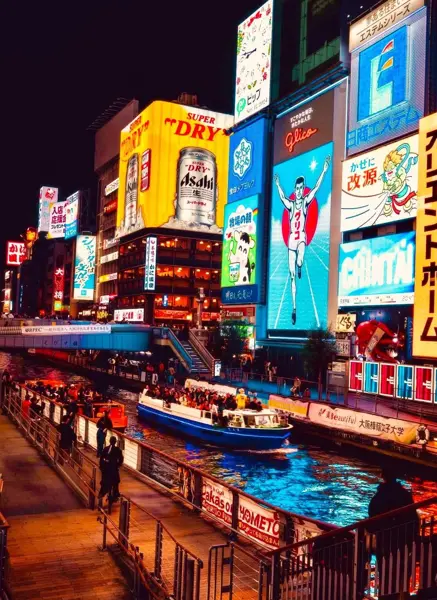
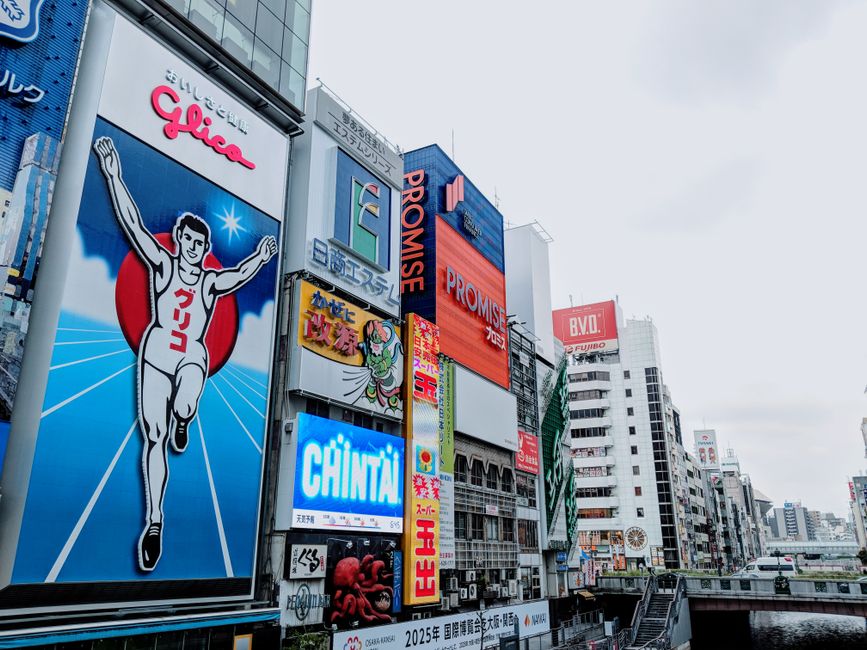
No visit to the southern district of Minami is complete without wandering through Dotonbori. The canal was carved out in 1612 by merchant Yasui Doton, who dedicated his personal assets to connect the Umezu and Kizugawa rivers. Completed in 1615, the waterway quickly developed into an entertainment and theater quarter. Today, the pedestrian paths flanking the canal are packed with visitors walking past towering mechanical signs, illuminated billboards, and food vendors.
Shinsekai and Tsutenkaku
Further south, the neighborhood of Shinsekai preserves mid-century working-class halls beneath the steel frame of Tsutenkaku Tower. Developed in the early twentieth century, Shinsekai remains famous for its casual dining counters serving freshly fried skewers, draft beer, and quick noodle bowls. It offers a grounded look at Osaka's post-war commercial heritage.
Kuromon Ichiba Market
Food is at the heart of daily routine in Osaka, and Kuromon Ichiba Market serves as a primary hub for culinary exploration. Stalls line covered arcades, serving skewered seafood, cabbage okonomiyaki pancakes prepared on flat-top iron griddles, and freshly turned, octopus-filled takoyaki. Arriving mid-morning allows you to sample street food while neighborhood residents and restaurant chefs complete their daily shopping.
How to Get Around Osaka
Navigating Osaka is straightforward thanks to an extensive grid of underground transit and surface commuter lines. The Midosuji subway line serves as the primary north-south spine, linking northern transport hubs like Umeda directly with southern districts like Namba, Dotonbori, and Tennoji.
Walking is the best way to explore dense central districts like Minami and Kita, where backstreets host small workshops and independent eateries. Bicycle travel is also popular, with wide sidewalks and riverside bike lanes linking neighborhoods along the Yodo and Okawa rivers.
Costs and Booking Local Experiences
Planning expenses for an Osaka journey depends on how you choose to explore. While walking around public canal promenades, temple courtyards, and castle outer grounds requires little expenditure, guided excursions help unpack the city's complex merchant and samurai history.
On Tour & Car, travelers can connect with verified local guides in Japan for focused walking and culinary routes. For example, the 4-hour Discover Osaka: History, Culture, Street Food & Hidden Gems group tour led by guide Ahmadzai Muhammad karim is available from $50 per person. Group outings like this provide direct access to neighborhood vendors and historical commentary on key districts.
Best Time to Visit and Seasonal Events
Osaka operates as a year-round destination, but specific seasons bring distinctive cultural highlights.
- Summer Festivals: In late July, the city hosts the Tenjin Matsuri, one of Japan's major celebrations. Gilded portable shrines parade through the streets before embarking onto lantern-lit barges along the Okawa River.
- Autumn and Winter Illuminations: As evenings cool, the city center brightens. The Midosuji Illumination runs from 03 Nov 2026 to 31 Dec 2026 as part of the broader Osaka Festival of the Lights, decorating the main central boulevard with millions of seasonal LEDs.
- Regional Celebrations: Traveling during late autumn or winter also aligns with national events like Labor Thanksgiving Day on 23 Nov 2026, New Year's Day on 01 Jan 2027, and Coming of Age Day on 11 Jan 2027. Travelers visiting nearby Kansai cities can also observe the Kobe Luminarie from 29 Jan 2027 to 07 Feb 2027.
Suggested Two-Day Osaka Itinerary
Day 1: Historic Strongholds and Northern Views
- Morning: Start at Osaka Castle. Explore the stone walls, deep defensive moats, and surrounding parkland.
- Afternoon: Head south via subway to Shitennoji Temple. Observe Japan's oldest official Buddhist compound and take in its classic layout.
- Evening: Ride the Midosuji line north to Kita to ascend Umeda Sky Building. Watch dusk fall across Osaka Bay and the Yodo River from the open-air roof deck.
Day 2: Market Culture and Southern Canals
- Morning: Walk the covered alleys of Kuromon Ichiba Market, sampling warm takoyaki and grilled seafood.
- Afternoon: Explore Shinsekai under Tsutenkaku Tower to experience classic merchant architecture and skewer stalls.
- Evening: Conclude along Dotonbori. Walk the illuminated waterfront boardwalks as mechanical shop signs reflect over the canal.
Regional Connections
Osaka functions as the transport crossroads of Western Japan, making it simple to combine with neighboring cities. Fast rail lines connect the city to Kyoto to the north, Hiroshima to the west, and Tokyo or Fukuoka via high-speed transit networks. Staying centrally near a Midosuji line station ensures quick transfers to both intercity bullet trains and Kansai regional lines.