
 New added
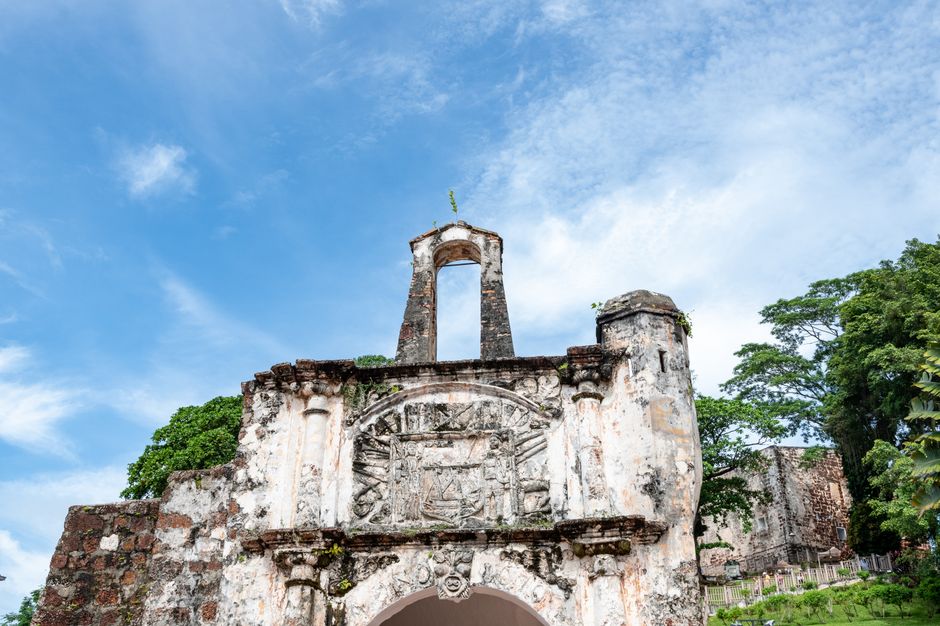
A Famosa
Commissioned in 1511 by Portuguese conqueror Afonso de Albuquerque following the fall of the Malacca Sultanate, this battered gatehouse—properly termed the Porta de Santiago—stands as the sole surviving fragment of a formidable sea-facing fortress. Once a sprawling citadel that encircled the hillside with thick ramparts and a four-story keep, the outpost fell to the Dutch East India Company (VOC) in 1641 after an agonizing five-month siege. The victorious Dutch repaired the damaged gateway, leaving an indelible mark above the pediment: a carved bas-relief bearing the VOC coat of arms and the inscription "ANNO 1670." When British forces systematically dynamited the fortress in 1807 to deny it to Napoleonic rivals, only the eleventh-hour intervention of Sir Stamford Raffles halted the demolition, sparing this solitary stone threshold from obliteration. Today, visitors encounter a stark, weathered monument defined by its coarse, honeycombed blocks of iron-rich laterite, stained in deep tones of scorched ochre and charcoal. Stepping inside the barrel-vaulted archway, the air cools slightly, allowing travelers to touch the porous, uneven masonry that has withstood centuries of monsoon humidity and artillery bombardment. Replicas of 17th-century bronze naval cannons flank the whitewashed exterior plinth, aimed toward the reclaimed coastline where colonial galleons once anchored. Standing beneath the worn crest, you feel the tangible weight of Southeast Asia's maritime crossroads, surrounded by the rustle of rain trees and the panoramic ascent toward the ruins of St. Paul’s Church above.
More in Malacca
Photo credits (1)
- User: (WT-shared) Slleong at wts wikivoyage, CC BY 1.0, via Wikimedia Commons