
 New added
Triana District
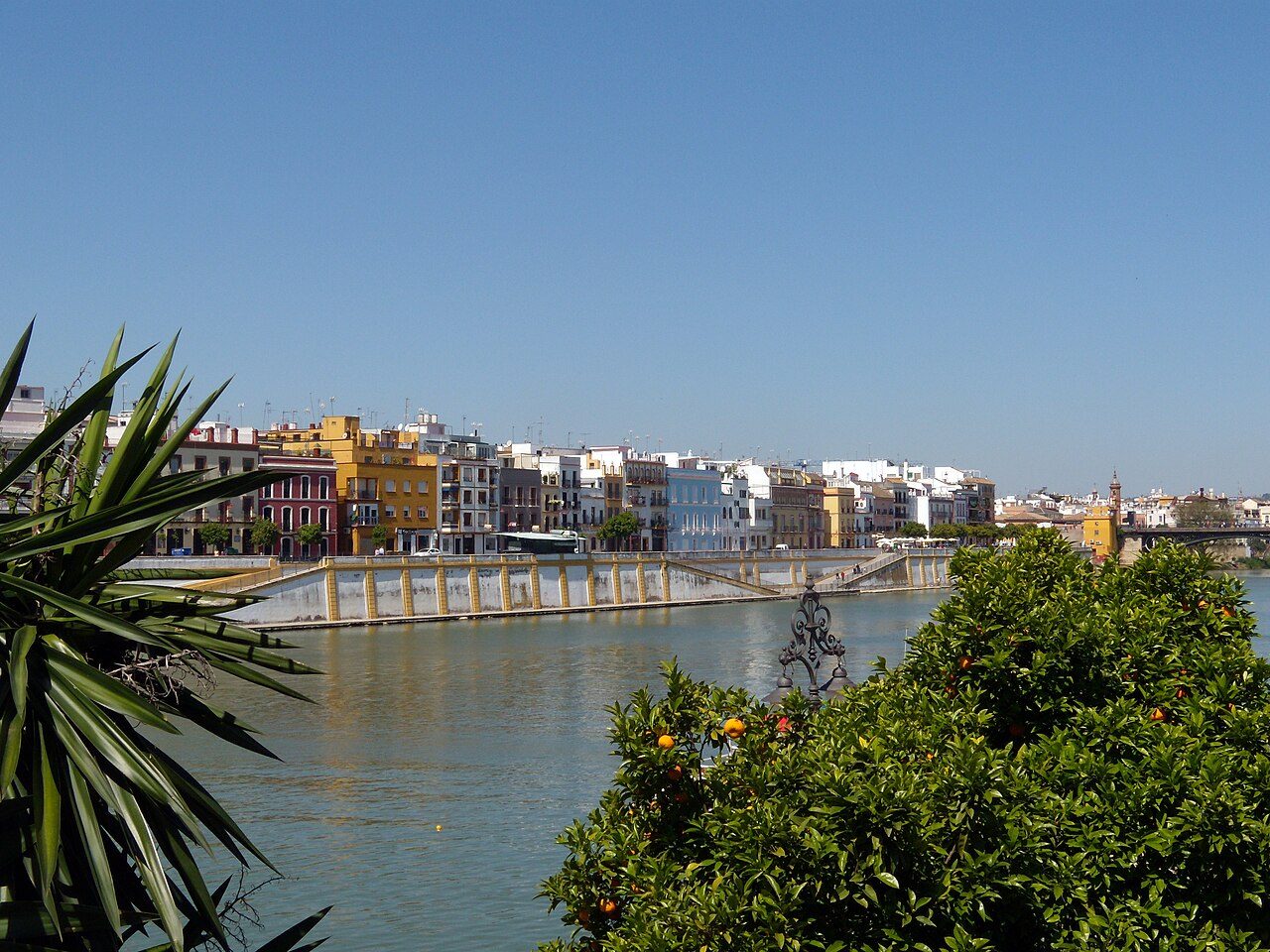
Cross the iron arches of the Puente de Isabel II—forged in 1852—and Seville yields to the fiercely independent rhythm of Triana, an artisan quarter rooted in seafaring, clay, and Gitano heritage. Below the bustling market floor at the bridgehead lie the excavated ruins of the Castillo de San Jorge, the grim seat of the Spanish Inquisition from 1481 to 1785. Deeper into the district stands the fortress-like Iglesia de Santa Ana, commissioned by King Alfonso X in 1276, showcasing Gothic-Mudéjar ribbed vaults and a polychrome ceramic tower. For centuries, kilns along Calle Alfarería supplied glazed tiles across the Spanish Empire; today, those vivid cobalt and ochre ceramics still sheath neighborhood doorways, courtyards, and artisanal ateliers. Walking along the riverfront Calle Betis, visitors are greeted by a ribbon of slender, pastel-washed facades whose wrought-iron balconies spill over with scarlet geraniums, offering panoramic vistas of the Torre del Oro across the Guadalquivir. The air carries the sharp brine of manzanilla sherry and the rich aroma of *pescaíto frito* drifting from tiled taverns into cobblestone alleys. In Triana, flamenco remains an unscripted birthright rather than a staged show. As twilight falls, travelers encounter the sharp acoustic cadence of spontaneous *palmas* (hand-clapping) and raspy guitar chords escaping from neighborhood *peñas*, where centuries of working-class pride resonate within whitewashed patios.
More in Seville
Photo credits (5)
- Gzzz, CC BY-SA 3.0, via Wikimedia Commons
- Holger Uwe Schmitt, CC BY-SA 4.0, via Wikimedia Commons
- BuzzerLone, CC BY 4.0, via Wikimedia Commons
- Weldon Kennedy from London, UK, CC BY 2.0, via Wikimedia Commons
- Andrei Dimofte from Stuttgart, Germany, CC BY 2.0, via Wikimedia Commons