
 New added
Plaza de España
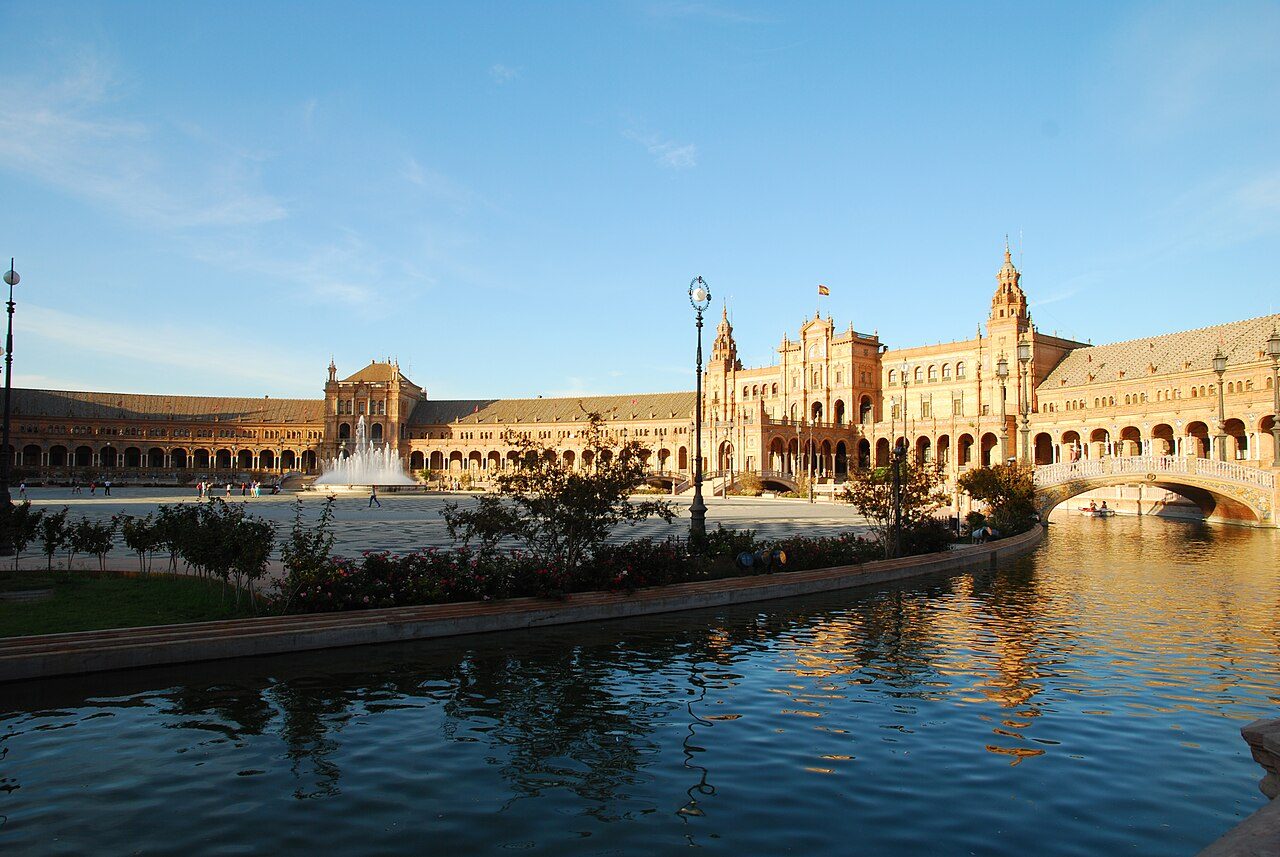
Conceived by Sevillian architect Aníbal González for the 1929 Ibero-American Exposition, the Plaza de España unfurls as a monumental crescent of exposed brick, marble, and polychrome ceramics. Built in the Regionalist style—a romantic fusion of Neo-Mudéjar and Renaissance Revival idioms—the sweeping complex forms a 200-meter-wide semicircular palace designed to symbolically embrace Spain’s former transatlantic territories. Anchoring the curve at either end, two soaring 74-meter towers pierce the Andalusian sky, rivaling the height of the Giralda, while a continuous 500-meter canal winds below, spanned by four ornate bridges representing the ancient Iberian kingdoms of Castile, León, Navarre, and Aragon. Standing beneath the cavernous double-decker portico, visitors step out of the blinding heat into the deep shade of coffered ceilings before approaching the perimeter of the plaza. Here, lining the palace facade, sit forty-eight vibrant *azulejo* (glazed ceramic) alcoves, each chronicling the heraldry, map, and defining historical triumphs of a Spanish province. The atmosphere hums with kinetic vitality: the rhythmic dip of oars into the canal, the cooling mist drifting from Vicente Traver’s central fountain, and the sharp, percussive clatter of spontaneous flamenco footwork echoing off glazed tiles and weathered terracotta balustrades.
More in Seville
Photo credits (5)
- Andrei Dimofte from Stuttgart, Germany, CC BY 2.0, via Wikimedia Commons
- Holger Uwe Schmitt, CC BY-SA 4.0, via Wikimedia Commons
- BuzzerLone, CC BY 4.0, via Wikimedia Commons
- Weldon Kennedy from London, UK, CC BY 2.0, via Wikimedia Commons
- Gzzz, CC BY-SA 3.0, via Wikimedia Commons