
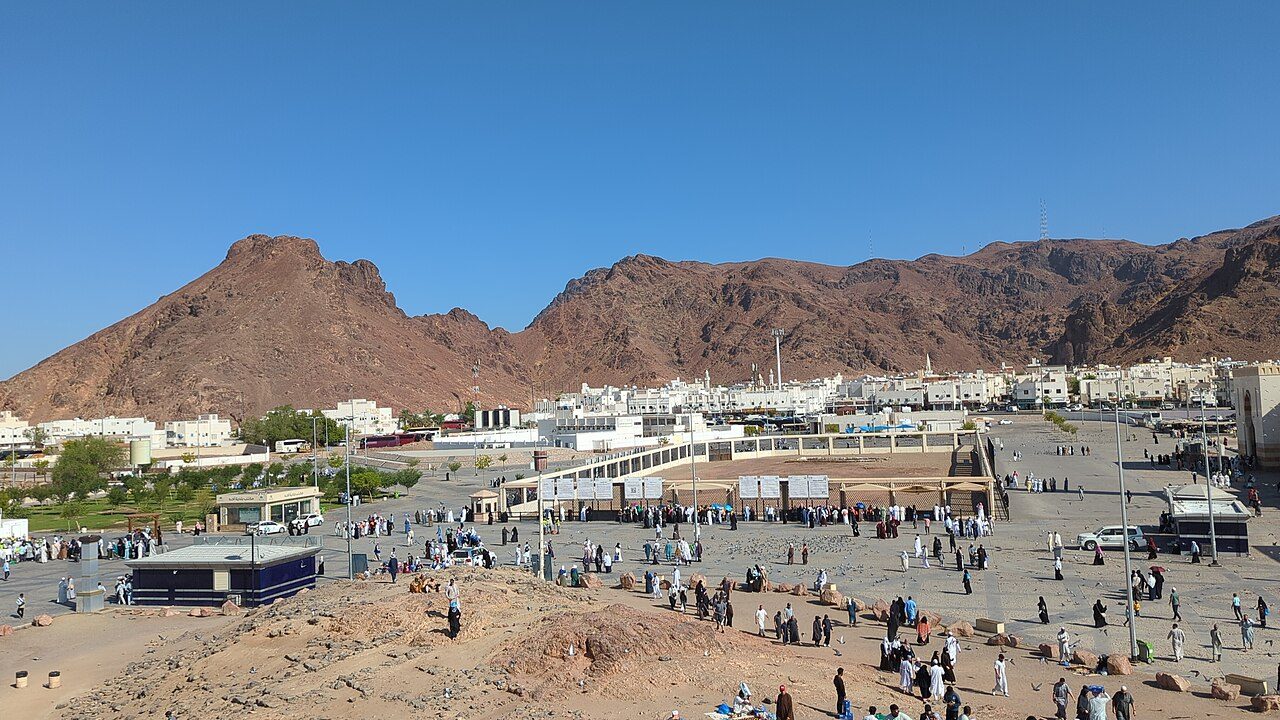
Uhud Mountain
Looming across Medina’s northern horizon, this seven-kilometer massif of crimson-tinged granite and volcanic basalt bore witness to the pivotal Battle of Uhud in March 625 CE (3 AH). Here, early Muslim forces led by the Prophet Muhammad confronted the Quraysh army from Mecca. At the mountain’s southern base rises *Jabal ar-Rumah* (the Archers’ Mound), the low rocky knoll where fifty marksmen were stationed with orders never to desert their post—a command whose breach triggered a tactical encirclement orchestrated by Khalid ibn al-Walid. Immediately adjacent lies the Martyrs’ Cemetery, bounded by high pale stone walls and green iron grilles, sheltering seventy unadorned earth-and-stone graves, most notably that of the Prophet’s uncle, Hamza ibn Abd al-Muttalib. Ascending the gravelly switchbacks of the Archers' Mound, travelers look out across the broad expanse where the cavalry charge turned the battle's tide, feeling the dry Hejaz wind channeling through the mountain's stark ravines. The surrounding air carries an intense, hushed solemnity as pilgrims gather along the cemetery enclosure to recite quiet supplications into the fenced courtyard. In the late afternoon, the raw, vertical crags shift in hue from dusty ochre to deep purple, offering an immediate, physical encounter with the rugged topography that shaped early Islamic history.
More in Medina
Photo credits (5)
- Ahmed, CC BY 4.0, via Wikimedia Commons
- Indonesiagood, CC BY 4.0, via Wikimedia Commons
- CR Guru PK, CC BY-SA 4.0, via Wikimedia Commons
- Indonesiagood, CC BY 4.0, via Wikimedia Commons
- Unknown author, CC BY-SA 3.0, via Wikimedia Commons