
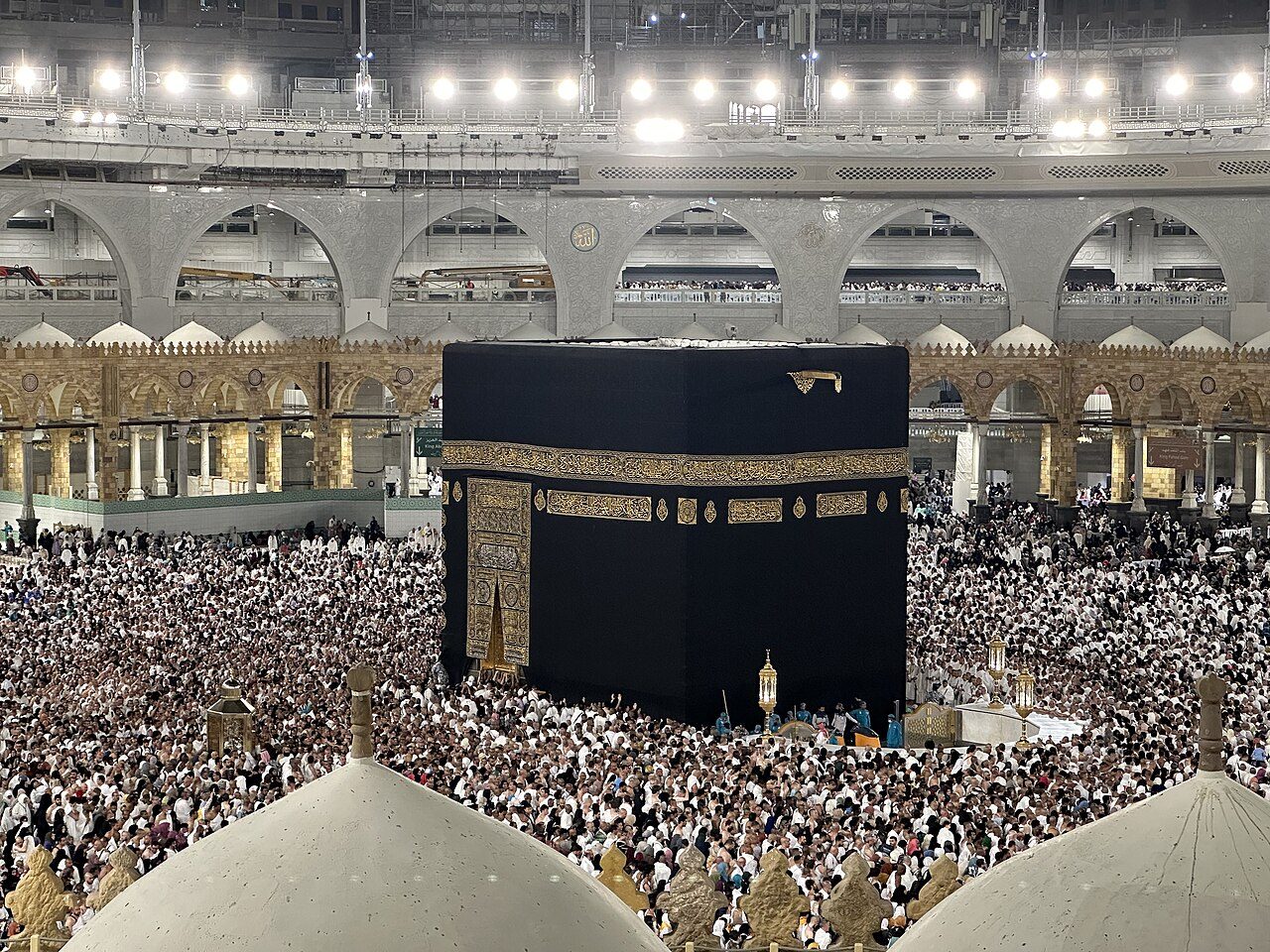
Kaaba
Rooted in monotheistic antiquity and attributed by Islamic tradition to the patriarchs Ibrahim and Ismail, the Kaaba stands as the spiritual epicenter of the Islamic world. Reconstructed by the Quraysh tribe in 608 CE—an event in which the Prophet Muhammad resolved a clan dispute by jointly positioning the eastern cornerstone—the edifice rises fifteen meters as a monolithic cube of local grey granite. Its exterior is cloaked in the *Kiswa*, an immense mantle of black silk hand-embroidered with over one hundred kilograms of pure gold and silver calligraphy. Distinctive architectural features punctuate the exterior: the sacred Black Stone (*al-Hajar al-Aswad*) polished smooth and cradled in an ornate silver casing, the gilded *Mizab al-Rahman* rainwater spout projecting from the roofline, and the low, semicircular marble wall of the *Hatim* tracing the structure’s original Abrahamic footprint. Standing upon the radiant, heat-resistant white Thassos marble of the surrounding *Mataf* courtyard, one is swept into an awe-inspiring sensory vortex. Millions of travelers encircle the stone in the synchronized, counter-clockwise tide of the *Tawaf*, their voices rising in the rhythmic, collective murmur of the *Talbiyah* prayer. The desert air carries the rich scents of smoldering agarwood oud and distilled Taif rosewater used to ritualistically wash the shrine’s threshold. Gazing upward at the shimmering golden portal of *Bab al-Tawbah* against the deep black silk, visitors encounter a kinetic spectacle of unified devotion, where centuries of theological heritage coalesce into an intense, unforgettable encounter.
More in Mecca
Photo credits (6)
- Qibla-direction, CC0, via Wikimedia Commons
- Indonesiagood, CC BY 4.0, via Wikimedia Commons
- Mohammad Bahareth, CC BY-SA 2.0, via Wikimedia Commons
- King Eliot, CC BY-SA 4.0, via Wikimedia Commons
- saudipics, CC BY-SA 4.0, via Wikimedia Commons
- King Eliot, CC BY-SA 4.0, via Wikimedia Commons