
 New added
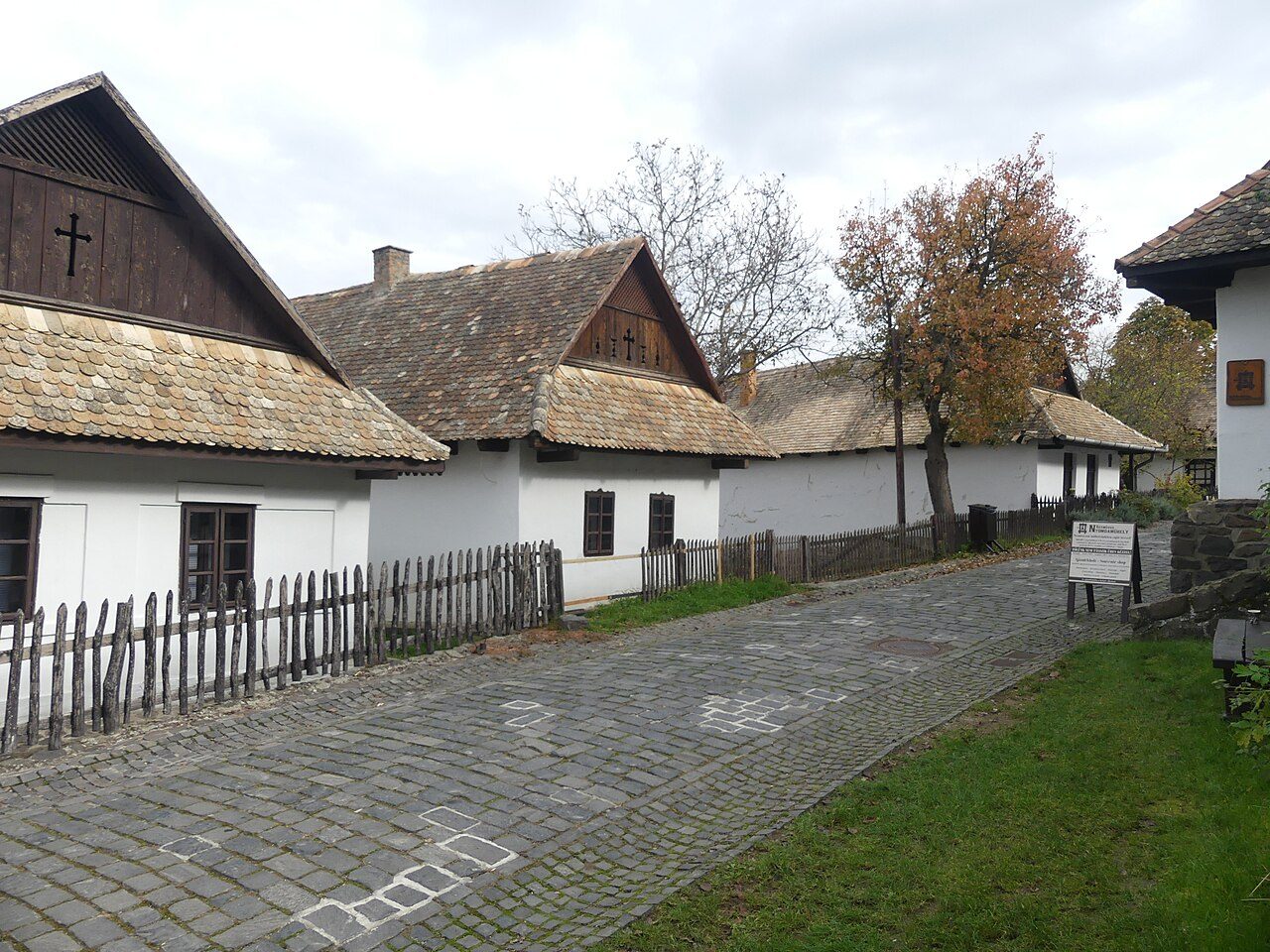
Hollókő Old Village
Tucked into the rolling Cserhát hills northeast of Budapest, Hollókő preserves the living traditions of the Palóc, a distinct regional subgroup whose architectural vernacular dates to medieval origins. After a devastating fire swept through the village in 1909, the community systematically rebuilt their homes upon original medieval stone foundations, swapping vulnerable thatched roofs for clay tile while fiercely protecting their ancestral layout. At the core of the village stands the 1889 Church of Saint Martin, a stark white sanctuary crowned by an octagonal wooden belfry clad in black oak shingles. Lining the branching lanes are roughly sixty-seven preserved peasant houses, distinguished by brilliant whitewashed plaster, timber-framed porches, and intricately pierced wooden balustrades that overlook fieldstone pathways. Ascending the village's central cobbled spine toward the jagged 13th-century fortress ruins established by the Kacsics clan, travelers encounter an immersive pastoral atmosphere scented with woodsmoke and drying herbs. Stepping over heavy timber thresholds reveals the strict tripartite interior layout typical of Palóc dwellings: the central hearth kitchen, the storage pantry, and the ceremonial "clean room" (*tiszta szoba*), adorned with hand-painted tulip-motif chests and stacks of featherbeds. The quiet lanes echo with the steady clatter of antique wooden looms, where weavers still craft geometric red-and-black textiles, while elders in layered, bell-shaped skirts and embroidered bonnets complete an environment untouched by contemporary urban sprawl.
More in Budapest

Photo credits (6)
- Elekes Andor, CC BY 4.0, via Wikimedia Commons
- Bybbisch94, Christian Gebhardt, CC BY-SA 4.0, via Wikimedia Commons
- Bybbisch94, Christian Gebhardt, CC BY-SA 4.0, via Wikimedia Commons
- User:Sveter (Please credit as "Petr Šmerkl, Wikipedia" in case you use this outside WMF projects.), CC BY-SA 3.0, via Wikimedia Commons
- Nan Palmero from San Antonio, TX, USA, CC BY 2.0, via Wikimedia Commons
- Thaler Tamas, CC BY-SA 4.0, via Wikimedia Commons