
 New added
Fisherman’s Bastion
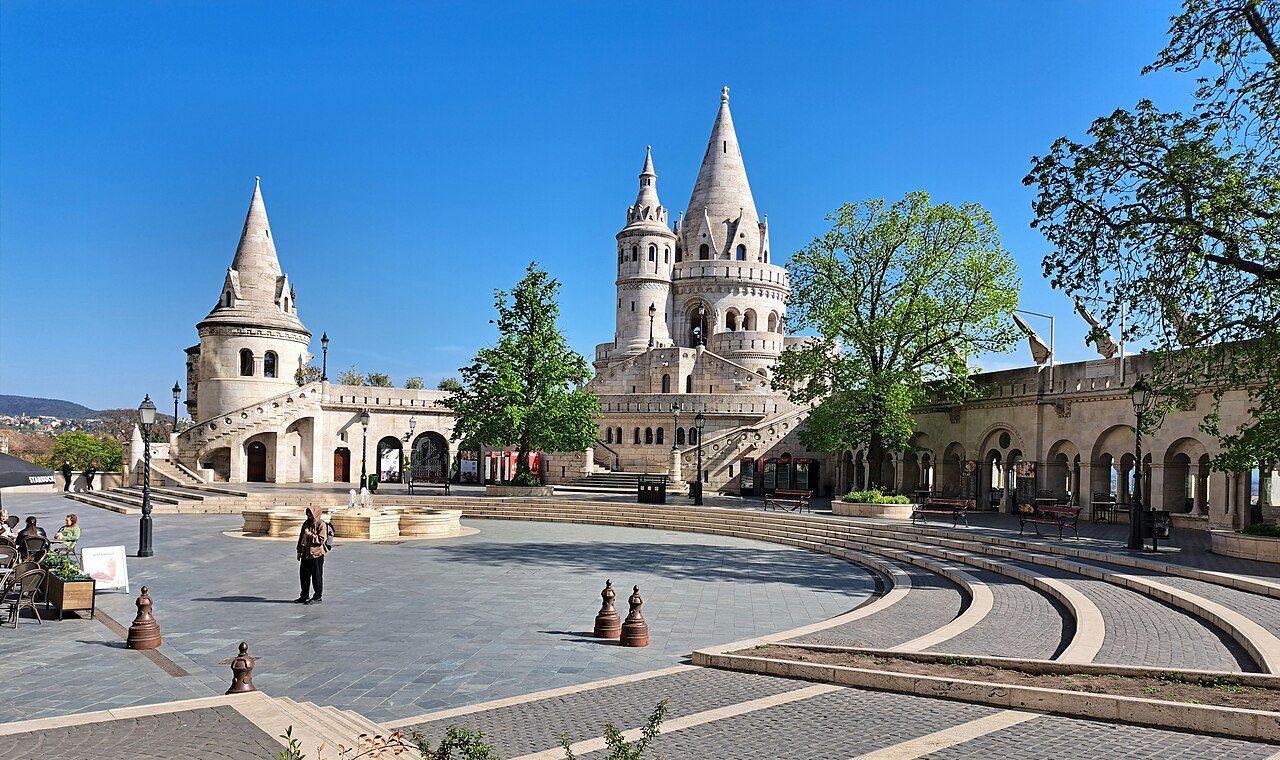
Crowning Castle Hill in a flourish of chalk-white limestone, the Neo-Romanesque ramparts of Fisherman’s Bastion were sculpted by architect Frigyes Schulek between 1895 and 1902 to commemorate the millennium of the Hungarian state. Rather than serving as an austere military redoubt, the monument was conceived as a theatrical panoramic terrace honoring the medieval guild of fishermen who once defended this stretch of Buda’s ramparts. Schulek wove fairy-tale whimsy into the historic fabric, erecting seven conical stone watchtowers to represent the seven Magyar chieftains who led their tribes into the Carpathian Basin in 895. At the bastion's heart, dynamic arcades and double staircases wrap around Alajos Stróbl’s bronze equestrian monument to King Saint Stephen, Hungary's first Christian monarch. Stepping through the cloisters, visitors are greeted by cool river breezes and the rhythmic click of shoes echoing across polished flagstones. Looking out through the traceried stone arches reveals Budapest’s most dramatic vista: the gray-blue Danube cutting through the metropolis, framed directly opposite by the spires of the Hungarian Parliament. At dawn, pale morning light washes across the carved balustrades and catches the glazed ceramic tiles of the adjacent Matthias Church, offering a tranquil vantage point before the city below fully stirs.
More in Budapest

Photo credits (6)
- Bybbisch94, Christian Gebhardt, CC BY-SA 4.0, via Wikimedia Commons
- Bybbisch94, Christian Gebhardt, CC BY-SA 4.0, via Wikimedia Commons
- User:Sveter (Please credit as "Petr Šmerkl, Wikipedia" in case you use this outside WMF projects.), CC BY-SA 3.0, via Wikimedia Commons
- Nan Palmero from San Antonio, TX, USA, CC BY 2.0, via Wikimedia Commons
- Elekes Andor, CC BY 4.0, via Wikimedia Commons
- Thaler Tamas, CC BY-SA 4.0, via Wikimedia Commons