
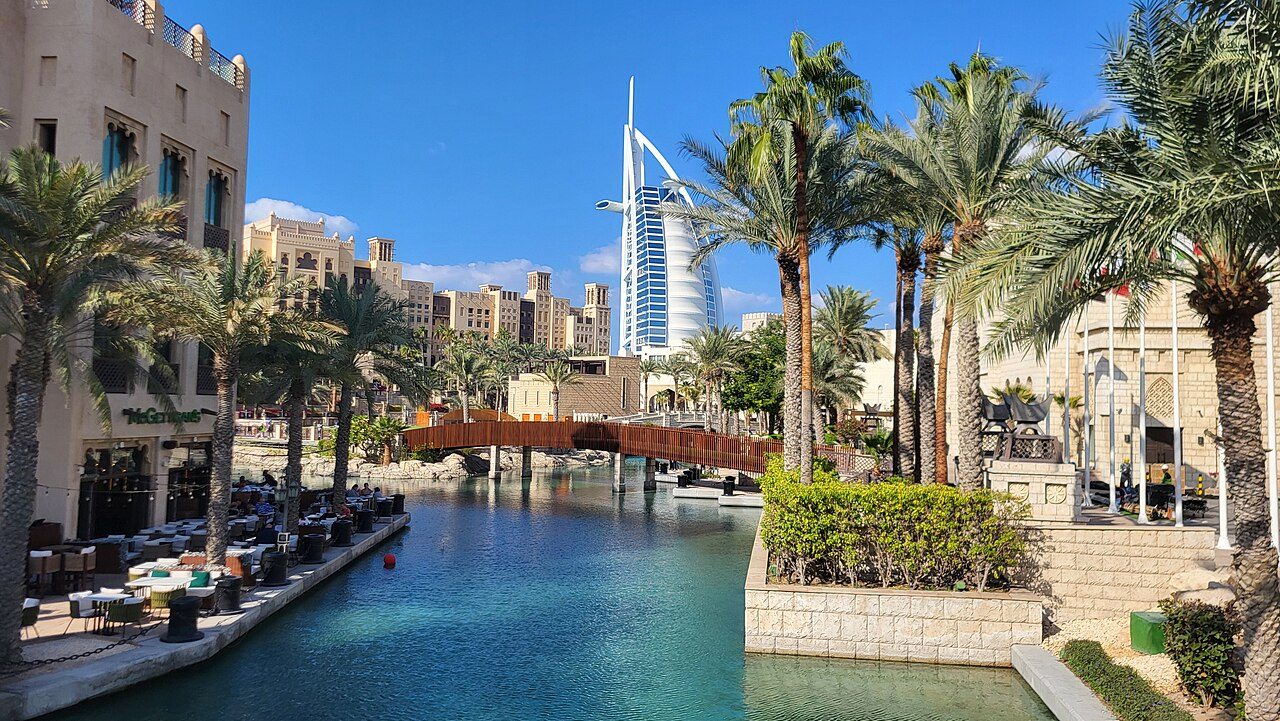
Burj Al Arab
Commissioned by Sheikh Mohammed bin Rashid Al Maktoum and completed in December 1999, the Burj Al Arab fundamentally redefined Dubai’s skyline. Architect Tom Wright engineered the 321-meter structural marvel to evoke the billowing sail of a traditional J-class yacht, tethering the emirate's pearl-diving heritage to its hyper-modern ambitions. Rooted to an artificial island 280 meters offshore, the tower relies on a subterranean honeycomb of 250 concrete foundation piles. Its exterior is dominated by a sweeping, Teflon-coated fiberglass facade designed to deflect the harsh Arabian sun, counterbalanced by an audacious cantilevered helipad suspended 212 meters above the sea. Crossing the restricted private causeway, travelers enter a world of theatrical maximalism orchestrated by interior designer Khuan Chew. Visitors find themselves dwarfed inside the soaring 180-meter atrium—the world's tallest—where tiered balconies graduate through a vivid rainbow spectrum toward the apex. Gilded surfaces catch the light at every turn, with roughly 1,790 square meters of 24-karat Italian gold leaf sheathing the columns and vaulted ceilings alongside crisp Statuario marble. The sensory assault unfolds through choreographed fiber-optic water spouts leaping alongside escalator aquariums, the resonant aroma of burning oud, and unobstructed vistas of the turquoise Persian Gulf stretching to the horizon.
More in Dubai
Photo credits (4)
- Renek78, CC0, via Wikimedia Commons
- Nealt, CC BY-SA 3.0, via Wikimedia Commons
- Phil6007, CC BY-SA 4.0, via Wikimedia Commons
- Sachimo, CC BY-SA 4.0, via Wikimedia Commons