
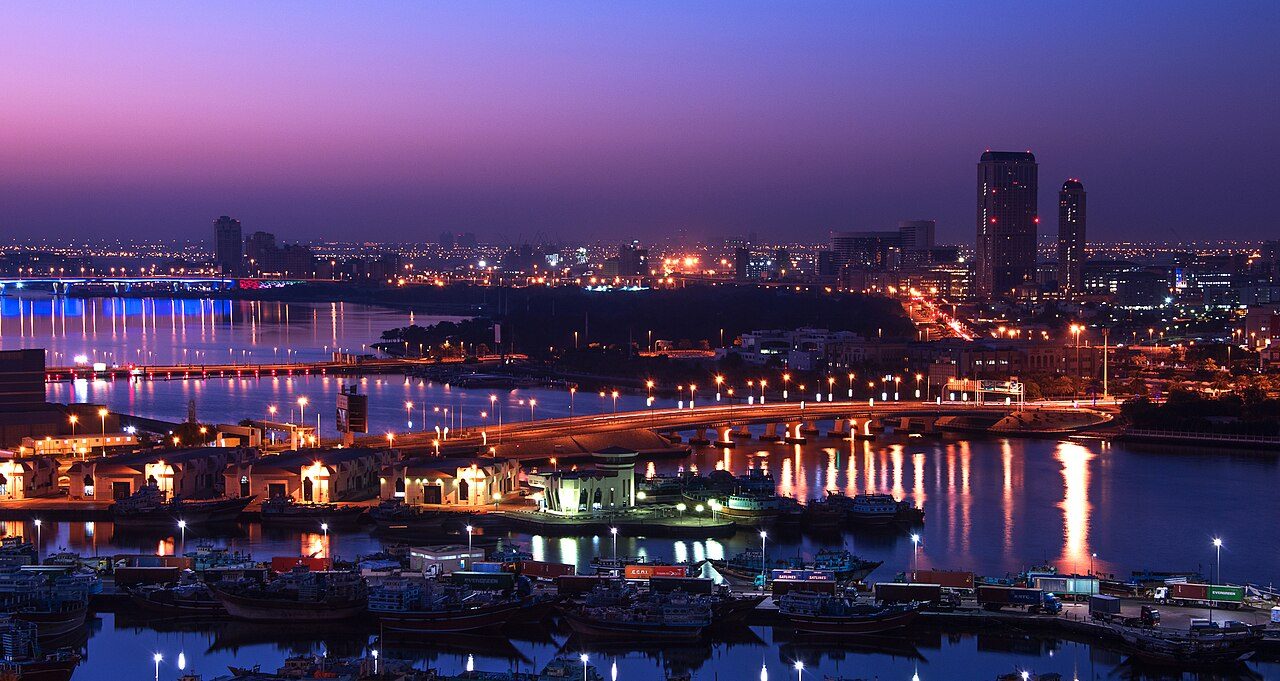
Dubai Creek
Long before steel and glass punctured the Arabian sky, this nine-mile saltwater inlet anchored the 1833 settlement of the Bani Yas tribe under the Al Maktoum dynasty. Historically sustained by pearling fleets and dhow trade with Persia and India, the waterway was radically transformed in the late 1950s when Sheikh Rashid bin Saeed Al Maktoum commissioned dredging operations to accommodate deep-draft cargo vessels, sparking the city’s commercial boom. Framing the southern bank, the 19th-century Al Fahidi Historical Neighbourhood preserves traditional vernacular architecture, defined by square wind towers (*barjeel*) and rugged walls fashioned from coral stone, gypsum, and palm timber. Directly across the channel in Deira, working wooden dhows moor three-deep along the wharves, their open decks stacked high with tires, textiles, and bulk goods bound for ports across the Indian Ocean. At the water’s edge, travelers step onto narrow wooden *abras*—traditional motorized ferry boats—handing a single one-dirham coin to the pilot before taking a seat along the central wooden bench. As the vessel pushes away from the quay, the rhythmic chug of the diesel engine vibrates beneath the floorboards, cutting through the emerald-green wake. Mid-stream, the brine of the inlet blends with the drifting aromas of cardamom, frankincense, and dried limes wafting from the nearby souks. Gulls wheel between creaking rigging and sand-colored minarets, immersing passengers in a tactile maritime passage that feels entirely detached from the gleaming towers rising in the distance.
More in Dubai

Photo credits (3)
- Phil6007, CC BY-SA 4.0, via Wikimedia Commons
- Renek78, CC0, via Wikimedia Commons
- Nealt, CC BY-SA 3.0, via Wikimedia Commons