
Orongo
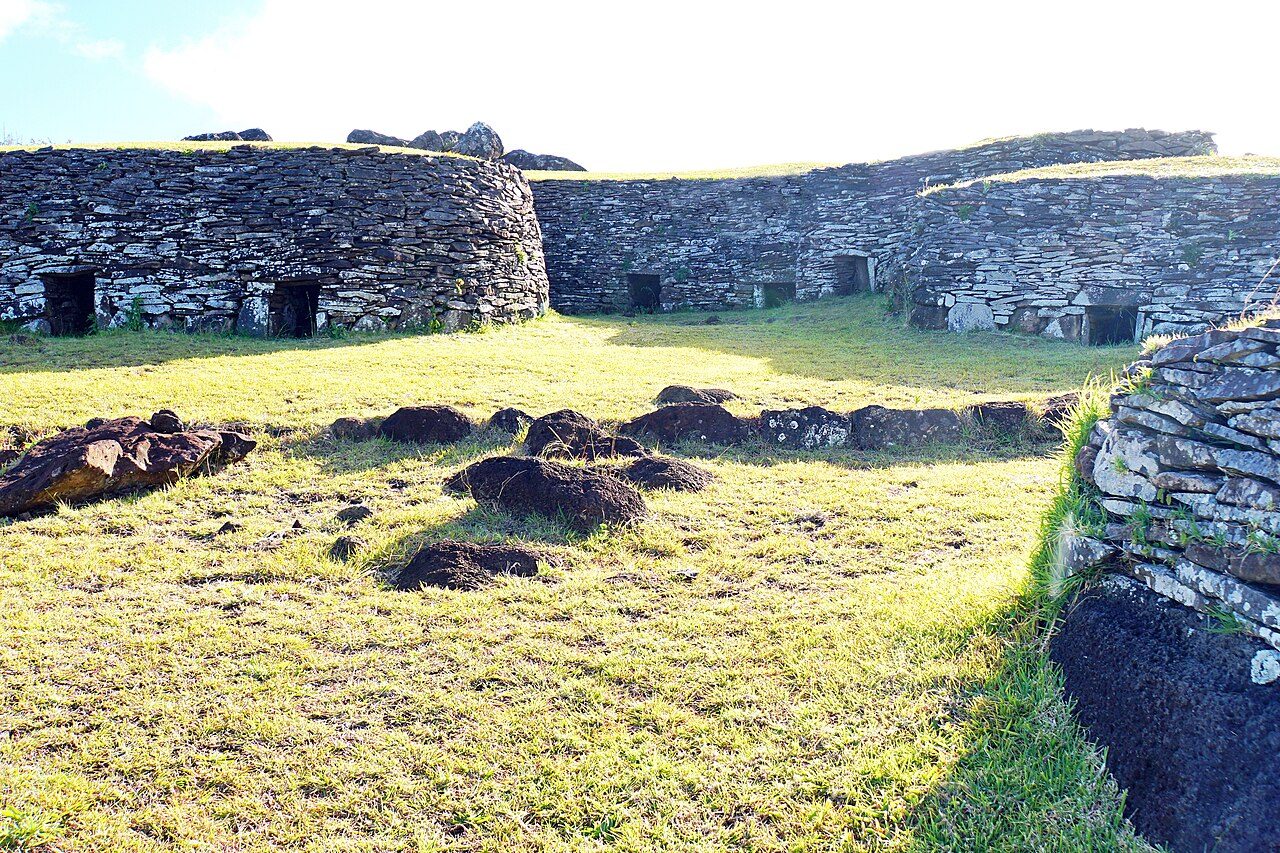
Perched precariously between the jagged rim of the Rano Kau volcanic caldera and a sheer 300-meter drop into the Pacific, Orongo served as the ceremonial epicenter of Rapa Nui’s Tangata Manu (Birdman) religion from the 18th until the late 19th century. As moai carving and traditional ancestor worship collapsed, rival clans assembled here each austral spring to compete for spiritual and political dominion. Fifty-three low-slung, elliptical stone houses—engineered from layered basalt slabs with turf-covered roofs and claustrophobic crawl-space entries—trace the narrow crest. At Mata Ngarau, the sacred compound at the ridge’s tapering tip, boulders are incised with hundreds of bas-relief petroglyphs of Make-Make, the island's creator deity, and stylized human figures with raptor heads. Walking the rim trail, visitors confront relentless oceanic gusts and an overwhelming sense of exposure. To one side lies the silent amphitheater of Rano Kau’s crater lake, patterned with floating green mosaics of totora reeds; to the other, the ocean drops straight down into crashing surf. Looking out to sea, travelers can clearly pick out the solitary spires of Motu Nui, Motu Iti, and Motu Kao-Kao—the jagged islets where ancient *hopu manu* (competitors) swam through shark-patrolled currents to secure the year's first sooty tern egg. Crouching beside the dark, subterranean-like dwellings, the stark isolation and sheer drop-offs bring the brutal stakes of the Birdman trials vividly to life.
More in Hanga Roa
Photo credits (4)
- Dennis G. Jarvis, CC BY-SA 2.0, via Wikimedia Commons
- Bjørn Christian Tørrissen, CC BY-SA 3.0, via Wikimedia Commons
- Dennis G. Jarvis, CC BY-SA 2.0, via Wikimedia Commons
- The original uploader was Hhooper1 at English Wikipedia ., CC BY 2.5, via Wikimedia Commons