
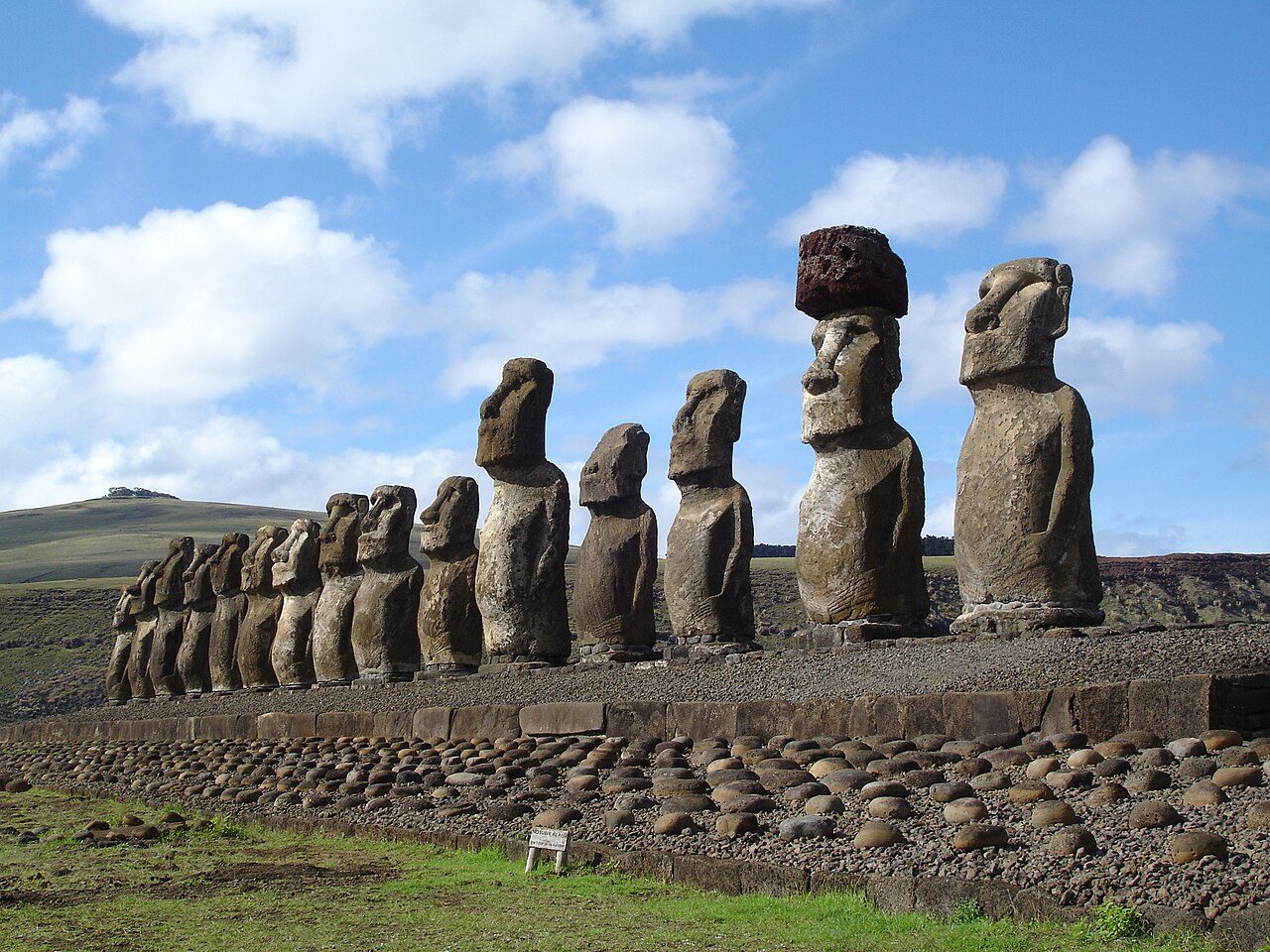
Ahu Tongariki
Rising against the churning surf of Hotu-iti bay, the monumental platform of Ahu Tongariki represents the zenith of Rapa Nui megalithic engineering. Spanning a 220-meter basalt terrace, fifteen monolithic *moai* carved from the golden-brown lapilli tuff of nearby Rano Raraku face inland, their sharp, stylized jawlines and sunken eye sockets presiding over the coastal plain. Overturned during clan conflicts in the late 18th century and later scattered inland by the catastrophic 1960 Valdivia tsunami, this sacred sanctuary was meticulously reconstructed during the 1990s by archaeologist Claudio Cristino in partnership with the Japanese crane manufacturer Tadano. The statues vary in size and character, including a solitary colossus crowned with an ochre-red scoria *pukao* (topknot) balancing precariously on its head. Standing upon the dew-drenched turf at dawn, travelers experience a dramatic spectacle as the morning sun crests the horizon directly behind the colossal figures, casting razor-sharp, obsidian silhouettes across the landscape. Fierce southeasterly trade winds whip ocean brine through the air, harmonizing with the relentless percussion of South Pacific swells crashing against jagged black volcanic shores. The scale is profoundly humbling; the central, towering *moai* weighs an estimated 86 metric tons, its charcoal-tinted stone surface flecked with lichens. Under this vast, isolated sky, the silent gaze of these ancestral Polynesian chieftains emanates an unmistakable aura of sacred *mana*, anchoring visitors to a mesmerizing, distant antiquity.
More in Hanga Roa
Photo credits (4)
- The original uploader was Hhooper1 at English Wikipedia ., CC BY 2.5, via Wikimedia Commons
- Bjørn Christian Tørrissen, CC BY-SA 3.0, via Wikimedia Commons
- Dennis G. Jarvis, CC BY-SA 2.0, via Wikimedia Commons
- Dennis G. Jarvis, CC BY-SA 2.0, via Wikimedia Commons