
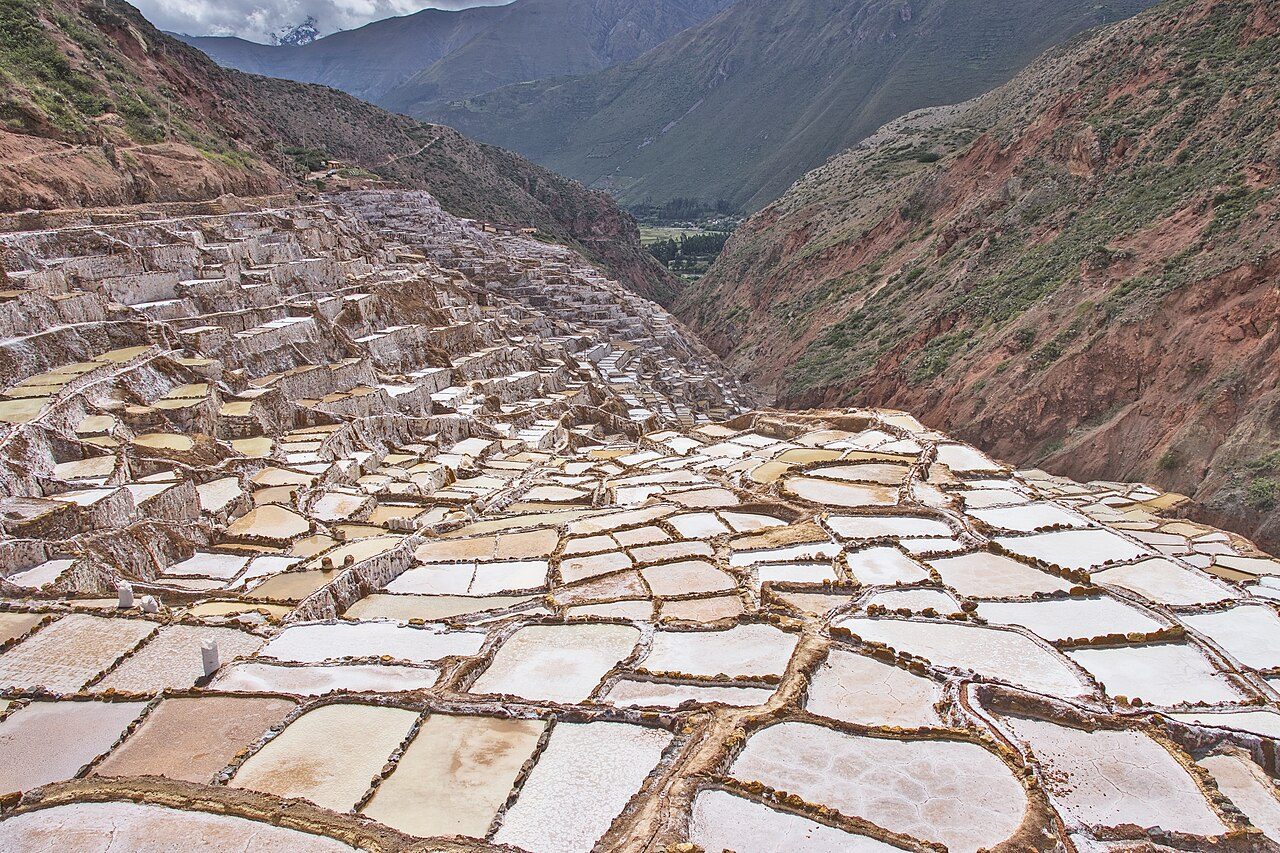
Maras Salt Mines
Cascading down the flanks of the Qaqawiñay mountain within the Sacred Valley, the artisanal salt pans of Maras date back to the Chanapata culture (circa 200–900 CE) and were later incorporated into the Inca Empire's state economy. Fed by Qoripujio, a subterranean spring that emerges warm and hypersaline from deep beneath the Andean bedrock, an ancient network of stone aqueducts feeds more than 3,000 stepped evaporation ponds (*pozas*). Today, these terraced plots remain collectively managed by families of the Maras and Pichingoto communities, who harvest three distinct strata of salt—from industrial brown base layers to prized, mineral-dense pink crystals—using traditional fractional crystallization techniques perfected over a millennium. Standing along the cliffside overlook, visitors are greeted by an arresting geometric mosaic that contrasts sharply with the arid red canyon walls. The high-altitude sun glares intensely off thousands of shallow, water-filled basins, shifting in hue from muddy ochre to blinding bone-white and soft rose. The mountain breeze carries a dry, saline mineral tang, punctuated by the steady, rhythmic murmur of warm brine coursing through clay and stone furrows. Below, local workers maneuver between the narrow earthen dikes with broad wooden scrapers, shoveling salt into pyramidal mounds in an unchanged cycle of Andean hydraulic engineering.
More in Cusco

Photo credits (6)
- Draceane, CC BY-SA 4.0, via Wikimedia Commons
- W. Bulach, CC BY-SA 4.0, via Wikimedia Commons
- Diego Delso, CC BY-SA 4.0, via Wikimedia Commons
- Håkan Svensson ( Xauxa ), CC BY 2.5, via Wikimedia Commons
- Christian Morales Callo, CC BY-SA 4.0, via Wikimedia Commons
- Xauxa , Håkan Svensson, CC BY 2.5, via Wikimedia Commons