
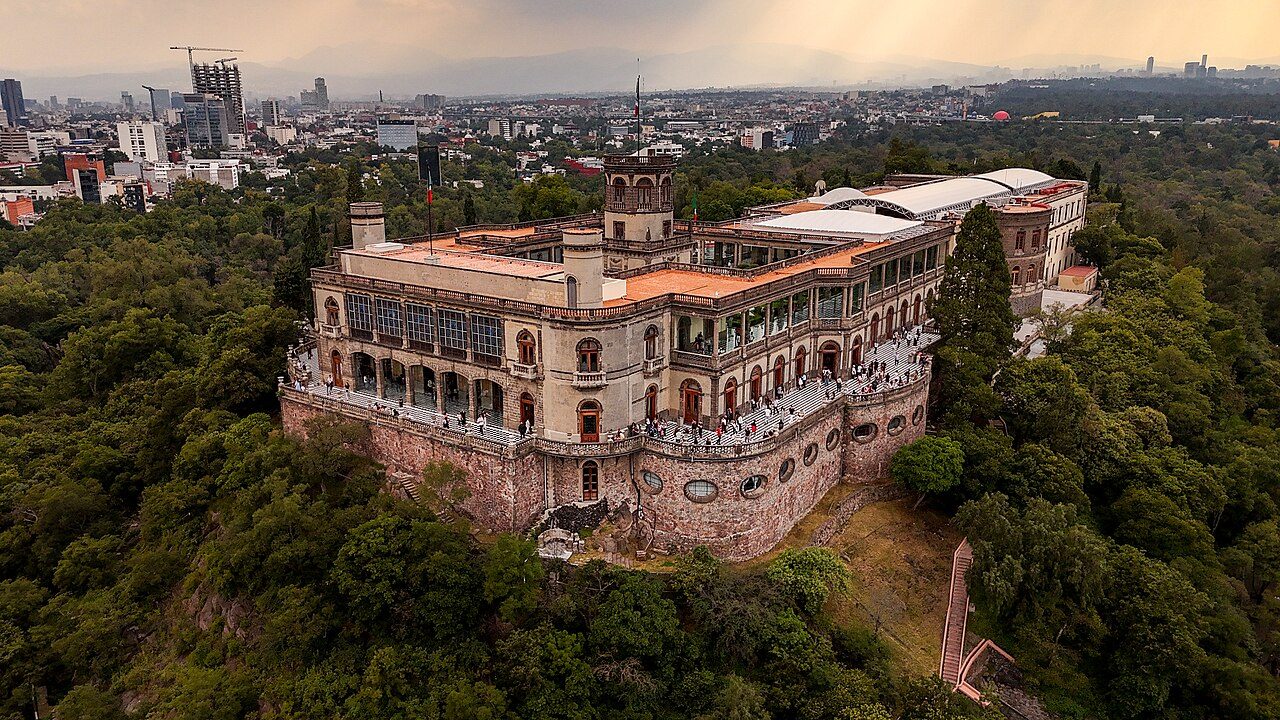
Chapultepec Castle
Perched atop a sacred volcanic outcrop rising above the ancient ahuehuete cypress trees, this monumental fortress stands as the only royal castle in the Americas. Initiated in 1785 under Spanish Viceroy Bernardo de Gálvez and scarred by the 1847 Mexican-American War—where the cadet *Niños Héroes* made their tragic last stand—the estate underwent an opulent transformation in the 1860s when Austrian Archduke Maximilian I and Empress Carlota refashioned it into an imperial residence. Today, the fortress harmonizes Neoclassical and Neo-Romantic architecture, functioning as the National Museum of History where grandiose state rooms give way to monumental twentieth-century murals by David Alfaro Siqueiros and Juan O'Gorman. Stepping out onto the rooftop Alcázar gardens, you walk across the iconic black-and-white checkerboard marble tiles flanked by manicured rose parterres and classical balustrades. Sunlight filters through the kaleidoscopic stained-glass gallery depicting Greco-Roman goddesses, illuminating the gilded carriages and velvet-draped imperial apartments later occupied by President Porfirio Díaz. Leaning against the stone parapet beneath the central *Caballero Alto* watchtower, you feel the brisk mountain breeze while gazing directly down the grand, tree-lined arrow of Paseo de la Reforma—a dramatic urban axis designed by Maximilian—watching Mexico City’s modern glass skyscrapers unfurl beneath nineteenth-century quietude.
More in Mexico City
Photo credits (7)
- Own work, CC BY-SA 4.0, via Wikimedia Commons
- Gobierno CDMX, CC0, via Wikimedia Commons
- ProtoplasmaKid, CC BY-SA 4.0, via Wikimedia Commons
- GAED, CC BY-SA 3.0, via Wikimedia Commons
- Oleg Yunakov, CC BY-SA 4.0, via Wikimedia Commons
- Octavio Alonso Maya Castro, CC BY-SA 3.0, via Wikimedia Commons
- No machine-readable author provided. Nachtwächter assumed (based on copyright claims)., CC BY-SA 3.0, via Wikimedia Commons