
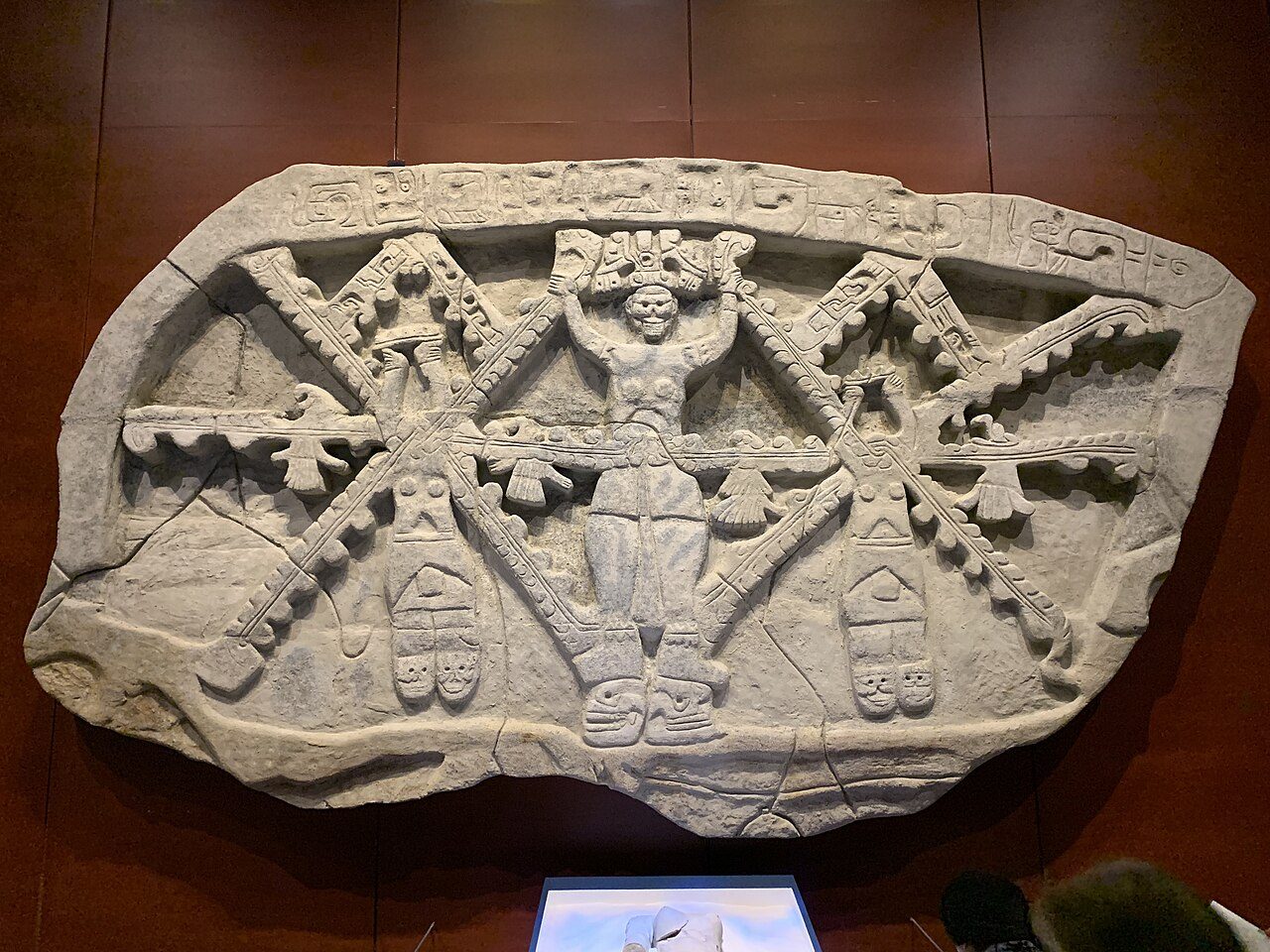
National Museum of Anthropology
In 1964, architect Pedro Ramírez Vázquez redefined civic monumentalism at the edge of Chapultepec Forest with the Museo Nacional de Antropología. Crossing the threshold, travelers emerge into a sweeping open-air courtyard dominated by *El Paraguas*—a colossal, cantilevered concrete canopy supported by a single bronze pillar carved in relief by the Chávez Morado brothers. The steady, hypnotic crash of water cascading from this inverted umbrella drowns out Mexico City's roar, cooling the sun-drenched volcanic stone patio and setting a reverent tone before visitors step into the enveloping silence of the surrounding pavilions. Inside, twenty-three ground-floor archaeological halls sweep through millennia of pre-Columbian civilizations using dramatic, focused illumination. In the Mexica room, the monolithic twenty-four-ton Aztec Sun Stone anchors the space, its basalt-carved cosmograms radiating an undeniable gravitas beneath soaring ceilings. Wandering deeper, you encounter the furrowed brows of multi-ton Olmec colossal heads carved from volcanic boulders, and descend into a faithful subterranean replica of Maya King Pakal’s tomb, where his vivid mosaic jade death mask gleams in the cool gloom. Every gallery seamlessly transitions into lush outdoor garden alcoves displaying full-scale temple replicas, letting you touch the humid foliage of Mesoamerica right alongside its sacred stones.
More in Mexico City
Photo credits (7)
- Oleg Yunakov, CC BY-SA 4.0, via Wikimedia Commons
- Gobierno CDMX, CC0, via Wikimedia Commons
- ProtoplasmaKid, CC BY-SA 4.0, via Wikimedia Commons
- GAED, CC BY-SA 3.0, via Wikimedia Commons
- Own work, CC BY-SA 4.0, via Wikimedia Commons
- Octavio Alonso Maya Castro, CC BY-SA 3.0, via Wikimedia Commons
- No machine-readable author provided. Nachtwächter assumed (based on copyright claims)., CC BY-SA 3.0, via Wikimedia Commons