
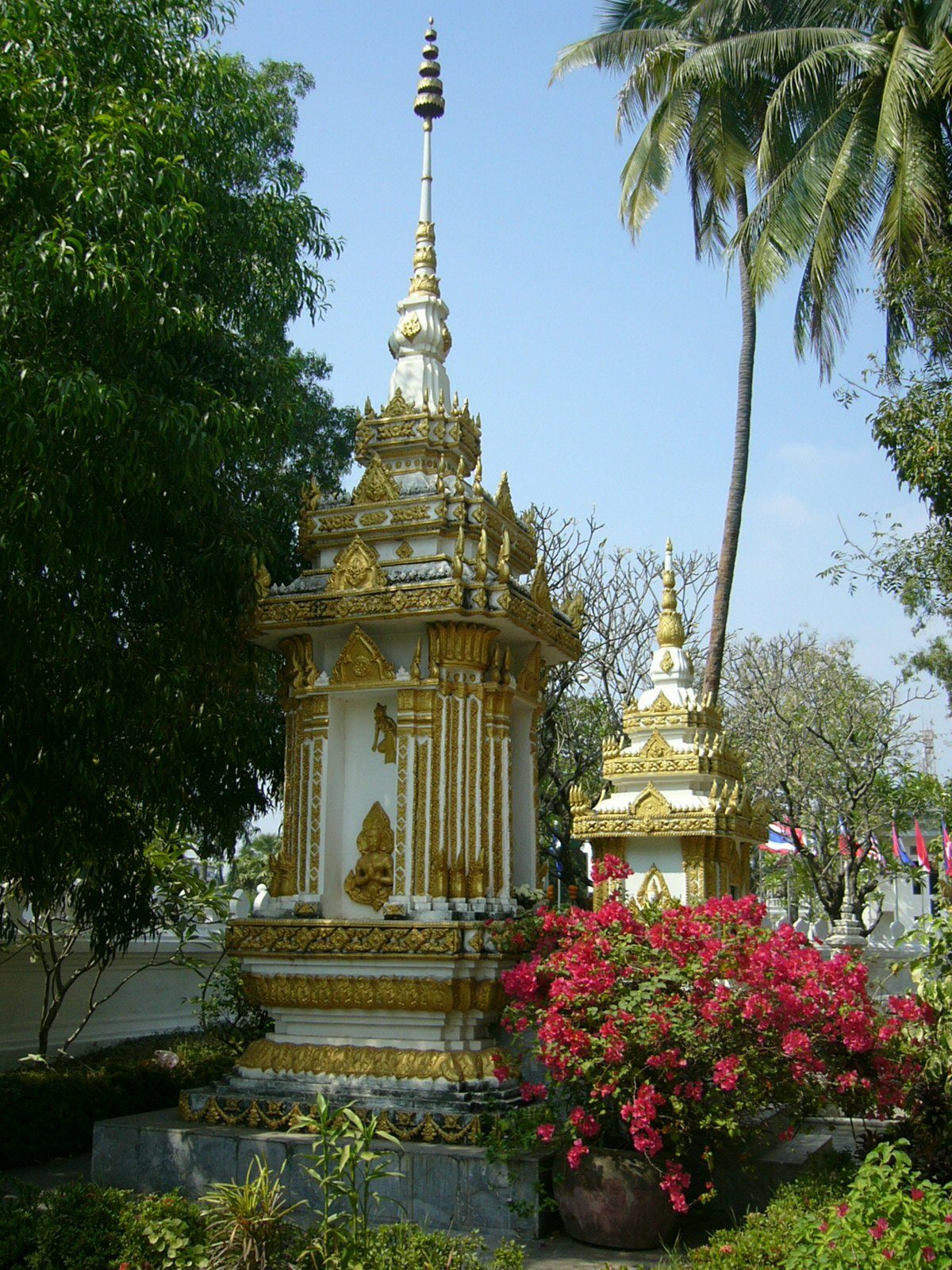
Wat Si Saket
Commissioned in 1818 by King Anouvong, the last monarch of the Kingdom of Vientiane, Wat Si Saket survives as the capital’s oldest original monastery. Its Siamese-influenced architecture—distinguished by a sweeping five-tiered roof and a pillared perimeter veranda—ironically spared it from total annihilation when Siamese armies razed Vientiane in 1828. Because the invaders recognized their own sacred aesthetic rather than traditional Lao forms, the sanctuary remained standing, preserving a vital, unbroken link to the country's pre-colonial Buddhist heritage. Stepping into the cloister's sheltered galleries, visitors encounter an extraordinary visual rhythm: thousands of miniature niches carved into pale masonry walls. More than 6,800 Buddha sculptures crafted from bronze, stone, and silver-plated terracotta sit silently in these alcoves, their collective gaze instilling an immediate, hushed reverence. Inside the central *sim* (ordination hall), century-old Jataka frescoes depict the Buddha’s past lives beneath a coffered wooden ceiling lacquered in crimson and gold leaf. The faint aroma of joss sticks and fallen frangipani drifts through the open-air colonnade, where the muted hum of modern Vientiane dissolves into contemplative quietude along pathways polished smooth by generations of barefoot monks and pilgrims.
More in Vientiane
Photo credits (4)
- User:Mattes, Public domain, via Wikimedia Commons
- Jialiang Gao www.peace-on-earth.org, CC BY-SA 3.0, via Wikimedia Commons
- Gerd Eichmann, CC BY-SA 4.0, via Wikimedia Commons
- Mohdirfaniitmandi, CC BY-SA 4.0, via Wikimedia Commons