
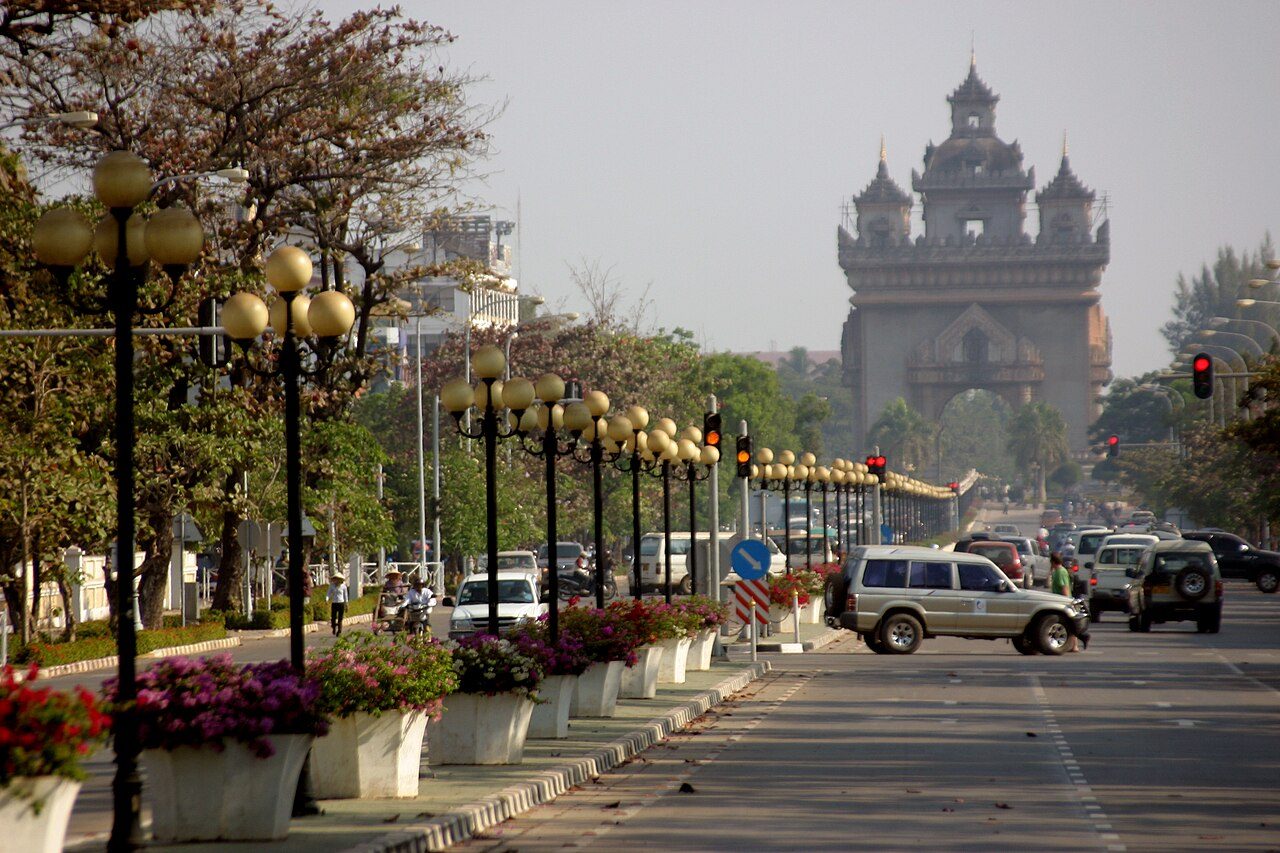
Patuxai
Rising at the terminus of Lane Xang Avenue, Patuxai—the "Victory Gate"—embodies a striking fusion of French monumentalism and indigenous Lao iconography. Designed by self-taught architect Tham Sayasithsena, the monument was erected between 1957 and 1968 to honor soldiers who perished in the struggle for independence from France. In a stroke of Cold War irony, the royal government cast the imposing edifice using American cement earmarked for a new military airfield, earning the structure its historical moniker, the "vertical runway." While evoking Paris’s Arc de Triomphe in silhouette, Patuxai asserts its Buddhist heritage through five ornate, lotus-crested stupas symbolizing peaceful coexistence, accompanied by exterior cornices sculpted with winged *kinnari* nymphs and guardian *naga* serpents. Stepping beneath the monument's four massive arches, travelers encounter cavernous vaulted ceilings painted in vivid turquoise and vermilion, detailed with depictions of Vishnu, Brahma, and Indra. A winding spiral staircase leads through interior concrete chambers—often hosting quiet stalls of handwoven silk scarves—before emerging onto the open-air observation platform. Up on this terrace, panoramic breezes offer relief from the tropical heat, revealing an axial view over Vientiane’s tree-lined avenues: the distant golden spire of Pha That Luang to the northeast, the lazy curve of the Mekong River to the south, and the symmetry of the park’s musical fountains dancing below.
More in Vientiane
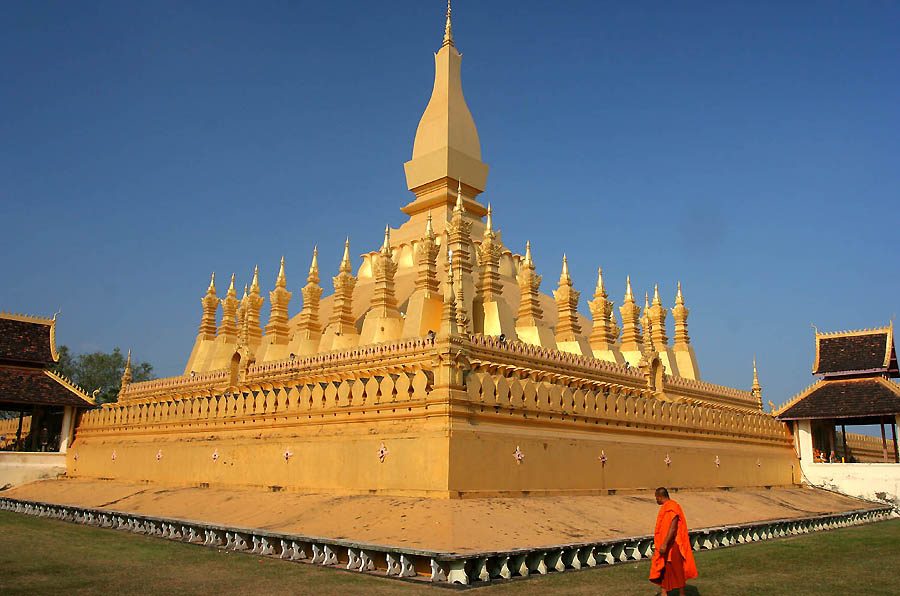
Photo credits (4)
- Gerd Eichmann, CC BY-SA 4.0, via Wikimedia Commons
- Jialiang Gao www.peace-on-earth.org, CC BY-SA 3.0, via Wikimedia Commons
- Mohdirfaniitmandi, CC BY-SA 4.0, via Wikimedia Commons
- User:Mattes, Public domain, via Wikimedia Commons