
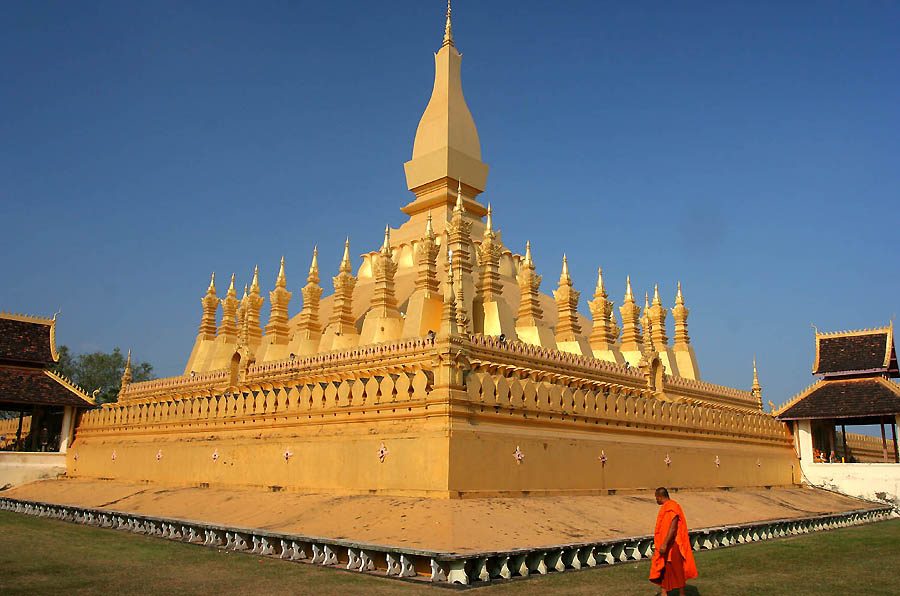
Pha That Luang
Commissioned in 1566 by King Setthathirath when he relocated the Lan Xang kingdom’s capital, Pha That Luang endures as the supreme spiritual symbol of Laos. Built atop an ancient Khmer foundation rumored to enshrine a sacred breastbone of the Buddha sent by Emperor Ashoka, the grand reliquary showcases the zenith of classical Lao architecture. The central spire ascends 45 meters into the sky, modeled as an elongated, curving lotus blossom coated in brilliant gold. Structurally, the monument forms a physical mandala: a 69-meter-wide square platform supports three ascending tiers that symbolize the path from worldly attachment to Buddhist enlightenment, encircled by thirty miniature stupas representing the virtues of the Buddha. Past the bronze effigy of King Setthathirath at the southern entrance, visitors traverse a shaded, square cloister whose vaulted galleries shelter weathered Khmer and Lan Xang sculptures scarred by the Siamese pillages of 1828. The midday glare ignites the stupa’s gilded facets against the tropical sky, casting a deep golden aura over the red-tiled courtyards below. Barefoot steps on sun-warmed stone are accompanied by the sweet tang of frangipani and sandalwood smoke drifting from devotee shrines. Saffron-robed monks from the adjacent wats move quietly among pilgrims bearing braided banana-leaf towers and orange marigolds, providing a reverent, living pulse to this centuries-old sanctuary.
More in Vientiane
Photo credits (4)
- Jialiang Gao www.peace-on-earth.org, CC BY-SA 3.0, via Wikimedia Commons
- Gerd Eichmann, CC BY-SA 4.0, via Wikimedia Commons
- Mohdirfaniitmandi, CC BY-SA 4.0, via Wikimedia Commons
- User:Mattes, Public domain, via Wikimedia Commons