
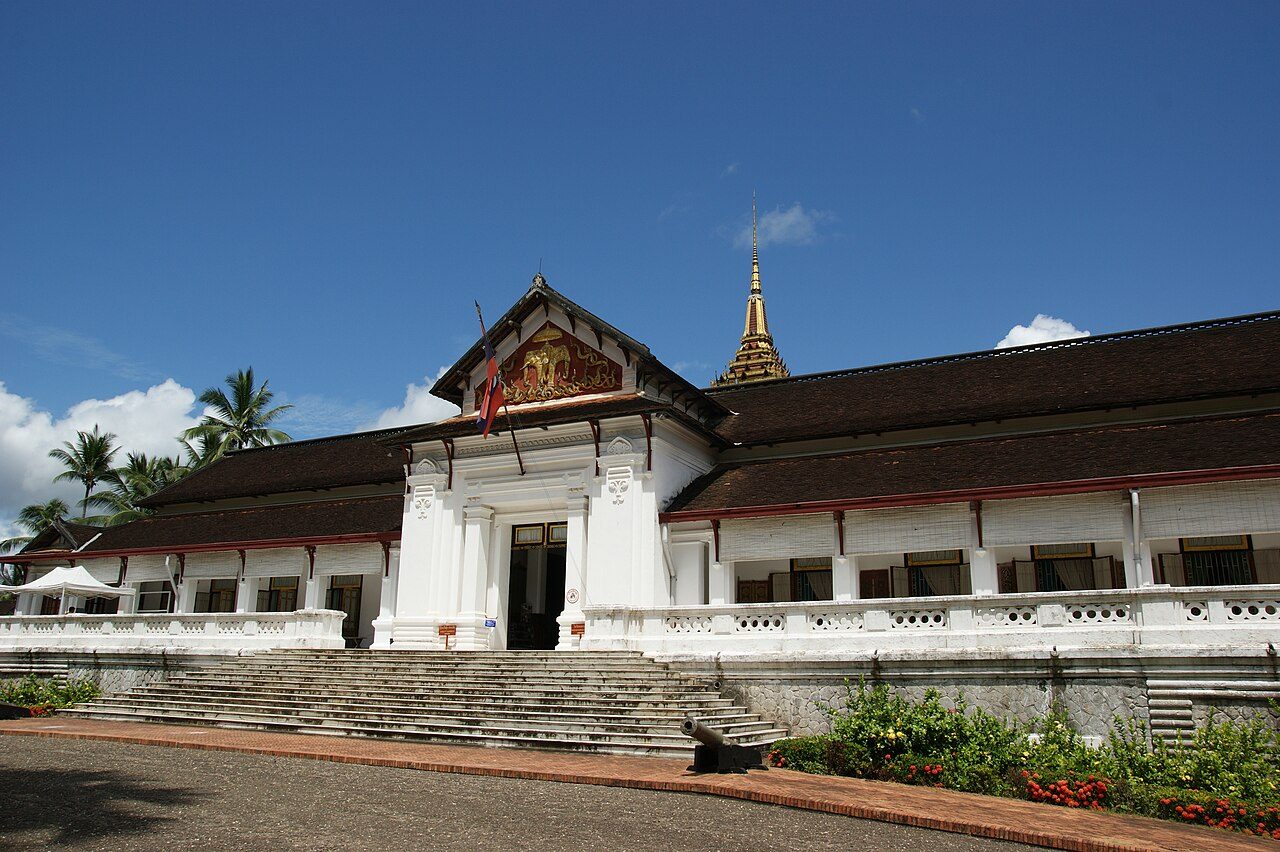
Royal Palace, Luang Prabang
Erected between 1904 and 1909 during the French colonial protectorate, Haw Kham—the "Golden Hall"—served as the official residence for King Sisavang Vong. The compound masterfully fuses classical French Beaux-Arts symmetry with traditional Lan Xang aesthetics, pairing European brickwork and sweeping Italian marble stairs with dramatic, multi-tiered roofs crowned by a gilded spire. The interior remains virtually untouched since 1975, when the monarchy was deposed by the Pathet Lao, preserving the royal family’s private bedchambers, state gifts, and diplomatic reception halls as a stark, preserved tableau of Laos’s final royal chapter. Stepping into the palace, the rich scent of polished native teakwood fills the air before giving way to the striking luminescence of the central Throne Room. Its walls, painted in deep crimson lacquer, are encrusted with thousands of Japanese cut-glass mosaics that sparkle in the dim light, portraying scenes of regional folklore, Buddhist lore, and traditional village life. Outside across the quiet, palm-shaded courtyard stands the ornate Wat Ho Pha Bang, an explosion of gold leaf and intricate green dragon pediments that shelters the sacred Phra Bang—an 83-centimeter-tall, gold-alloy Buddha cast in the fourteenth century that remains the spiritual talisman of the former royal capital.
More in Luang Prabang
Photo credits (5)
- Allie Caulfield, CC BY 2.0, via Wikimedia Commons
- Phillip Maiwald ( Nikopol ), CC BY-SA 3.0, via Wikimedia Commons
- Basile Morin, CC BY-SA 4.0, via Wikimedia Commons
- Walter.jenner, CC BY-SA 3.0, via Wikimedia Commons
- Christophe95, CC BY-SA 4.0, via Wikimedia Commons