
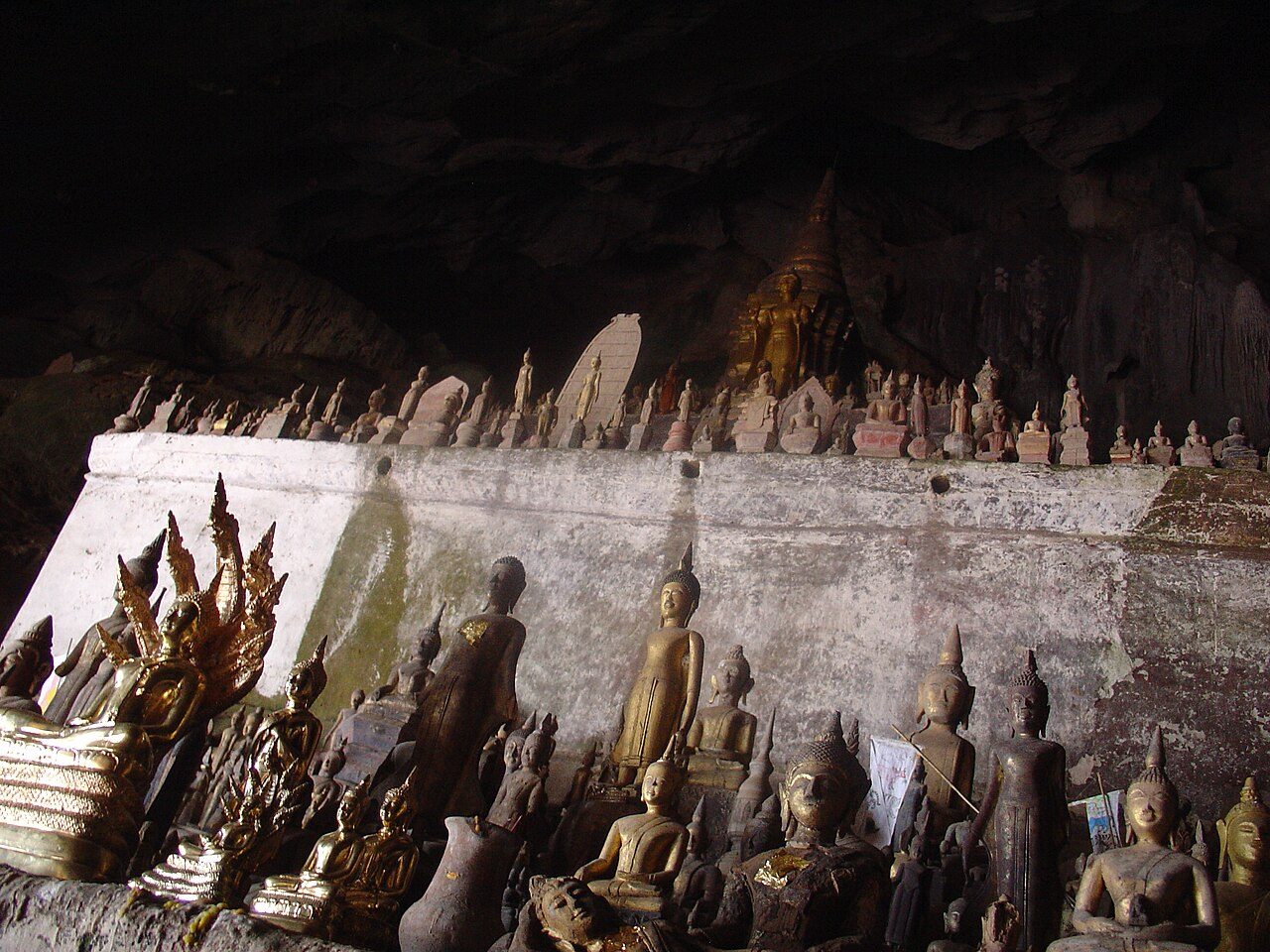
Pak Ou Caves
Perched high within a sheer limestone karst at the sacred confluence of the Mekong and Nam Ou rivers, the Pak Ou Caves served as an animist sanctuary for river spirits long before Theravada Buddhism swept the Lan Xang Kingdom in the 16th century. Royal patronage transformed these cavernous fissures into state shrines when King Setthathirath and subsequent Luang Prabang monarchs initiated annual Lao New Year (Pi Mai) pilgrimages, ritually perfuming and washing the accumulated icons. The complex comprises two distinct geological chambers: Tham Ting, a shallow, daylight-flooded lower grotto carved directly into the cliff face, and Tham Theung, an ink-black cavern set higher up the cliffside, accessed via a steep climb of whitewashed stone steps. Stepping off a wooden longtail boat onto the river landing, visitors enter a surreal sanctuary crowded with over 4,000 Buddha sculptures, spanning centuries of devotional offerings. These figures—carved from lacquered wood, horn, and composite resin, many encrusted with flaking gold leaf—cluster across every shelf, crag, and tiered altar. In Tham Ting, natural light glints off effigies cast predominantly in the distinctively Lao "Calling for Rain" mudra, their hands pointing rigidly toward the earth. Above, Tham Theung envelops travelers in subterranean chill, heavy with the scent of damp stone and smoldering joss sticks, where a handheld torch reveals silent phalanxes of weathered deities guarding the jagged limestone shadows.
More in Luang Prabang
Photo credits (5)
- Walter.jenner, CC BY-SA 3.0, via Wikimedia Commons
- Phillip Maiwald ( Nikopol ), CC BY-SA 3.0, via Wikimedia Commons
- Basile Morin, CC BY-SA 4.0, via Wikimedia Commons
- Christophe95, CC BY-SA 4.0, via Wikimedia Commons
- Allie Caulfield, CC BY 2.0, via Wikimedia Commons