
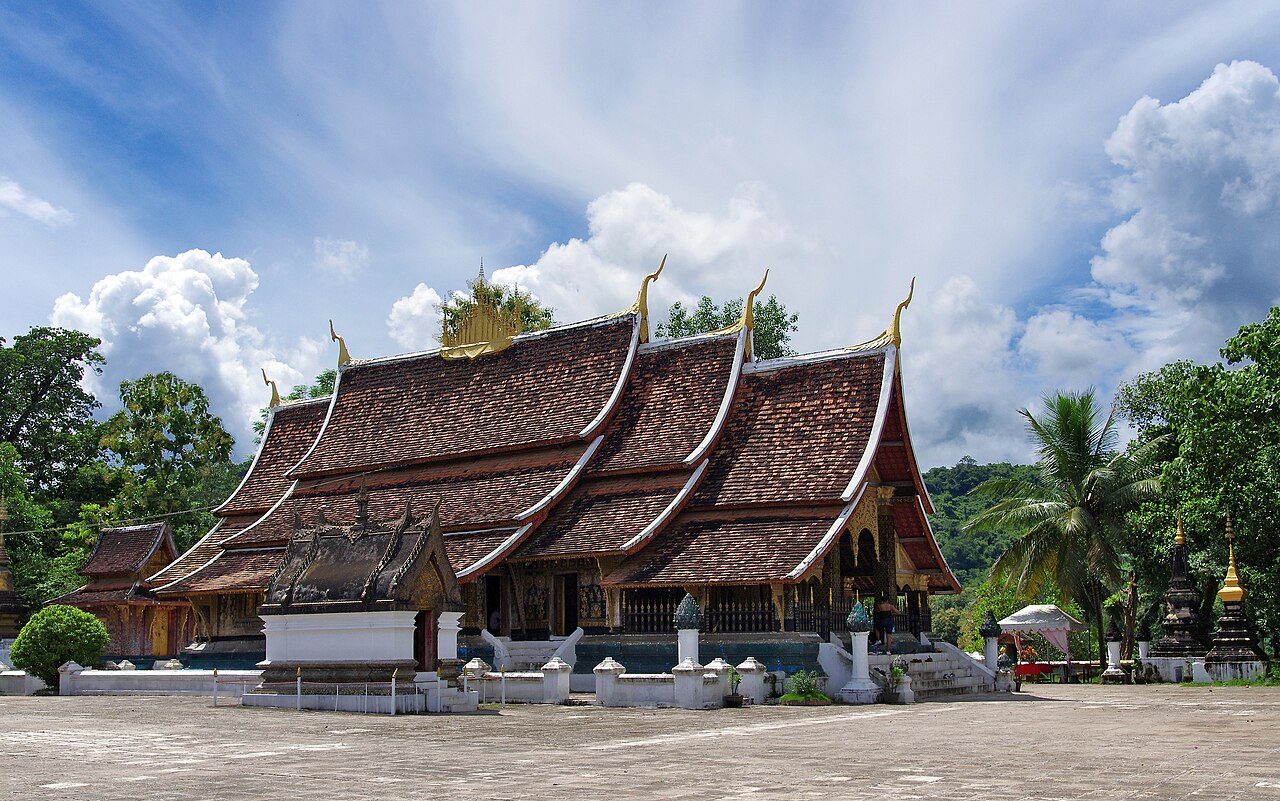
Wat Xieng Thong
Commissioned in 1560 by King Setthathirath on the eve of shifting the Lan Xang capital to Vientiane, Wat Xieng Thong stands near the confluence of the Mekong and Nam Khan rivers as the zenith of classic Luang Prabang temple architecture. Its central *sim* (ordination hall) embodies this regional aesthetic with sweeping, three-tiered roofs that curve dramatically downward toward the flagstones like the wings of a descending bird. On the rear exterior gable, a magnificent mosaic of the "Tree of Life," pieced together from shards of brilliant colored glass against a deep vermilion backdrop, glints in the equatorial sun, framed by gilded teak reliefs illustrating scenes from the Buddhist underworld and the epic *Phra Lak Phra Lam*. Stepping across the sun-dappled courtyards beneath flowering frangipani trees, travelers encounter a complex of jewel-box shrines and pavilions, including the diminutive Red Chapel, home to a rare 16th-century reclining bronze Buddha. Inside the soaring Funerary Chariot Hall, visitors stand in the shadow of a colossal, 12-meter-high gilded teak hearse adorned with fierce seven-headed serpent *nagas*, crafted for the 1960 rites of King Sisavang Vong. The gentle murmur of chanting monks mingles with the lingering scent of smoldering beeswax candles, immersing visitors in a living sacred sanctum that remarkably survived the 1887 Black Flag Army raids unscathed.
More in Luang Prabang
Photo credits (5)
- Phillip Maiwald ( Nikopol ), CC BY-SA 3.0, via Wikimedia Commons
- Basile Morin, CC BY-SA 4.0, via Wikimedia Commons
- Walter.jenner, CC BY-SA 3.0, via Wikimedia Commons
- Christophe95, CC BY-SA 4.0, via Wikimedia Commons
- Allie Caulfield, CC BY 2.0, via Wikimedia Commons