
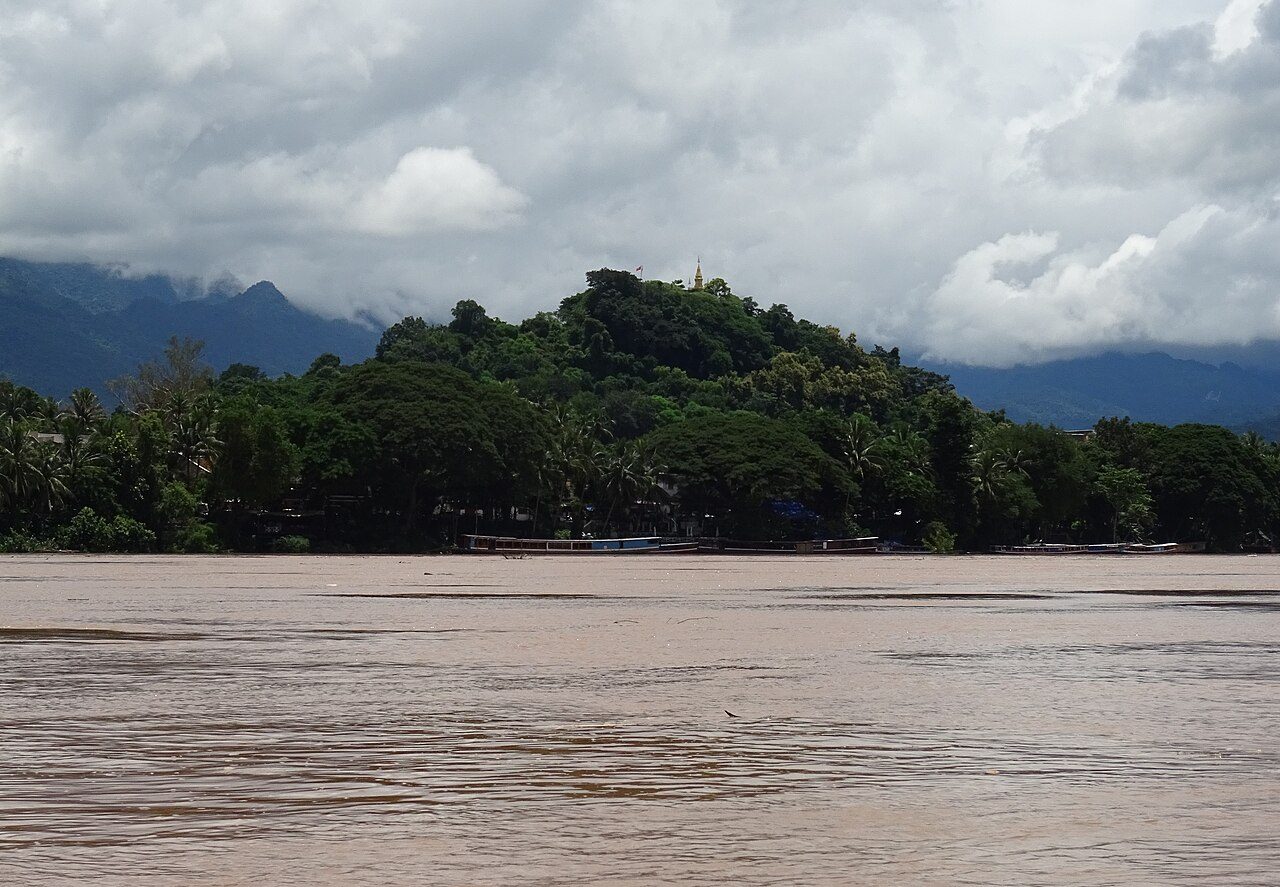
Mount Phousi
Rising 100 meters above the UNESCO-protected peninsula, the sacred limestone hill of Mount Phousi—steeped in lore as a mountain shifted by the monkey god Hanuman—serves as the spiritual navel of Laos’s former royal capital. Reaching the crest requires ascending 328 winding brick steps shaded by fragrant white *dok champa* (frangipani) blossoms and flanked by whitewashed balustrades modeled after undulating Naga serpents. Midway along the slope, Wat Tham Phousi reveals a secluded rock grotto sheltering a sacred Buddha footprint and gilded statuary depicting the days of the week. At the summit platform stands That Chomsi, a gleaming 20-meter golden stupa commissioned in 1804 by King Anourouth, its burnished, needle-thin spire puncturing the tropical skyline. At the top, the air carries the scent of smoldering joss sticks and marigold garlands left by pilgrims purchasing caged sparrows to release for Theravada Buddhist merit. Standing upon the sun-warmed flagstones, travelers take in an uninterrupted 360-degree panorama: below, the terracotta roofs of French-Indochinese shophouses puncture a dense canopy of palms, pinned tightly between the slow, silt-heavy coils of the Mekong and the turquoise waters of the Nam Khan River. As dusk approaches, the jagged limestone karsts on the horizon fade to charcoal silhouettes, and the dying sunlight casts an intense bronze sheen across the river confluence and the stupa's brilliant gold leaf.
More in Luang Prabang
Photo credits (5)
- Christophe95, CC BY-SA 4.0, via Wikimedia Commons
- Phillip Maiwald ( Nikopol ), CC BY-SA 3.0, via Wikimedia Commons
- Basile Morin, CC BY-SA 4.0, via Wikimedia Commons
- Walter.jenner, CC BY-SA 3.0, via Wikimedia Commons
- Allie Caulfield, CC BY 2.0, via Wikimedia Commons