
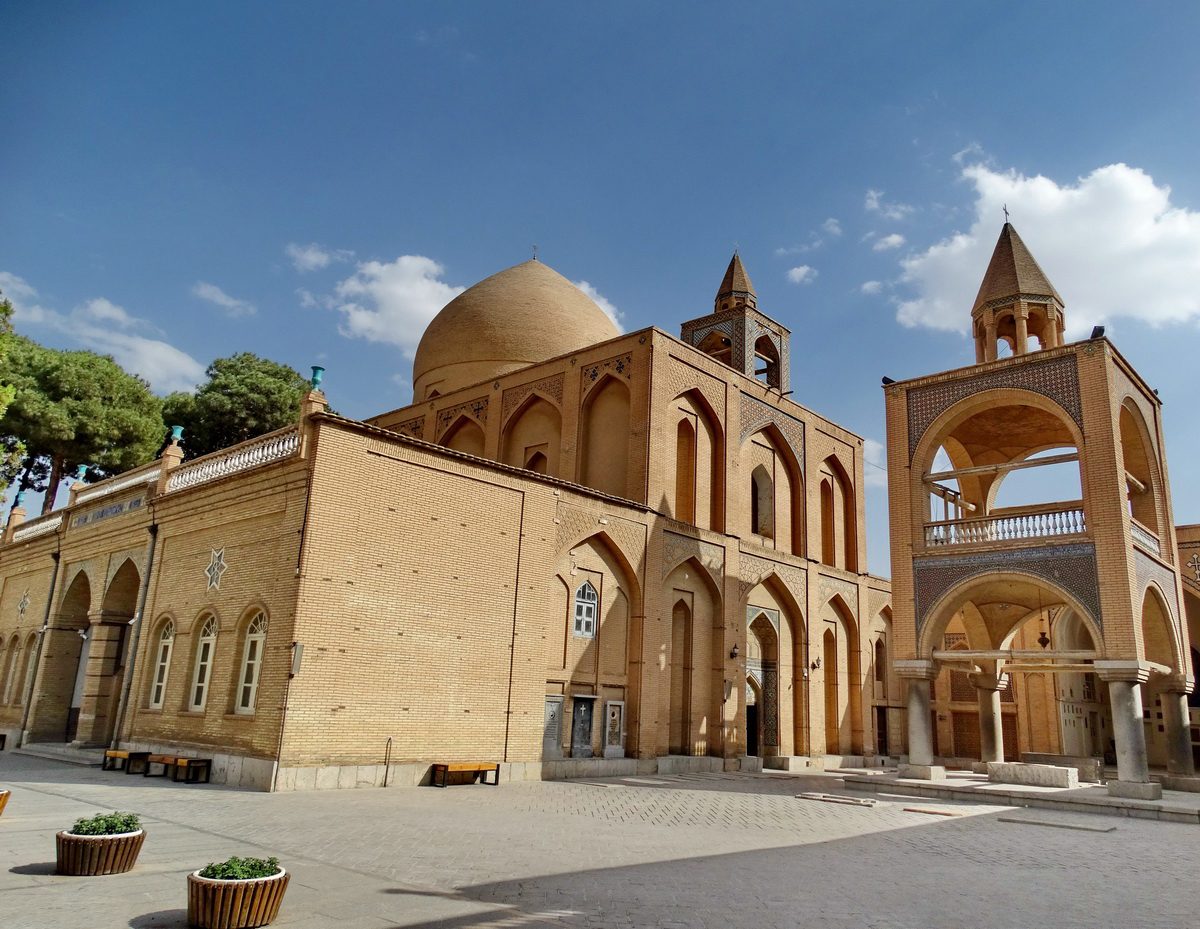
Vank Cathedral
Tucked within Isfahan’s historic Armenian quarter of New Julfa, Vank Cathedral arose between 1655 and 1664 following Shah Abbas I’s mass resettlement of Christian artisans from the Caucasian frontier. From the quiet stone courtyard, the exterior presents a striking architectural paradox. Its modest buff-brick masonry, round-arched windows, and bare central dome mimic the silhouette of a traditional Safavid mosque rather than a classical cross-in-square Caucasian basilica—a deliberate structural compromise designed to integrate the displaced community into the Persian imperial landscape. A freestanding 18th-century belfry and weathered memorial *khachkars* (intricately carved cross-stones) anchor the grounds, hinting at the sacred sanctuary within. Crossing the heavy timber threshold shatters the austere facade, plunging visitors into an overwhelming riot of gold leaf, cobalt, and lapis lazuli. The soaring nave is ringed at its base by yellow-and-azure ceramic tiles bearing Persian floral motifs, while every remaining inch of wall and vault is swathed in dramatic tempera murals executed by Armenian masters influenced by Flemish and Italian engravings. Standing beneath the radiant, gilded dome, travelers trace the narrative of Genesis, only to be drawn downward into the terrifying, visceral tableaus of the Last Judgment along the northern wall. Here, amidst the scent of aged plaster, vivid scenes of horned demons, gaping Leviathans, and the gruesome martyrdom of Saint Gregory the Illuminator gaze back in breathtaking, theatrical detail.
More in Isfahan
Photo credits (4)
- Rasool abbasi17, CC BY-SA 4.0, via Wikimedia Commons
- شهاب الدین علیشاهی, CC BY-SA 4.0, via Wikimedia Commons
- درفش کاویانی, CC BY-SA 3.0, via Wikimedia Commons
- Zahradibaji, CC BY-SA 4.0, via Wikimedia Commons