
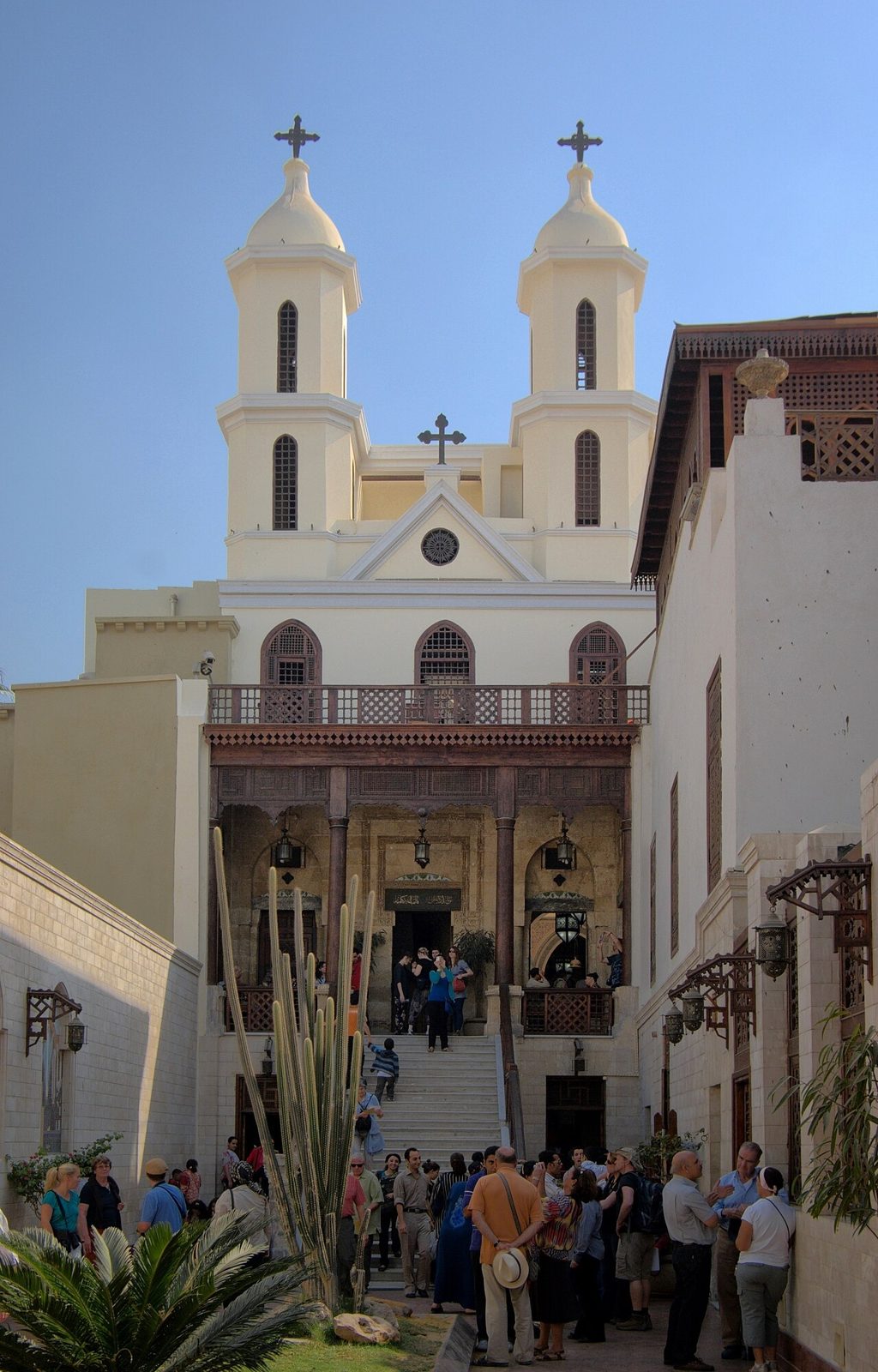
Hanging Church
Perched atop the southern gatehouse of the Roman-era Babylon Fortress, the Church of Saint Virgin Mary earned its Arabic moniker, *al-Mu‘allaqah* ("The Suspended"), because its nave spans precariously over a sunken passage. While its foundations date to the 3rd or 4th century, the basilican structure seen today reflects late 7th-century reconstructions and subsequent 11th-century embellishments, when Pope Christodolos shifted the seat of the Coptic papacy here from Alexandria. Passing through a mosaic-lined courtyard and climbing twenty-nine stone steps, visitors enter a sanctuary framed by an extraordinary timber roof, fashioned in the shape of an inverted ship to invoke Noah’s Ark. Inside, cool, dim air carries the fragrant weight of frankincense and beeswax. Thirteen marble pillars divide the central nave, representing Christ and the disciples—including a lone, unpolished column of dark basalt symbolizing Judas. Masterful 10th-century screens of ebony and cedar, intricately inlaid with ivory crosses and stars, partition the three eastern chapels and frame dozens of antique icons, including an 8th-century portrait of Mary revered as the "Coptic Mona Lisa." Standing near the raised marble ambon, travelers can peer through cutouts in the floorboards to glimpse the staggering Roman masonry resting far below, capturing an enduring intersection of imperial ruin and living Christian devotion.
More in Cairo

Photo credits (3)
- Berthold Werner, CC BY-SA 3.0, via Wikimedia Commons
- MusikAnimal, CC BY-SA 3.0, via Wikimedia Commons
- Mohamed abdelzaher, CC BY-SA 4.0, via Wikimedia Commons