
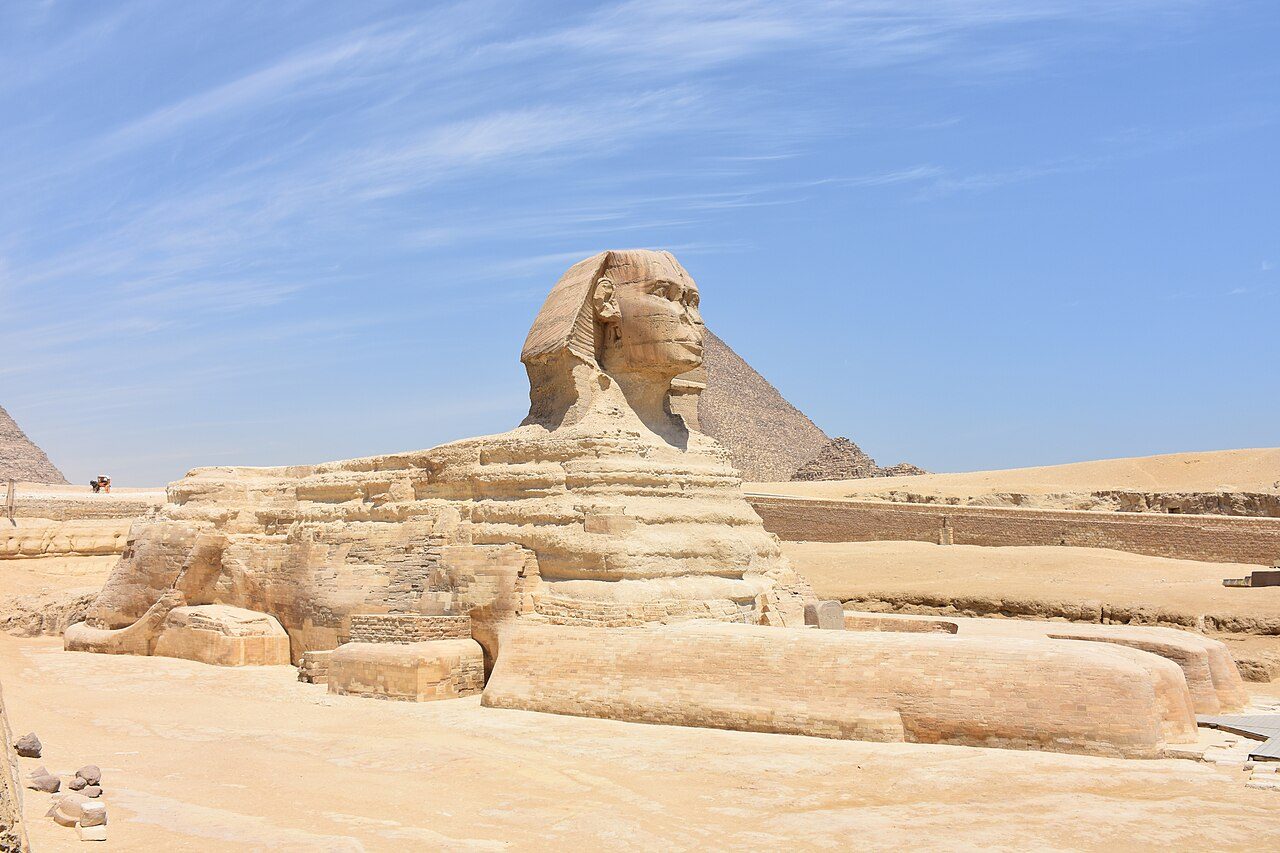
Great Sphinx of Giza
Carved directly from a monolithic ridge of Eocene limestone around 2500 BCE, this colossal sentinel has guarded the Giza Plateau since the Fourth Dynasty reign of Pharaoh Khafre. Measuring 73 meters long and 20 meters high, the monument unites a couched lion’s powerful frame with a royal portrait thought to depict Khafre himself, crowned by the pleated folds of an imperial *nemes* headdress. Deep horizontal strata ripple across its weathered flank—sculpted over millennia by ancient marine deposits, windborne grit, and prolonged burial beneath desert sands—while faint flecks of original red ochre pigment still cling to the battered cheeks. Nestled between its massive limestone forepaws sits the Dream Stele, a towering pink granite slab inscribed by Thutmose IV in 1401 BCE to honor a divine promise of kingship. Approaching via the elevated stone causeway beside the granite-pillared Valley Temple, visitors descend toward the sunken bedrock enclosure where the monument's sheer scale becomes dizzying. The desert heat carries a fine dust that catches the light against the soaring silhouette of Khafre’s pyramid, aligned directly behind the sculpture. In the amber wash of late afternoon, deep shadows dramatize the fractured contours of its missing nose and uraeus cobra, while the figure’s steady, enigmatic gaze remains fixed perpetually on the eastern horizon, anchored in five thousand years of quiet defiance.
More in Cairo


Photo credits (3)
- MusikAnimal, CC BY-SA 3.0, via Wikimedia Commons
- Mohamed abdelzaher, CC BY-SA 4.0, via Wikimedia Commons
- Olaf Tausch, CC BY 3.0, via Wikimedia Commons