
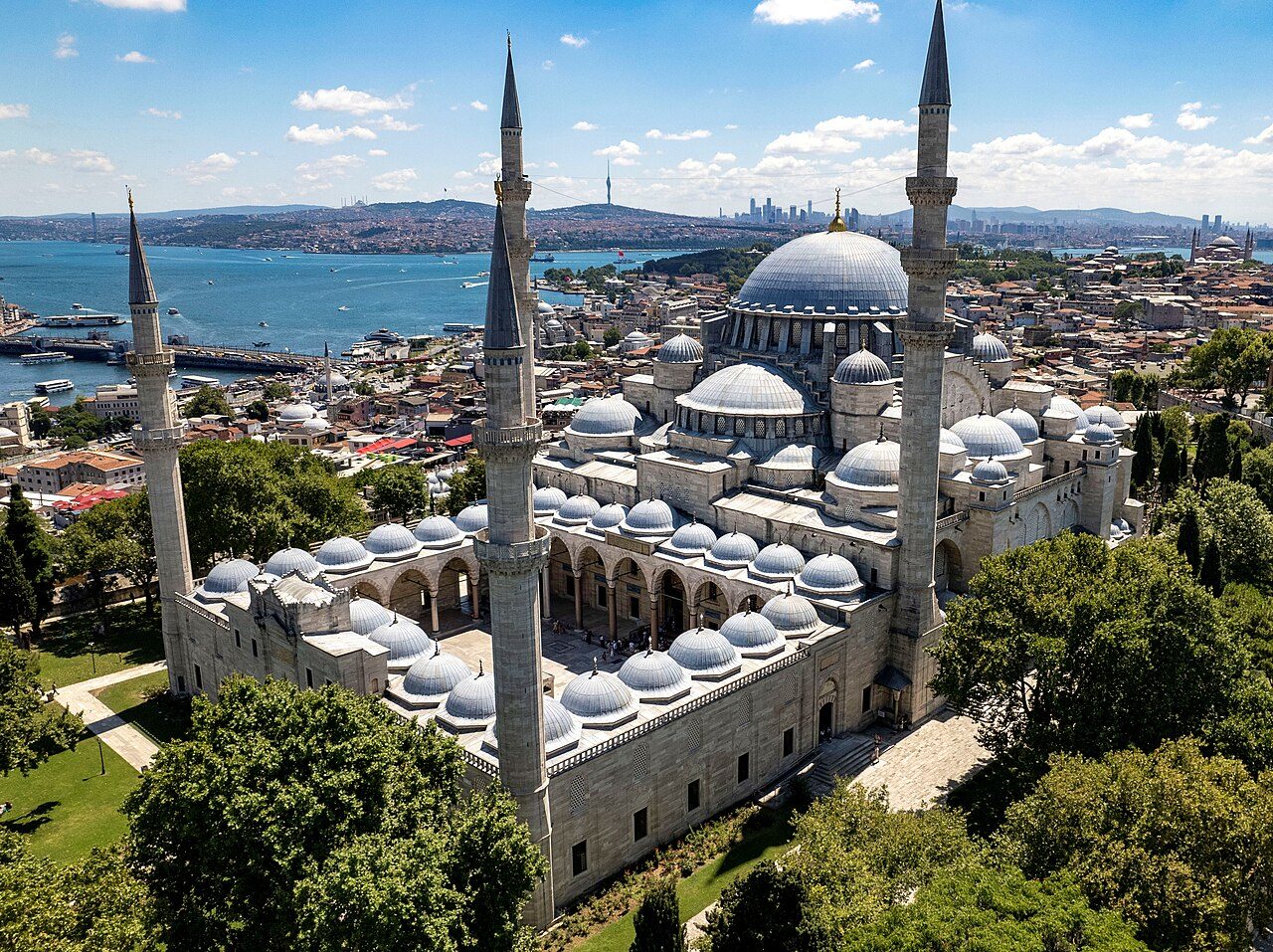
Suleymaniye Mosque
Commissioned in 1550 by Sultan Süleyman the Magnificent and executed by imperial architect Mimar Sinan, this monumental complex crowns Istanbul’s Third Hill as the definitive achievement of Classical Ottoman architecture. Completed in 1557, the site was conceived not as an isolated sanctuary, but as an expansive *külliye* (social complex) incorporating madrasas, a bathhouse, and a public soup kitchen. Sinan masterfully anchored the skyline with four slender minarets bearing ten balconies—symbolizing Süleyman as the tenth Ottoman sultan. Inside, a staggering 53-meter-high central dome rests weightlessly upon four monolithic porphyry columns salvaged from antique ruins in Baalbek, Alexandria, and Byzantine Constantinople, stabilized by ingenious subterranean water cisterns and hidden clay acoustic jars. Crossing the white marble-and-porphyry forecourt into the prayer hall, visitors are enveloped by an intentional, airy serenity far removed from the city's frantic trade. Sunlight pours through 128 stained-glass apertures crafted by the master glazier Sarhoş İbrahim, illuminating deep-crimson carpets, soaring ivory-toned arches, and understated Iznik tiles fired in early cobalt and turquoise hues. The air smells subtly of aged stone and wool beneath low-hanging ring chandeliers once fitted with ostrich eggs to deter spiderwebs. In the rear cemetery garden, quiet paths lead past the ornate, octagonal mausoleums of Süleyman and his consort Hürrem Sultan, terminating at a breezy outer terrace that reveals an unmatched panoramic vista stretching across the Golden Horn, Galata, and the Bosphorus strait.
More in Istanbul
Photo credits (5)
- Hunanuk, CC0, via Wikimedia Commons
- Moonik, CC BY-SA 3.0, via Wikimedia Commons
- Diego Delso, CC BY-SA 4.0, via Wikimedia Commons
- Diego Delso, CC BY-SA 4.0, via Wikimedia Commons
- Robot8A, CC BY-SA 4.0, via Wikimedia Commons