
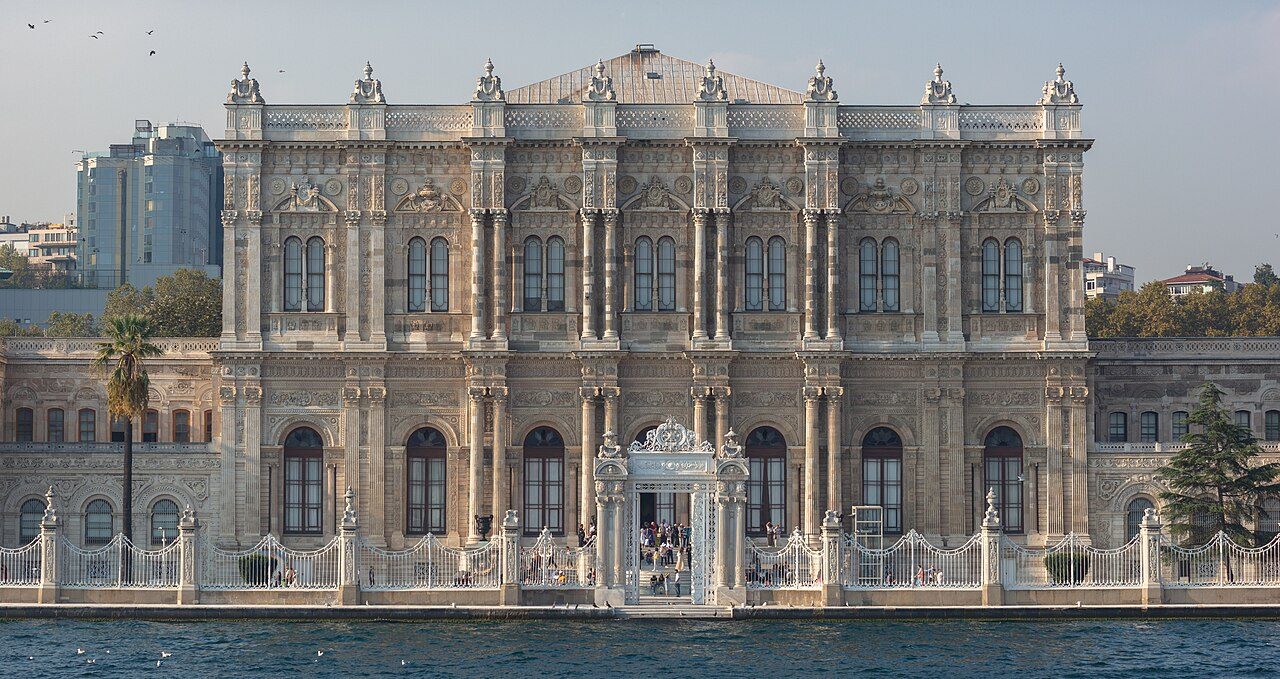
Dolmabahce Palace
Commissioned by Sultan Abdülmecid I between 1843 and 1856 to replace the medieval confines of Topkapı, Dolmabahçe Palace boldly signaled the Ottoman Empire’s pivot toward Western Europe. Stretching along the European embankment of the Bosphorus, its 600-meter white marble facade fuses French Baroque, German Rococo, and Neoclassical grandeur with traditional Ottoman palatial design. Behind monumental, lace-carved wrought-iron gates, visitors step into manicured seaside gardens framed by sculpted swans, monumental clock towers, and sweeping views of maritime traffic. The interior is a masterclass in opulence, containing 285 rooms, 46 reception halls, and six alabaster-lined imperial hamams, with fourteen tons of gold leaf gilding the ornate ceilings above. Inside, visitors climb the double-horseshoe Crystal Staircase, its Baccarat balusters refracting amber light beneath brass chandeliers, before entering the cavernous Muayede Salonu (Ceremonial Hall). Here, eyes are drawn up to the 36-meter dome, beneath which hangs Queen Victoria’s gift to the sultan: a four-and-a-half-ton Bohemian crystal chandelier boasting 750 lamps. The grandeur yields to profound solemnity in the private quarters of the Harem, where modern Türkiye’s founder, Mustafa Kemal Atatürk, spent his final days. Standing before his modest bed, visitors encounter a poignant pause in the nation’s narrative, marked by a bedside clock whose hands remain permanently frozen at 9:05 a.m.—the exact moment of his death on November 10, 1938.
More in Istanbul
Photo credits (5)
- Diego Delso, CC BY-SA 4.0, via Wikimedia Commons
- Moonik, CC BY-SA 3.0, via Wikimedia Commons
- Diego Delso, CC BY-SA 4.0, via Wikimedia Commons
- Hunanuk, CC0, via Wikimedia Commons
- Robot8A, CC BY-SA 4.0, via Wikimedia Commons