
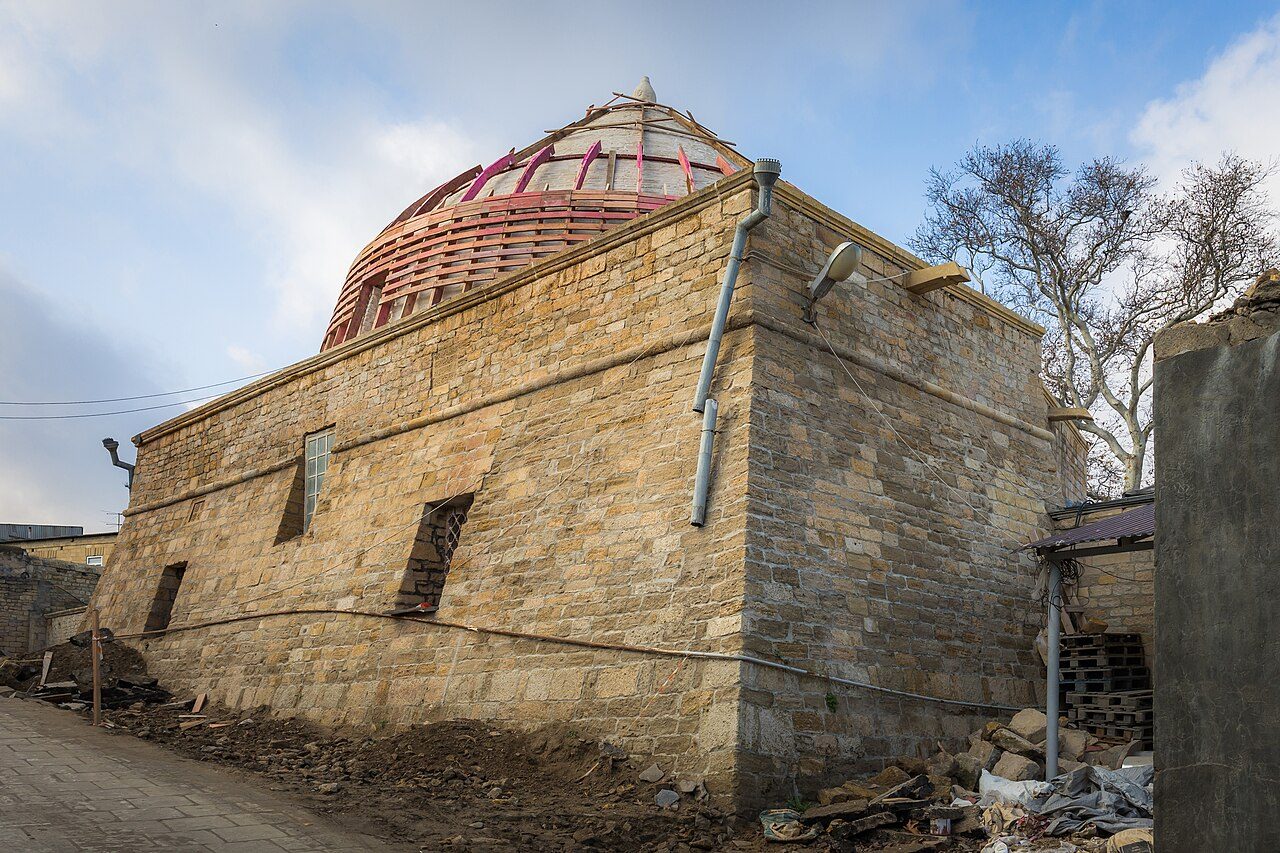
Juma Mosque of Derbent
Founded between 733 and 734 CE under the Umayyad commander Maslama ibn Abd al-Malik, the Juma Mosque of Derbent endures as the oldest Islamic sanctuary in Russia and the wider Caucasus. Rebuilt in the late fourteenth century by the master builder Taj al-Din following a catastrophic earthquake, the complex reflects an early Syrian-influenced basilica layout rather than the soaring minarets of later Ottoman or Persian traditions. Heavy pillars support three long, parallel naves capped by an octagonal dome, all chiseled from weathered Caspian limestone that glows with a pale amber hue in the sub-Caucasian sun. Passing beneath the pointed archway of the southern gate, visitors enter an enclosed courtyard dominated by four colossal, centuries-old plane trees, whose sprawling canopies cast mottled green shade over the stone flags. Flanked by the quiet, arched cells of an adjoining fifteenth-century madrasa, the courtyard offers an immediate respite from the dense stone alleyways of Derbent’s old town. Inside the prayer hall, the atmosphere shifts to cool, cavernous stillness; sunlight angles through high clerestory windows, catching the textured whitewash of the stone arcades and illuminating rows of soft carpets that stretch into shadowed corners, evoking thirteen centuries of continuous devotion.
More in Derbent
Photo credits (6)
- Alexander Novikov, CC BY-SA 4.0, via Wikimedia Commons
- Alexander Novikov, CC BY-SA 4.0, via Wikimedia Commons
- Vyacheslav Bukharov, CC BY-SA 4.0, via Wikimedia Commons
- Fred Schaerli, CC BY-SA 3.0, via Wikimedia Commons
- Martemmedia, CC BY-SA 4.0, via Wikimedia Commons
- Anzor Agamirzoyev, CC BY-SA 4.0, via Wikimedia Commons