
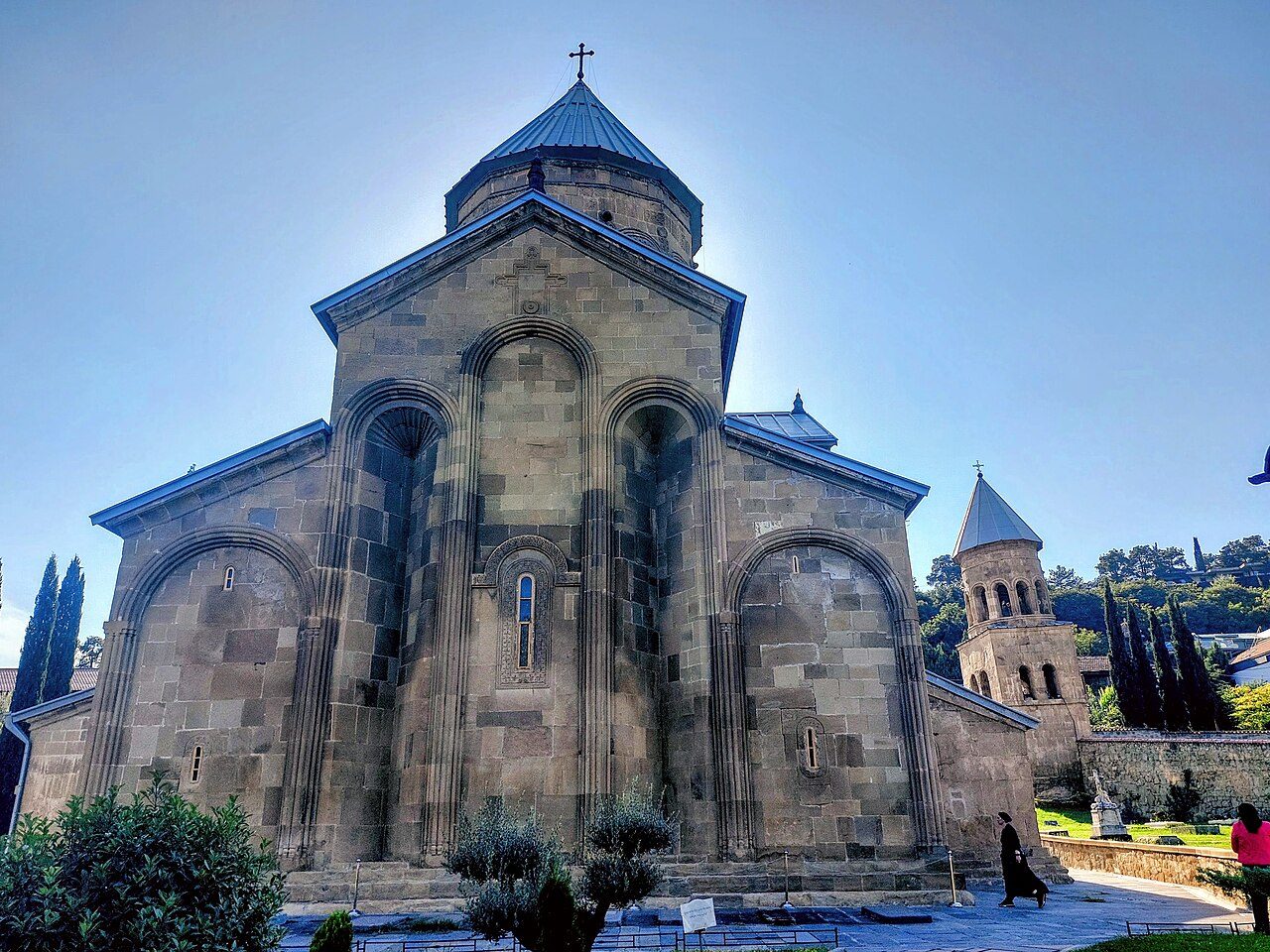
Samtavro Monastery
Rooted in the 4th century when King Mirian III and Queen Nana embraced Christianity through Saint Nino, Samtavro Monastery anchors Mtskheta’s sacred core. The complex’s centerpiece, the Transfiguration Cathedral, was reconstructed in the 1030s under King George I. Built in the classic medieval Georgian cross-in-square design, the church features weathered, honey-hued sandstone facades adorned with deep-cut relief carvings and blind arcades, all crowned by a high-drummed conical dome. Just steps away in the garden stands the miniature Church of St. Nino, a tiny barrel-vaulted stone chapel marking the site of the sacred blackberry bush (*makhvlovani*) where the evangelizer famously prayed and healed the queen. Stepping into this working nunnery brings an immediate sensory shift into quiet reverence, scented with burning beeswax and frankincense. Beneath the cathedral’s vaulted ceiling, narrow windows cast shafts of daylight across surviving fragments of 17th-century frescoes and the carved stone sarcophagi containing the remains of King Mirian and Queen Nana. A steady stream of pilgrims gathers reverently near the shrine of Saint Gabriel Urgebadze, a beloved 20th-century monastic confessor, whispering prayers and pressing forehead to stone amid the warm glow of hanging oil lamps and the soft rustle of black-robed nuns moving across the flagstones.
More in Mtskheta
Photo credits (4)
- Kober, CC0, via Wikimedia Commons
- xiquinhosilva, CC BY 4.0, via Wikimedia Commons
- Alexey Komarov, CC BY-SA 4.0, via Wikimedia Commons
- Adam Harvey, CC BY 2.0, via Wikimedia Commons