
 New added
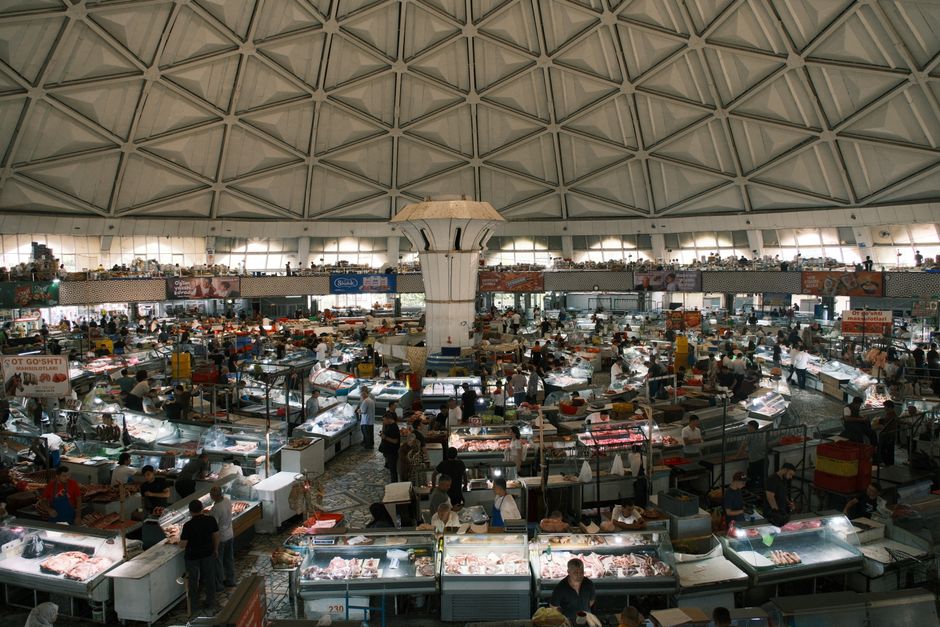
Chorsu Bazaar
At the historic crossroads of the Silk Road where desert caravans once converged, Chorsu Bazaar embodies Tashkent’s architectural reinvention. Rebuilt following the catastrophic 1966 earthquake and completed in 1980 by architects Vladimir Azimov and Sabir Adylov, the market's central pavilion stands as a monumental fusion of Soviet modernist brutalism and traditional Islamic design. Crowning the complex is a colossal, ribbed concrete dome—spanning over sixty meters across—clad in geometric turquoise and cerulean majolica tiles. Beneath this soaring cupola, an open-plan, three-tiered concentric rotunda funnels Central Asian sunlight and cooling drafts directly onto the bustling trade floors below. Stepping inside thrusts travelers into an intoxicating sensory storm of regional commerce. The upper mezzanine rings with the banter of merchants peddling towering pyramids of golden dried apricots, mountain walnuts, translucent amber shards of *navat* (rock sugar), and chalky spheres of dried *qurut* cheese. Descending the curving walkways to the lower level reveals marble slabs piled with cuts of beef and fragrant coils of *kazi* (spiced horsemeat sausage). Beyond the concrete perimeter, narrow alleys lead through billowing clouds of charcoal smoke, where bakers slap rounds of sesame-studded *non* flatbread into glowing clay *tandir* ovens alongside vendors turning skewers of cumin-crusted mutton *shashlik* over open embers.
More in Tashkent
Photo credits (5)
- Visola Tangirova, CC0, via Wikimedia Commons
- Amirhon Atahanov, CC BY-SA 4.0, via Wikimedia Commons
- Bobyrr, CC BY-SA 4.0, via Wikimedia Commons
- Mrshaxas, CC BY-SA 4.0, via Wikimedia Commons
- LBM1948, CC BY-SA 4.0, via Wikimedia Commons