
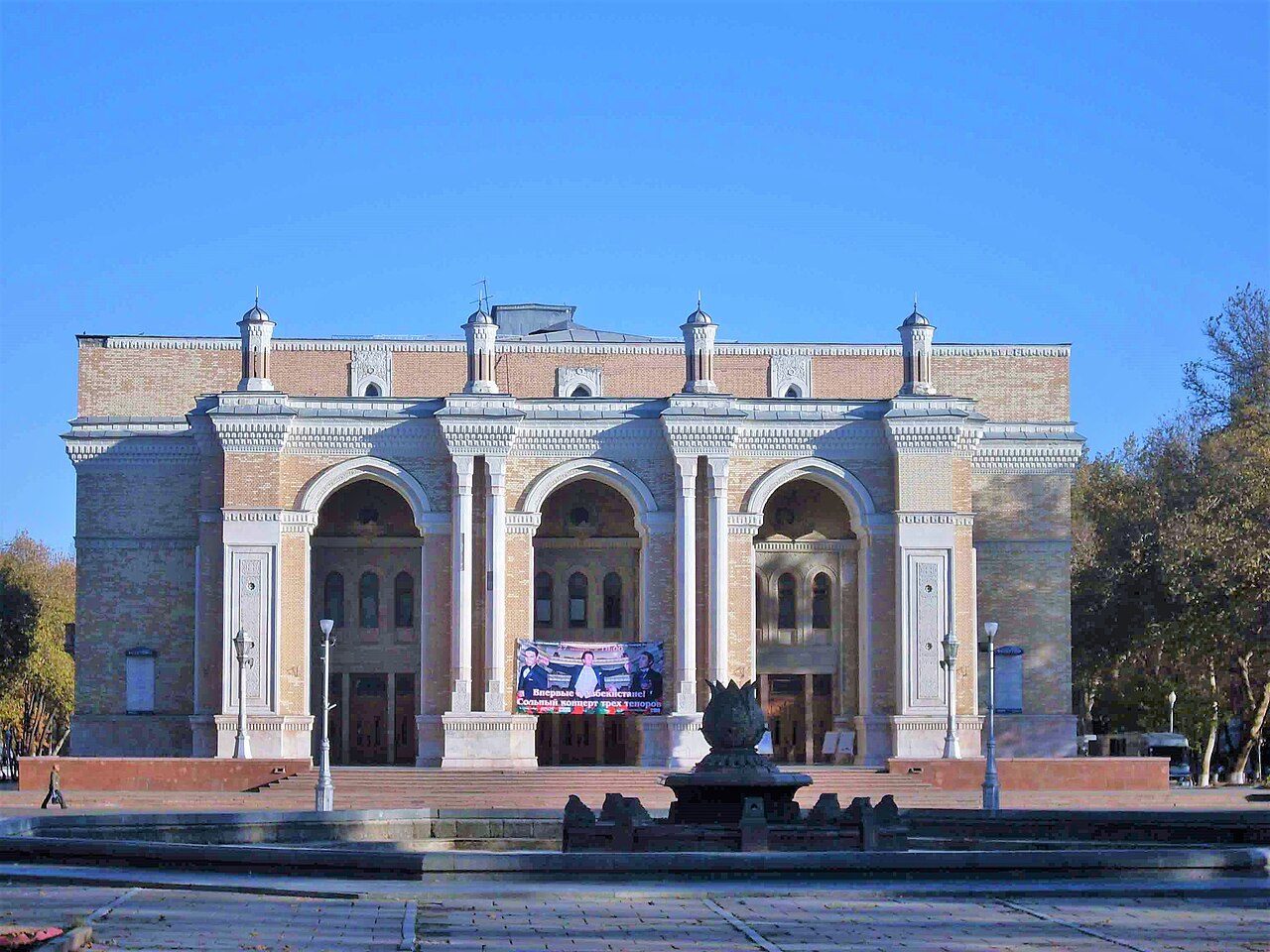
Navoi Theatre
Commissioned in the late 1930s and completed in 1947 under the direction of Alexey Shchusev—the architect behind Lenin’s Mausoleum—the Alisher Navoi Opera and Ballet Theatre stands as an imposing synthesis of Stalinist classicism and traditional Uzbek architectural motifs. Built in part by Japanese prisoners of war following World War II, the edifice achieved legendary status when it emerged entirely unscathed from the catastrophic 1966 earthquake that flattened surrounding Tashkent. Approaching the square, travelers encounter a monumental triple-arched portico rendered in pale brick and carved stone, fronted by a stepped granite fountain sculpted in the profile of a blooming cotton boll that dances with colored lights after dusk. Beyond the bronze entryway, the interior unfolds into six lavishly appointed side foyers, each curated by folk masters to represent the artistic traditions of Uzbekistan's historic regions: Tashkent, Samarkand, Bukhara, Khiva, Termez, and Fergana. Walking between these pavilions, visitors can run their fingers near intricate *ganch*—deeply undercut, lace-like gypsum carvings—and admire delicate *muqarnas* vaulting and regional floral murals. Inside the circular 1,400-seat auditorium, crimson velvet upholstery and tiered gilded balconies rise toward a massive, radiant crystal chandelier, immersing audiences in superb acoustics that host everything from Tchaikovsky’s ballets to historic Uzbek folk operas.
More in Tashkent
Photo credits (5)
- Bobyrr, CC BY-SA 4.0, via Wikimedia Commons
- Visola Tangirova, CC0, via Wikimedia Commons
- Amirhon Atahanov, CC BY-SA 4.0, via Wikimedia Commons
- Mrshaxas, CC BY-SA 4.0, via Wikimedia Commons
- LBM1948, CC BY-SA 4.0, via Wikimedia Commons