
 New added
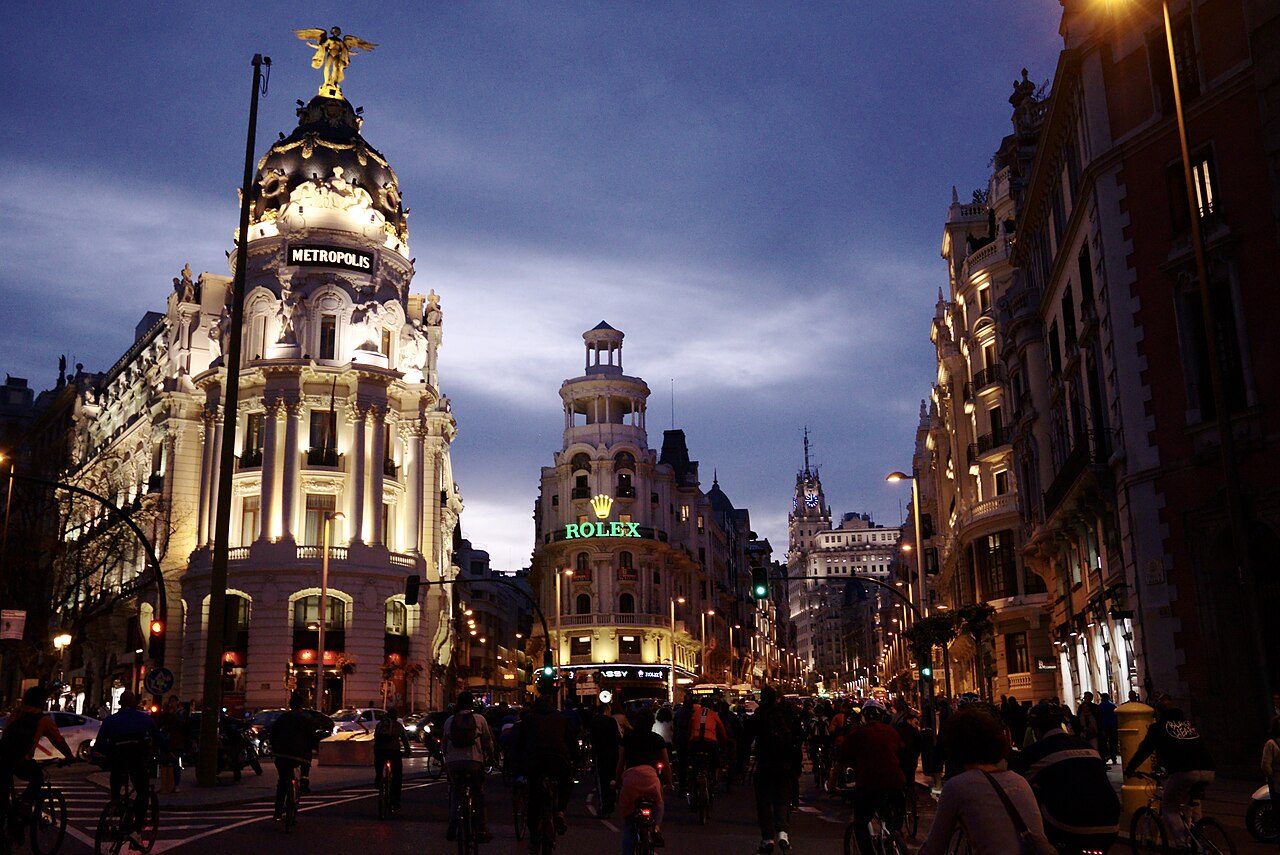
Gran Via
Inaugurated in 1910 when King Alfonso XIII struck the first ceremonial blow with a silver pickaxe, Gran Vía sliced through hundreds of medieval alleyways to thrust Madrid into the modern age. The resulting boulevard became an open-air exhibition of early twentieth-century architecture, evolving chronologically from French Beaux-Arts elegance to sleek Art Deco. Anchoring its eastern junction, the iconic Edificio Metrópolis gleams with a slate-tiled dome adorned in 24-karat gold leaf, shadowed by a dramatic bronze statue of Winged Victory. Farther west, the fortress-like Edificio Telefónica—a baroque-inspired granite tower designed by Ignacio de Cárdenas that stood as Europe's tallest skyscraper upon its 1929 completion—still bears the cultural weight of its past as a wartime Republican lookout. Standing near the sloping pavement of Plaza del Callao, visitors are enveloped by the cinematic energy of Spain’s grand theater district. Overhead, the landmark blue-and-yellow Schweppes neon sign blazes from the prow-like facade of the Art Deco Edificio Carrión, casting an electric glow over the swirling current of pedestrians and red-and-white taxis below. The air carries a distinct Madrid friction: hot exhaust and roasted chestnuts mingling with the chatter pouring from historic cinema lobbies. Gazing up past carved stone caryatids toward illuminated clock towers, one experiences the relentless pulse of an avenue that engineered Madrid’s urban identity.
More in Madrid
Photo credits (5)
- Nicolas Vigier, CC0, via Wikimedia Commons
- Gerda Arendt, CC0, via Wikimedia Commons
- Boaventuravinicius, CC BY-SA 3.0, via Wikimedia Commons
- Matt Joseph, CC BY-SA 4.0, via Wikimedia Commons
- Sharon Mollerus from Minneapolis, United States, CC BY 4.0, via Wikimedia Commons