 New added
Eiffel Tower
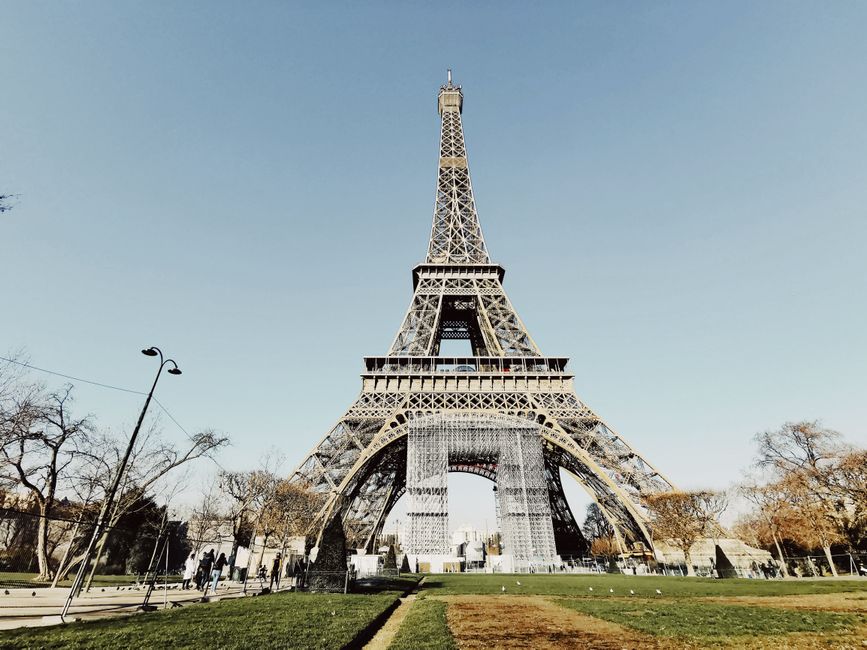
Erected for the 1889 *Exposition Universelle* to commemorate the centennial of the French Revolution, Gustave Eiffel’s 330-meter beacon defied the fierce derision of contemporary artists to become the definitive triumph of Industrial Age engineering. Constructed from over 18,000 puddle-iron components bound by 2.5 million hot rivets, the lattice-beam structure rests on four sweeping masonry piers aligned to the cardinal points. Its tapering silhouette is coated in a custom, three-tone gradient known as "Eiffel Tower Brown"—darker at the base and lighter toward the lantern—deliberately mixed to offset atmospheric perspective against the Parisian sky. Standing beneath the soaring arches of the Esplanade, travelers encounter a dizzying geometry of interwoven iron, accompanied by the mechanical rumble of historic, water-powered hydraulic elevator cables grinding along the south and east pillars. Ascending beyond the vertiginous glass floor of the first tier, the journey culminates on the windswept summit platform, 276 meters above the Champ de Mars. Here, buffeted by crisp breezes off the Seine, visitors look down upon the Haussmannian avenues radiating outward like spokes of a wheel, until twilight falls and twenty thousand golden flash lamps ignite the wrought-iron silhouette in a kinetic, five-minute burst of light.