
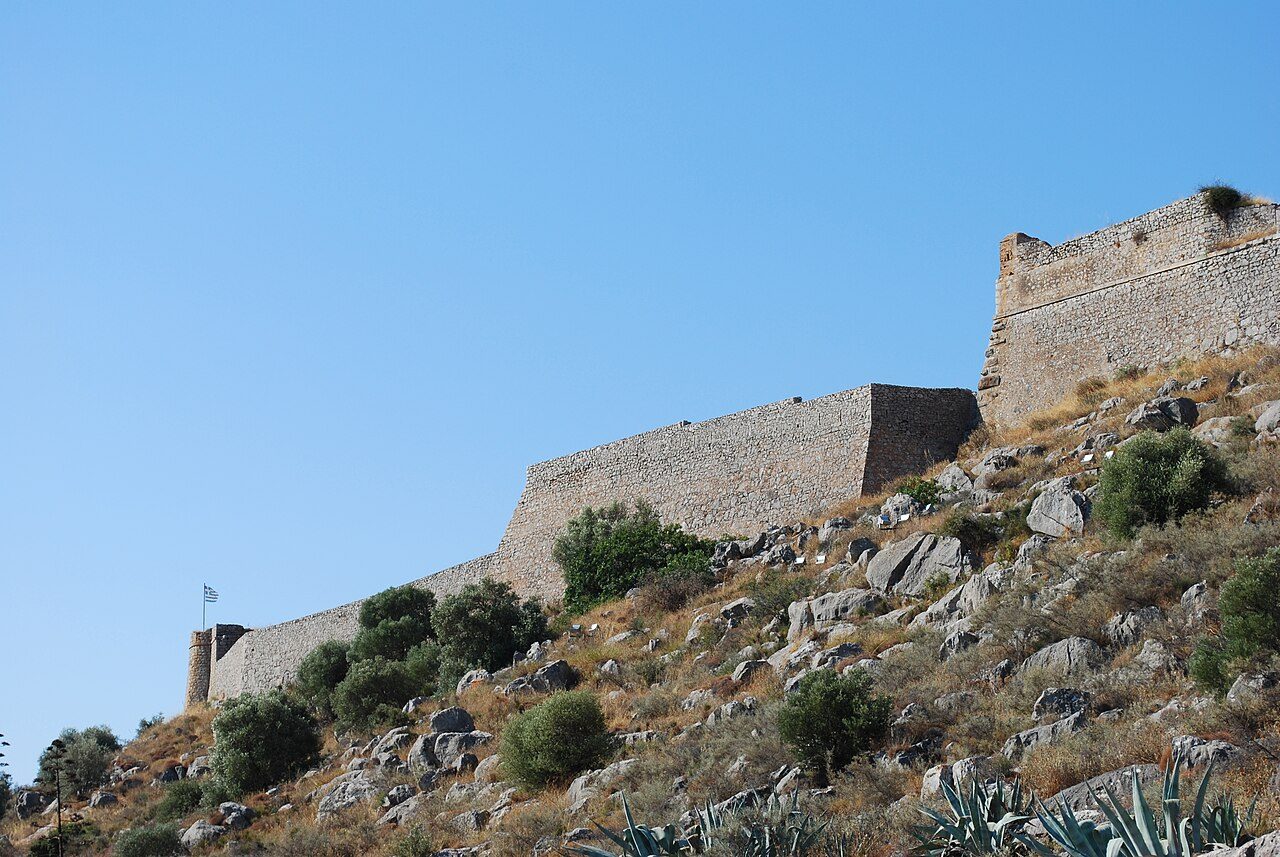
Palamidi
Crowning a 216-meter limestone ridge above the Argolic Gulf, Palamidi stands as a formidable masterwork of late-Venetian military architecture. Constructed between 1711 and 1714 under engineers Antonio Giancix and Lasalle during the rule of Provveditore Agostino Sagredo, the fortress was designed to defend the Peloponnese through eight self-sufficient, interlocking bastions. Named after classical and Christian warriors—including Leonidas, Miltiades, and the vaulted central redoubt of Agios Andreas—each bastion functioned as an independent stronghold with its own cisterns and ammunition stores. Despite this ingenious Baroque defensive layout, the Venetians held the citadel for barely a year before falling to an Ottoman siege in 1715, preceding its pivotal recapture by Greek insurgents under Staikos Staikopoulos in 1822. Visitors encounter Palamidi’s immense scale by braving the legendary switchback stairway—fabled at 999 steps, though officially numbering around 857—carved into cliffs perfumed with wild thyme. At the summit, maritime gales whistle through gun ports that frame sweeping panoramas of Nafplio’s terracotta roofs and the distant water-bound Bourtzi castle. The blinding Mediterranean sun yields to sudden, claustrophobic chill within the Miltiades bastion, where travelers must stoop beneath a low arch to enter the dark, damp subterranean cell. Here, Greek War of Independence hero Theodoros Kolokotronis was imprisoned on charges of high treason in 1834, leaving behind a tangible sense of confinement etched into the raw Peloponnesian bedrock.
More in Nafplio
Photo credits (3)
- Jeanhousen, CC BY 3.0, via Wikimedia Commons
- Andreas Trepte, CC BY-SA 2.5, via Wikimedia Commons
- DieBuche, CC BY-SA 3.0, via Wikimedia Commons