
Nafplio
Hugging the calm waters of the Argolic Gulf in the eastern Peloponnese, Nafplio unfolds beneath limestone ridges capped with stone fortifications. Walking its compact core involves navigating narrow marble alleys lined with neoclassical townhouses, iron balconies draped in bougainvillea, and quiet stairways climbing into the old hillside quarter of Psaromachalas. The city served as the first capital of independent Greece from 1827 until 1834, preserving a built heritage shaped by successive waves of Venetian, Ottoman, and Greek rule. Overhead stands the Palamidi, an expansive Venetian fortress constructed in 1714 and reached via a steep stone stairway cut into the cliff. Down in the harbor, the 15th-century water bastion of Bourtzi rests on a small rocky islet, while daily activity converges on Syntagma Square. This paved central space is anchored by a grand 1713 Venetian naval storehouse that now holds the archaeological museum, alongside the Vouleftiko, the former Ottoman mosque that housed the first Greek parliament. Evenings center on the volta, an unhurried sunset promenade along the waterfront quay beneath the Acronafplia walls. Tavernas serve regional dishes like gogges, hand-rolled Peloponnesian pasta finished with browned butter and grated mizithra cheese, alongside fresh citrus harvested from the nearby Argive plain. Because vehicles cannot enter the paved historic quarters, the town is traversed entirely on foot. Visiting in May or October offers mild temperatures, calm coastal winds, and uncrowded alleys, making it easy to wander comfortably at any hour.
Read more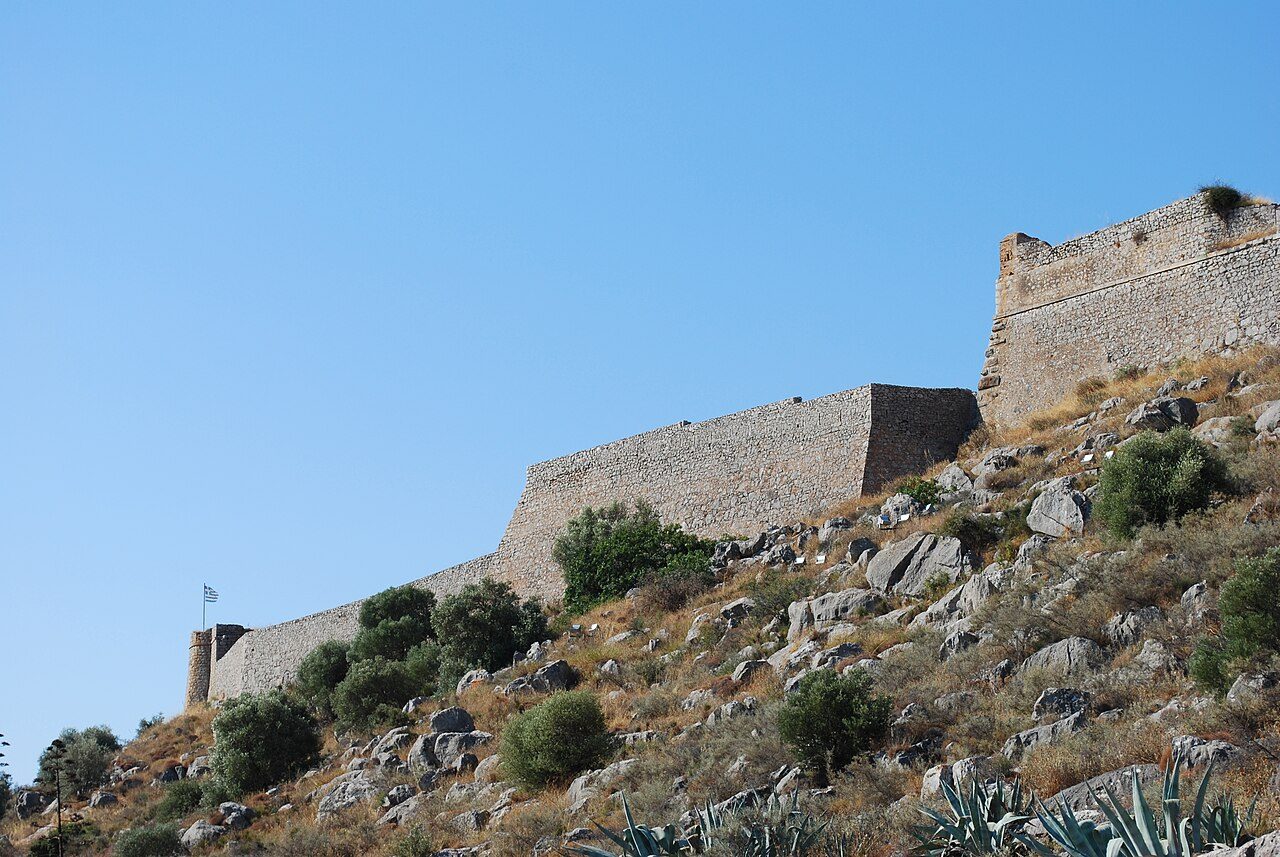
What to see in Nafplio
Photo credits (3)
- Jeanhousen, CC BY 3.0, via Wikimedia Commons
- Andreas Trepte, CC BY-SA 2.5, via Wikimedia Commons
- DieBuche, CC BY-SA 3.0, via Wikimedia Commons