
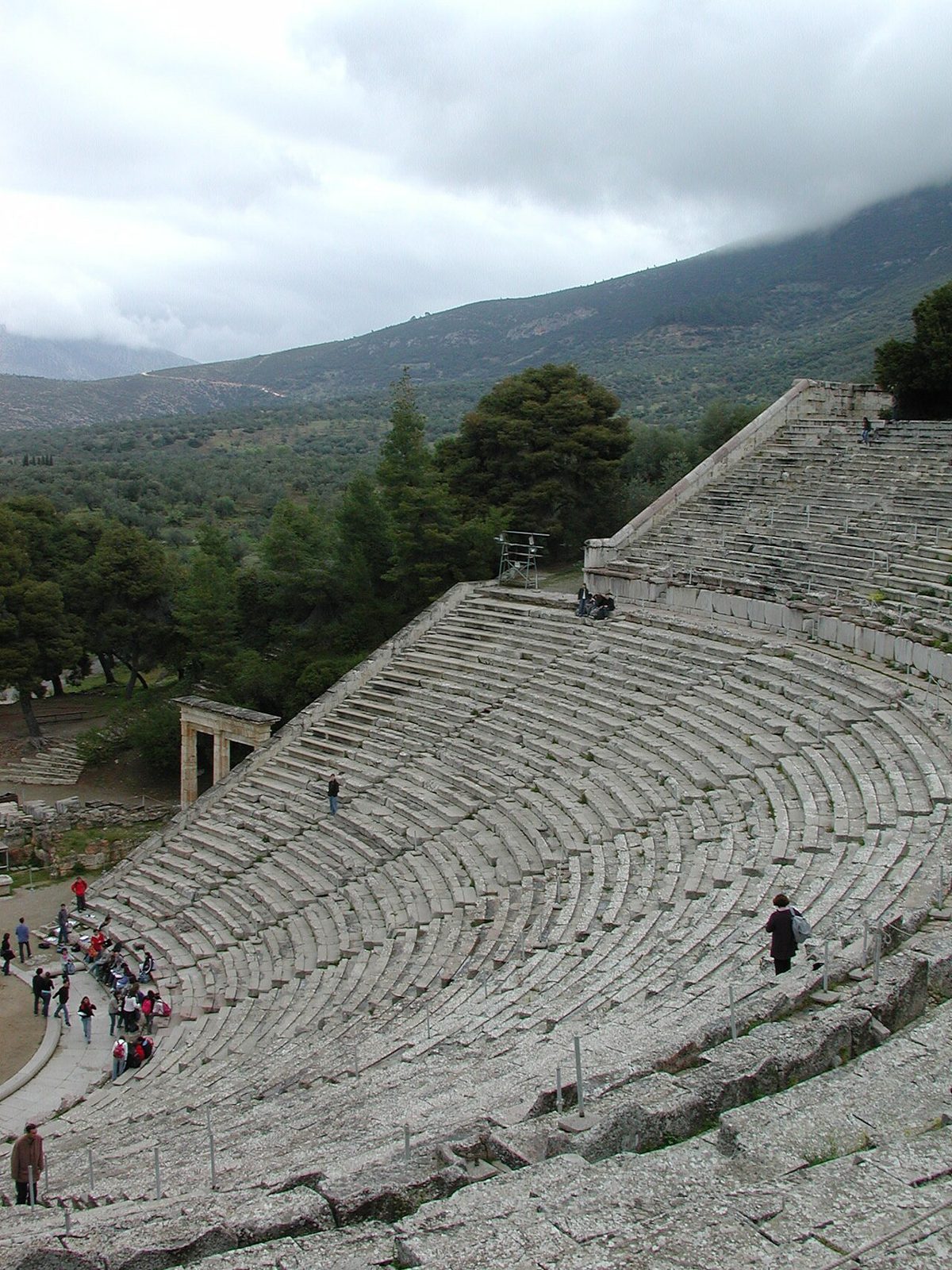
Epidaurus
Carved into the pine-forested flanks of Mount Kynortion around 340 BCE by architect Polykleitos the Younger, the Ancient Theatre of Epidaurus represents classical Greece’s supreme acoustic and mathematical achievement. Originally constructed as an integral therapeutic element of the Sanctuary of Asklepios—where patients believed artistic harmony fostered physical healing—the amphitheater exemplifies Hellenistic symmetry. Fifty-five tiers of pale grey limestone rise in an expansive fan, divided by a central walkway into an inner cavea of 34 rows and an upper Roman addition of 21. At the focal point rests the perfectly preserved circular *orchestra*, twenty meters in diameter and bordered by a crisp limestone rim, flanked by reconstructed monumental stone entryways (*parodoi*). Ascending the steep, sun-warmed steps, travelers encounter an acoustic phenomenon unchanged for millennia: the drop of a coin or the striking of a match at the center stage carries clearly to the fifty-fifth row, unamplified. From this dizzying vantage point, the dry Argolid air carries the scent of crushed wild thyme and resin, framing a panoramic vista across the rolling Peloponnesian valleys. Far from a hollow ruin, sitting on the cool stone seats connects the visitor directly to ancient audiences, where the architectural geometry still transforms the faintest human whisper into a communal experience.
More in Nafplio
Photo credits (3)
- DieBuche, CC BY-SA 3.0, via Wikimedia Commons
- Andreas Trepte, CC BY-SA 2.5, via Wikimedia Commons
- Jeanhousen, CC BY 3.0, via Wikimedia Commons