
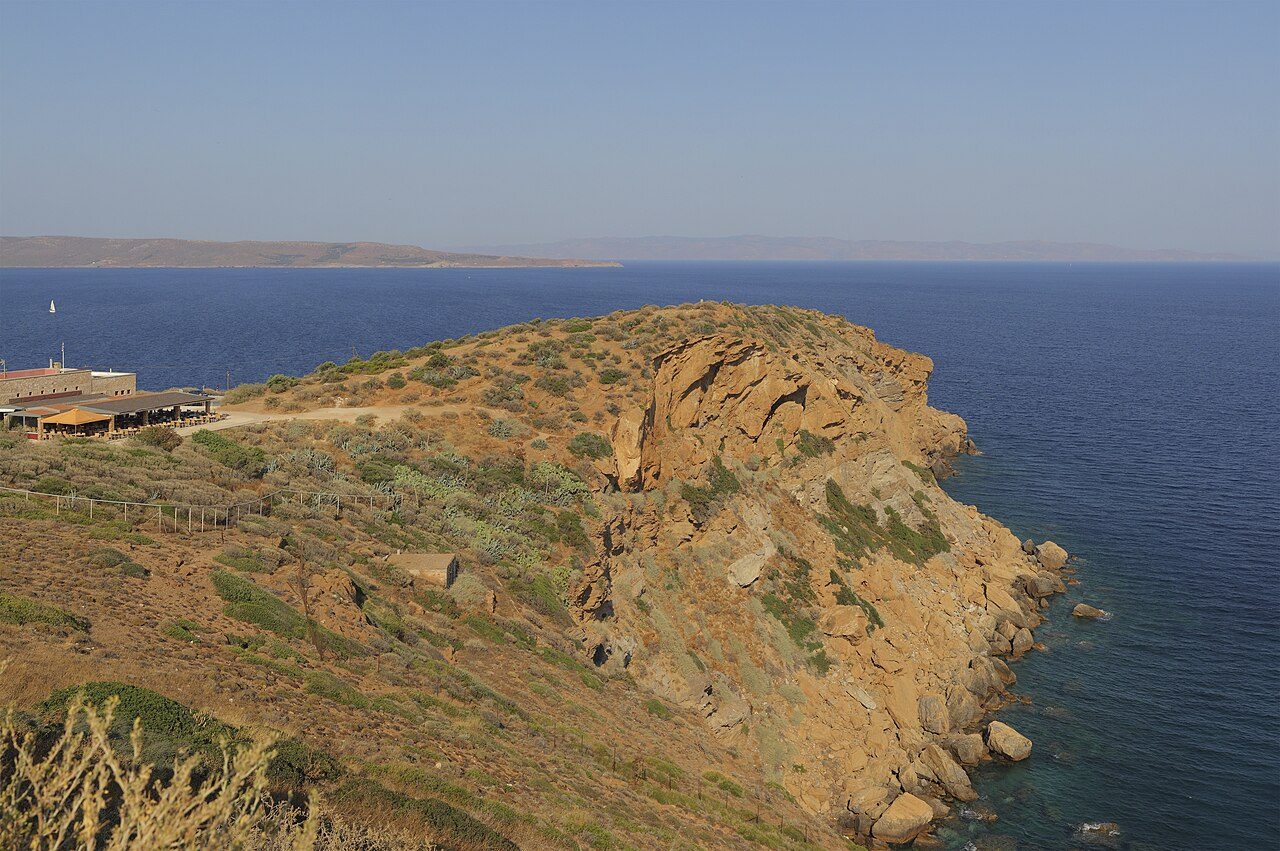
Temple of Poseidon, Sounion
Erected between 444 and 440 BC during the Golden Age of Pericles—likely by the architect responsible for the Hephaisteion in Athens—the Temple of Poseidon crowns the sheer, 65-meter headland of Cape Sounion. Built in the austere Doric order using brilliant white marble quarried from nearby Agrileza, the sanctuary was engineered specifically to withstand corrosive sea salt; its towering columns feature only 16 flutes rather than the standard 20, reducing surface area exposed to the elements. Today, 16 of the original 34 columns still pierce the sky atop a stepped limestone platform. Etched into the base of one northern pillar, sharp-eyed visitors can spot the 1810 graffiti of Lord Byron, marking the historic threshold where King Aegeus reputedly threw himself into the waters below after spotting the black sails of Theseus. Standing on this wind-scoured promontory, travelers are enveloped by the scent of wild sea thyme and the rhythmic boom of breakers against the cliffs below. The vantage point commands an unobstructed panorama across the Saronic Gulf toward the distant Cyclades. As evening approaches, the Aegean shifts from deep sapphire to burnished bronze, casting elongated shadows through the marble peristyle and illuminating the very precipice where ancient Athenian triremes once offered final libations to the sea god before braving the open waters.
More in Athens
Photo credits (7)
- A.Savin, CC BY-SA 3.0, via Wikimedia Commons
- Giles Laurent, CC BY-SA 4.0, via Wikimedia Commons
- Srishti Sethi, CC BY-SA 4.0, via Wikimedia Commons
- Giles Laurent, CC BY-SA 4.0, via Wikimedia Commons
- JFKennedy at English Wikipedia, Public domain, via Wikimedia Commons
- Giles Laurent, CC BY-SA 4.0, via Wikimedia Commons
- Jean Housen, CC BY-SA 4.0, via Wikimedia Commons